

Introduction
By Dr. Anthonymaria Odukaesieme, D.Sc.
Human civilization has made remarkable progress in science, technology, medicine, economics, governance, and education. These advances have expanded human knowledge, increased productive capacity, and transformed societies in unprecedented ways. Yet despite such achievements, many of the most persistent challenges facing humanity remain deeply rooted in human behavior.
Across nations, institutions, communities, and families, societies continue to experience corruption, abuse of power, dishonesty, irresponsibility, distrust, violence, leadership failure, social fragmentation, and moral decline. These challenges often persist even where resources, knowledge, laws, and opportunities are available.
This reality raises a fundamental question:
Why do individuals, institutions, and societies frequently fail to achieve their highest potential despite possessing the knowledge and means to do so?
Throughout history, scholars and thinkers have attempted to answer this question through various disciplines. Psychology studies the mind and behavior. Sociology examines social structures and interactions. Political science investigates governance and power. Economics explores the allocation of resources. Ethics examines moral principles and conduct. Each discipline contributes valuable insights into human affairs.
However, there remains a need for a systematic framework dedicated specifically to the study of character as a determining factor in human outcomes.
Character Intelligence Science emerges in response to this need.
Character Intelligence Science is the systematic study of character, its development, expression, measurement, influence, and impact on individuals, institutions, societies, and civilizations.
The discipline is founded on the proposition that character is not merely a moral attribute but a strategic human capacity that significantly influences decision-making, leadership, relationships, governance, organizational performance, social stability, and sustainable development.
Within this framework, Character Intelligence refers to the capacity to recognize, develop, apply, regulate, and sustain constructive character qualities in ways that contribute to individual flourishing and collective wellbeing.
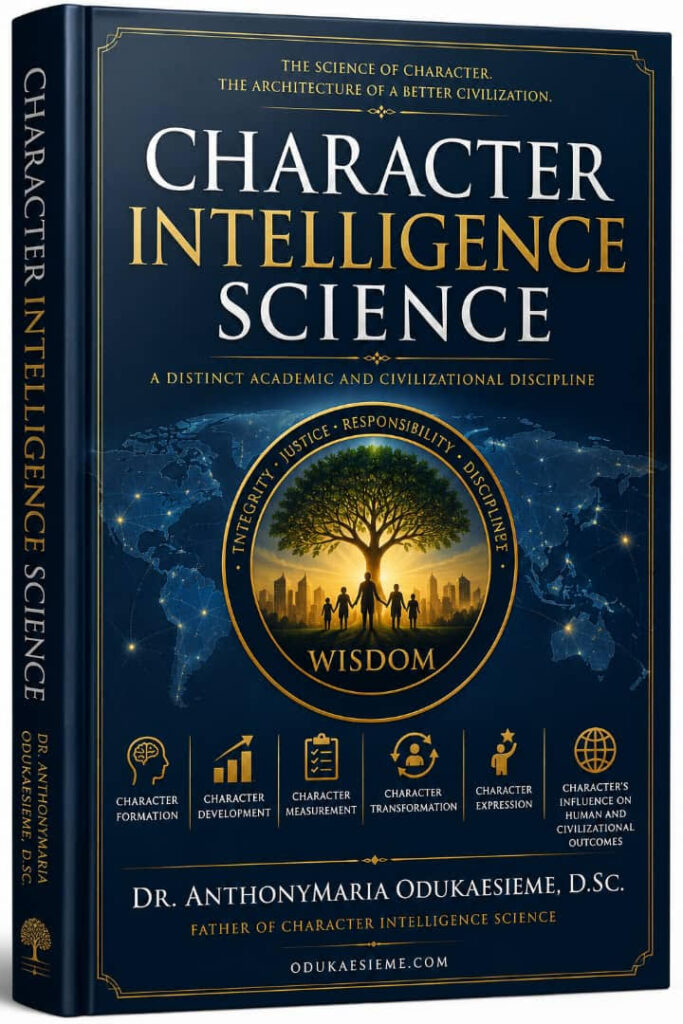
The central object of study in Character Intelligence Science is Character Intelligence itself: its structure, dimensions, dynamics, development, assessment, applications, and consequences.
The discipline seeks to answer several foundational questions:
- What is character?
- What is Character Intelligence?
- How does character influence behavior and decision-making?
- How can character strengths and deficits be identified?
- How does character affect leadership and governance?
- How does character influence institutional performance?
- What role does character play in societal stability and development?
- How can Character Intelligence be cultivated and sustained?
Character Intelligence Science does not claim that character alone explains all human behavior or societal outcomes. Human beings operate within complex biological, psychological, social, economic, cultural, political, and environmental systems. Rather, the discipline proposes that character is a critical and often underexamined variable that interacts with these factors and significantly influences outcomes.
As an interdisciplinary field, Character Intelligence Science draws insights from philosophy, ethics, psychology, sociology, leadership studies, education, governance, systems theory, and human development while maintaining its own distinct object of study and conceptual framework.
The discipline is guided by several foundational assumptions:
- Character influences behavior.
- Behavior influences outcomes.
- Repeated outcomes shape institutions and societies.
- Character can be developed, strengthened, and transformed.
- Sustainable development requires both competence and character.
- The quality of human systems is influenced by the character of the individuals who operate them.
The significance of Character Intelligence Science lies in its potential contribution to multiple domains of human endeavor, including education, leadership development, governance, organizational management, conflict resolution, community development, and public policy.
This book therefore seeks to establish Character Intelligence Science as a distinct academic discipline by presenting its foundations, principles, concepts, dimensions, models, methodologies, and applications. It is intended not only as a contribution to scholarship but also as a framework for understanding the relationship between character and human progress.
The chapters that follow explore the theoretical foundations of the discipline, examine its practical relevance, and propose pathways for future research and application.
The ultimate purpose of Character Intelligence Science is not merely to understand character, but to deepen humanity’s understanding of how character contributes to responsible leadership, effective institutions, peaceful societies, and sustainable human flourishing. In Wisdom, character becomes the compass of knowledge; and in Character Intelligence, human potential finds direction, responsibility, and purpose.
Dr. Anthonymaria Odukaesieme, D.Sc. — Father of UNISOPHY