

By Dr. Anthonymaria Odukaesieme, D.Sc.
Father of UNISOPHY | Father of Wisdomology | Father of Character Intelligence Science
*Philosophy* is the broad academic discipline and intellectual tradition that employs reason, logic, and critical inquiry to investigate the fundamental nature of existence, reality, knowledge, truth, values, and ethics. For more than two millennia, philosophy has evolved into diverse branches—including metaphysics, epistemology, ethics, logic, aesthetics, and political philosophy—all dedicated to the pursuit of wisdom and understanding.
Unisophy, by contrast, is a contemporary philosophical framework proposed by Dr. Anthonymaria Odukaesieme. It is founded on the principle of Universal Oneness, which affirms that all existence is interconnected and interdependent. Unisophy integrates intellectual intelligence with character intelligence, presenting wisdom and ethical character as essential foundations for human flourishing, peaceful coexistence, and sustainable global development.
Breaking Down the Concepts
Philosophy
Scope: Broad, comprehensive, and historically diverse. Philosophy embraces numerous schools of thought and disciplines, including epistemology (the study of knowledge), metaphysics (the study of reality), ethics (the study of moral conduct), logic (the principles of reasoning), and aesthetics (the study of beauty and art).
Approach: Philosophy seeks truth through reasoned inquiry, critical analysis, dialogue, and rational argument. It examines fundamental questions about life, reality, morality, and human existence while encouraging intellectual reflection and independent thought.
Unisophy
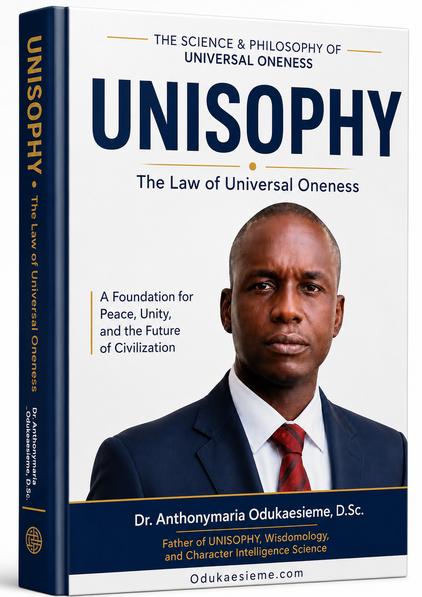
Scope: Specific and centered on the philosophy of Universal Oneness. It proposes that humanity, nature, and the universe form an interconnected whole, where the well-being of each depends upon the well-being of all.
Approach: Unisophy integrates intellectual intelligence with character intelligence by emphasizing wisdom, humility, integrity, empathy, discipline, justice, and shared responsibility. It proposes that enduring solutions to global challenges—including conflict, extremism, inequality, environmental degradation, and social fragmentation—can best be achieved through the recognition and practice of Universal Oneness. It maintains that no individual, community, or nation can truly flourish in isolation.
From Philosophical to Unisophical
The term philosophical describes ideas, methods, principles, or perspectives that belong to or are derived from philosophy in general.
The term unisophical is the adjectival form of Unisophy. Just as philosophical relates to philosophy, unisophical relates to Unisophy. It refers to ideas, principles, methods, values, and perspectives grounded in the philosophy of Universal Oneness. A unisophical approach seeks to harmonize knowledge, wisdom, ethical character, and collective human responsibility within a unified worldview.
Conclusion
Philosophy provides humanity with the broad intellectual tradition for exploring reality, knowledge, ethics, and the meaning of life. Unisophy builds upon that tradition by proposing a distinctive philosophical framework centered on Universal Oneness and the integration of wisdom with ethical character. While philosophy encompasses many schools of thought, Unisophy offers a focused perspective that seeks to inspire personal transformation, social responsibility, global harmony, and the flourishing of humanity through the recognition that all existence is fundamentally interconnected.
“The creation of a new branch of knowledge is the highest expression of scientific originality and the enduring legacy of a Doctor of Science.”