

Wisdom represents the highest order of human intelligence. It emerges when intelligence transcends the mere acquisition of information and integrates knowledge, understanding, experience, reasoning, reflection, and judgment into coherent and beneficial action. Wisdom is therefore not defined by how much one knows, but by how effectively knowledge is understood, integrated, evaluated, and applied within reality.
From the perspective of ethical and universal patterns, wisdom may be understood as a universal ordering principle of intelligence, expressed through the integration of knowledge, understanding, experience, reasoning, reflection, judgment, and beneficial action. It develops as intelligence progresses from recognizing isolated facts to perceiving the patterns, relationships, principles, structures, interactions, dependencies, and consequences that govern the interconnectedness of reality.
At its deepest level, wisdom arises from perceiving reality as an interconnected system rather than as a collection of isolated phenomena. It is rooted in the recognition of Universal Oneness, in which distinct phenomena exist within networks of relationship, interaction, interdependence, and mutual consequence. Knowledge may be extensive without being integrated or appropriately applied; wisdom organizes and applies knowledge within context to determine coherent and beneficial action.
Understanding is found in the relationships among phenomena. A fact alone constitutes information; organized and interpreted information forms knowledge. When intelligence identifies the patterns, causes, mechanisms, interactions, dependencies, and consequences connecting those elements, understanding emerges. It deepens as cognition moves from isolated observation to systemic and relational comprehension within the interconnected structure of reality.
Within Universal Oneness, all phenomena may be understood as interdependent components of a larger whole. Their interactions shape behavior and consequences across systems. Thus, understanding is not merely knowing what exists, but comprehending how and why things are connected and how they influence one another.
The progression from information to wisdom may therefore be expressed as:
INFORMATION → KNOWLEDGE → UNDERSTANDING → WISDOM → INTELLIGENT ACTION
Information provides data; knowledge organizes and interprets it; understanding identifies relationships, structures, patterns, mechanisms, and consequences; wisdom integrates this understanding into sound judgment; and intelligent action applies that judgment appropriately within interconnected reality.
Knowledge asks: What is known?
Wisdom: Where Does Wisdom Come From, And Where Is Understanding To Be Found?
Understanding asks: How are known elements related, and through what principles or mechanisms do they interact?
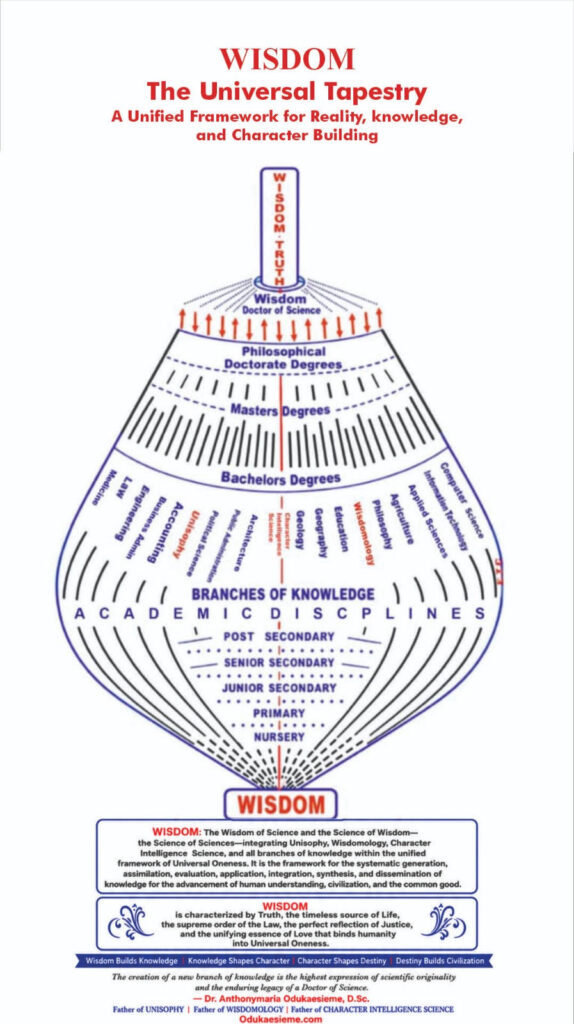
Wisdom asks: What is the most coherent, appropriate, and beneficial course of action, given what is known and understood within an interconnected system of reality?
Wisdomology, the Science of Wisdom, investigates how information becomes knowledge, knowledge becomes understanding, understanding becomes wisdom, and wisdom becomes intelligent action. It examines the principles, structures, processes, conditions, and consequences involved in this transformation across cognition, learning, decision-making, behavior, society, and systems of life.
Wisdom is not treated here as mystical or supernatural, but as a higher-order cognitive phenomenon that can be systematically studied. Its manifestations, development, and effects are therefore open to scientific inquiry, even though not all aspects are yet fully measurable or explained. Its scope extends across intelligence, character, civilization, environment, and Universal Oneness.
The central scientific question is not how much we know, but how effectively intelligence transforms knowledge into understanding, understanding into wisdom, and wisdom into intelligent action within an interconnected reality. This distinction highlights the fundamental gap between information accumulation and meaningful application.
Wisdom may therefore be defined as integrated intelligence expressed through sound judgment and beneficial action. Understanding is the comprehension of relationships, structures, patterns, mechanisms, interactions, and consequences. Knowledge is organized information; intelligence is the capacity to process, integrate, evaluate, and apply it; character is its stable expression in behavior; and Universal Oneness is the recognition of reality as an interconnected whole.
The civilizational importance of wisdom lies in its capacity to guide decisions within complex systems involving long-term consequences, competing interests, and systemic effects. Scientific and technological advancement alone is insufficient without the parallel development of wisdom to ensure that knowledge and intelligence are used responsibly and beneficially.
The objective of Wisdomology is to study wisdom in all its dimensions—its origins, structure, development, mechanisms, measurement, and application—and its relationship with intelligence, knowledge, understanding, learning, experience, judgment, character, and interconnected reality. Its core proposition is that knowledge must evolve into understanding, understanding into wisdom, and wisdom into intelligent and beneficial action.
Ultimately, wisdom is the capacity of intelligence to perceive the interconnectedness of reality, understand the relationships that constitute the whole, and act appropriately within it. This provides the foundational scientific basis for Wisdomology as a discipline and establishes the broader term definition: Wisdom is the Oneness of creation and the Law that governs it—the reflection of Love- the Universal Oneness we share.
— Dr. Anthonymaria Odukaesieme, D.Sc.
Founder of Unisophy, Wisdomology, and Character Intelligence Science