

The meaning of Wisdom extends beyond intellectual ability. Wisdom signifies the capacity to understand reality in its wholeness and to live, reason, and act in accordance with that understanding. It is the disciplined application of intelligence to what is true, right, beneficial, and harmonious.
To possess knowledge is to have information. To possess understanding is to comprehend the meaning and relationships within that knowledge. To possess intelligence is to have the capacity to reason, evaluate, adapt, and solve problems. But to possess Wisdom is to integrate these capacities and direct them toward the highest and most beneficial purpose.
Wisdom therefore gives meaning to knowledge and direction to intelligence. Without Wisdom, knowledge may remain fragmented, intelligence may become merely instrumental, and power may be exercised without sufficient regard for consequence. Wisdom establishes the higher order in which these faculties can function constructively.
The meaning of Wisdom is also inseparable from relationship. Nothing exists entirely by itself. Every individual, organism, system, and element exists within relationships that influence its existence and condition. Wisdom recognizes these relationships and understands that an action affecting one part may ultimately affect the whole.
This understanding gives Wisdom a universal dimension. It moves the mind from isolated existence toward interconnected existence—from the perception of separate parts toward recognition of the whole. In this sense, Wisdom is a pathway to understanding Universal Oneness: the recognition that diversity does not eliminate unity, but expresses it.
Wisdom therefore means knowing one’s place within the whole and acting with awareness of that relationship. It calls intelligence to responsibility, knowledge to understanding, freedom to discipline, and human advancement to the wellbeing of creation.
At its highest meaning, Wisdom is the capacity to discern the order underlying existence and to align thought, character, and action with that order. It is intelligence directed by understanding, understanding guided by truth, and truth expressed through responsible action.
Thus, Wisdom is not merely something a person learns; it is something intelligence progressively embodies. Its ultimate evidence is found not in words alone, but in the quality of judgment, character, conduct, relationships, and consequences produced by its application.
Wisdom, in this sense, is the intelligence of right relationship—with oneself, with others, with nature, with society, and with creation as a whole.
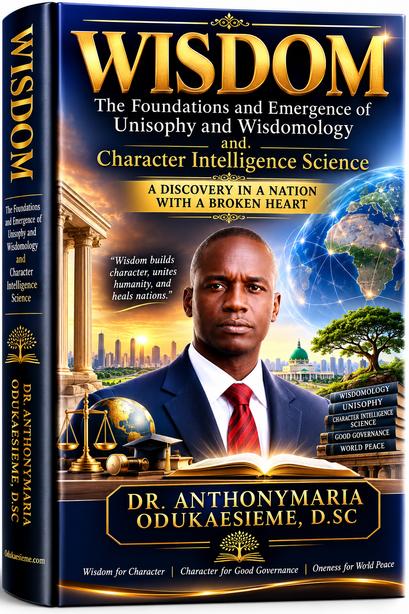
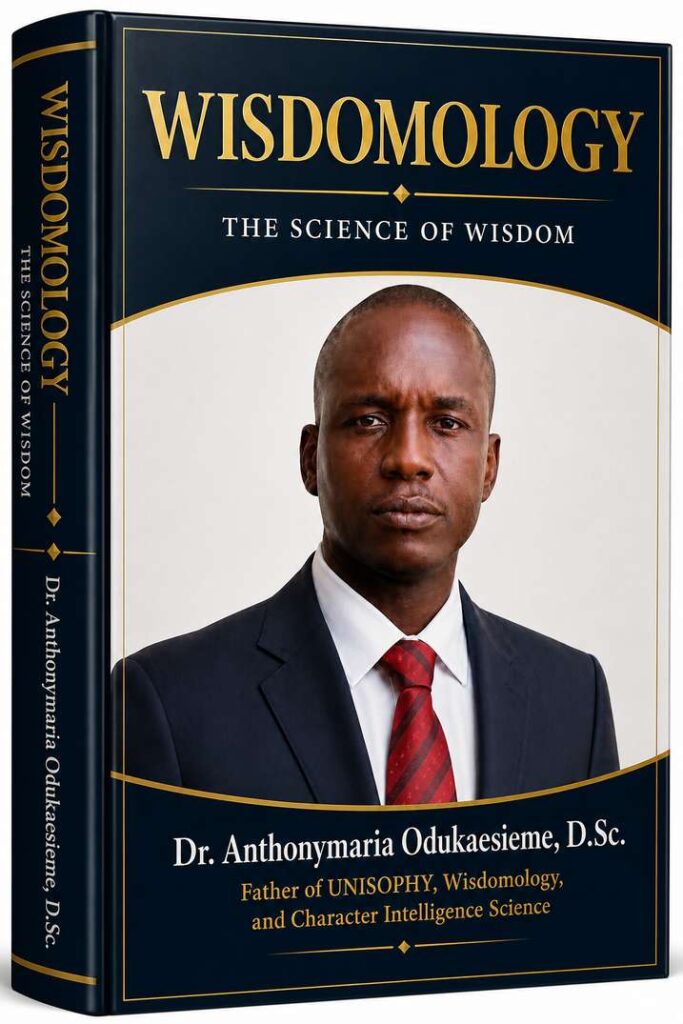
This is the foundation upon which Wisdomology develops: the systematic study of Wisdom as the highest integrative principle of intelligence and as a pathway to understanding the interconnectedness, order, and oneness of creation.
–Dr. Anthonymaria Odukaesieme, D.Sc.
Father of UNISOPHY
Father of WISDOMOLOGY
Father of CHARACTER INTELLIGENCE SCIENCE
Odukaesieme.comOdukaesieme.com