

Wisdom is not merely something a person knows; it is something a person becomes.
Human life is shaped by the principles we establish, the disciplines we practice, the choices we make, the challenges we endure, and the values we consistently express. Yet these qualities are not isolated virtues. Within Character Intelligence Science, they can be understood as interconnected dimensions of a unified human capacity: the capacity to transform intelligence into principled, responsible, and beneficial conduct.
This integrated structure constitutes what may be called the Architecture of Wisdom.
In this expression of the attitudinal and behavioural dimensions of Character Intelligence, Principle gives direction. Discipline gives order. Perseverance gives endurance. Maturity gives balance. Strength gives the capacity to forgive. Confidence gives courage to believe. Character gives moral expression. Self-control gives mastery. Grace gives humility. Integrity gives truthfulness. Courage gives the strength to speak and act rightly. Patience gives peace. Respect recognizes the dignity of others. Generosity gives without calculation. Resilience rises after failure. Humility accepts correction. Loyalty preserves trust. Dedication sustains purpose. Compassion responds to the needs of others. Determination refuses to surrender. Conviction remains faithful to truth. Contentment overcomes envy. Focus protects purpose. Reliability honours one’s word. Self-mastery governs desire.
Beyond these qualities, the virtues of Faith provide the inner assurance that gives direction to Character Building. Faith trusts with certainty, and that trust gives Hope meaning to discipline and patience, enabling the human being to endure the present while remaining oriented toward a desired good that is yet to be realized.
These qualities may appear distinct, but their highest expression reveals an underlying unity.
They are not merely a collection of virtues. They are interacting dimensions of Character Intelligence through which intelligence becomes capable of regulating the self, relating responsibly to others, responding appropriately to circumstances, and pursuing what is beneficial to the whole.
This is where the Architecture of Wisdom becomes scientifically significant.
A virtue considered in isolation may produce only a partial expression of good character. Discipline without compassion may become harshness. Courage without wisdom may become recklessness. Confidence without humility may become arrogance. Conviction without understanding may become intolerance. Strength without mercy may become domination. Knowledge without responsibility may become destructive. Intelligence without character may become dangerous.
Therefore, the quality of a human life cannot be adequately understood by measuring isolated virtues alone. What matters is the relationship among them—their integration, regulation, proportion, and direction toward a coherent moral purpose.
The greater the harmony among these dimensions, the greater the capacity of the individual to convert intelligence into wise action.
This integrated harmony expresses Oneness.
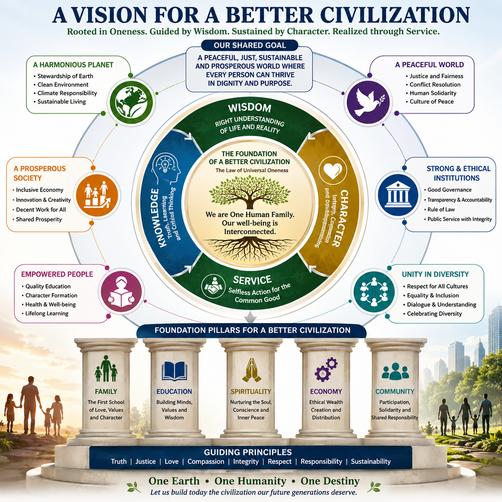
Oneness, within this framework, is not merely the idea that everything exists together. It is the recognition that the individual exists within a larger network of relationships in which the wellbeing of the self, the wellbeing of others, and the wellbeing of creation are interconnected.
The human being is therefore not an isolated intelligence.
Human intelligence exists within relationship.
And the principle that gives this relationship its highest moral expression is Love.
Love, in this scientific and philosophical framework, is not reduced to emotion or sentiment. It is an organizing ethical principle that directs intelligence beyond self-interest toward recognition of the dignity, interconnectedness, wellbeing, and intrinsic worth of others and of life itself.
Love therefore gives Wisdom its direction.
Oneness provides the principle of interconnectedness.
Character provides the moral structure.
Intelligence provides the capacity to understand, evaluate, and choose.
Wisdom emerges when these dimensions are integrated into coherent and beneficial action.
Thus:
Intelligence enables perception.
Knowledge provides content.
Understanding provides meaning.
Judgment provides evaluation.
Character provides moral direction.
Love provides ethical orientation.
Oneness provides the larger relational context.
Wisdom provides their integrated expression in action.
This is the deeper architecture through which intelligence becomes Wisdom.
The wise person therefore does not merely possess virtues separately. The wise person integrates them.
Truth is joined with compassion.
Strength is joined with mercy.
Discipline is joined with understanding.
Courage is joined with humility.
Justice is joined with love.
Knowledge is joined with responsibility.
Freedom is joined with responsibility toward the whole.
Power is joined with restraint.
Success is joined with humility.
And intelligence is joined with character.
Wisdom is consequently not the accumulation of virtues. It is the intelligent integration of virtues into a coherent way of being.
This distinction is fundamental to Character Intelligence Science.
A person may possess knowledge without wisdom, intelligence without character, strength without compassion, confidence without humility, or conviction without understanding. The possession of a desirable quality does not automatically produce wisdom.
Wisdom appears when desirable qualities are harmonized, regulated, and expressed appropriately within the circumstances of life.
The wise person therefore asks not only, “What can I do?” but also:
“What ought I to do?”
“Why ought I to do it?”
“What will my action produce?”
“Who will be affected by it?”
“Does it preserve truth?”
“Does it respect human dignity?”
“Does it contribute to the wellbeing of the whole?”
These questions move intelligence from capability to responsibility and from responsibility to wisdom.
The questions contained in this chapter are therefore not merely tests of behaviour. They are instruments for examining the development and integration of Character Intelligence:
Can you establish principles for yourself and abide by them?
Can you discipline yourself when others are doing otherwise?
Can you persevere when the journey becomes difficult?
Can you choose peace over the need to prove a point?
Can you forgive even when deeply hurt?
Can you walk away from what no longer helps you grow?
Can you believe in yourself when others do not?
Can you remain kind without expecting anything in return?
Can you remain humble in the face of success?
Can you speak truth in love?
Can you admit when you are wrong?
Can you help someone who can never repay you?
Can you celebrate another person’s success without envy?
Can you remain faithful to your values under pressure?
Can you be still and allow things to unfold?
Each question reveals a dimension of character.
But taken together, they reveal something greater: the structural relationship among the dimensions that constitute the Architecture of Wisdom.
This is why Wisdom cannot be adequately represented as a single virtue.
Wisdom is a system of integration.
It is the reconciliation of intelligence, knowledge, understanding, experience, judgment, character, and love into a coherent mode of existence.
When these dimensions operate in harmony, the individual becomes capable of making decisions that are not merely intelligent, but morally ordered, relationally responsible, contextually appropriate, and beneficial to the whole.
That is Character Intelligence in its higher expression.
And when Character Intelligence reaches a state in which intelligence, virtue, and action are harmonized with the principles of Oneness and the Law of Love, that integrated condition is called WISDOM.
Wisdom, therefore, is not simply what the wise person knows.
It is the pattern by which the wise person lives.
And when Wisdom is lived rather than merely spoken, it becomes the Wisdom of the Wise.
The ultimate measure of Wisdom is consequently not how much one knows, nor merely how intelligent one appears, but how harmoniously intelligence is transformed into character, how character is transformed into conduct, and how conduct contributes to the wellbeing of the whole.
This is the movement:
from information to knowledge,
from knowledge to understanding,
from understanding to judgment,
from judgment to character,
from character to responsible action,
from responsible action to wisdom,
and from wisdom to the conscious expression of Love within the Oneness of existence.
The Architecture of Wisdom therefore reveals a central proposition of Character Intelligence Science:
Wisdom is the integrated intelligence of character, expressed through virtuous action, governed by Love, and oriented toward the Oneness and wellbeing of the whole.
This is the Wisdom of the Wise.
—Dr. Anthonymaria Odukaesieme, D.Sc.
• Founder of Unisophy
• Founder of Wisdomology
• Founder of Character Intelligence Science