

Wisdom represents the highest order of expression in human intelligence. It is the point at which intelligence transcends the mere acquisition, storage, and manipulation of information and becomes capable of understanding reality, discerning truth, evaluating consequences, and directing knowledge toward what is right, harmonious, and beneficial.
Human intelligence gives the mind the capacity to perceive, learn, remember, reason, analyse, create, solve problems, adapt, and make decisions. Yet intelligence, by itself, does not necessarily determine whether what the mind is capable of doing ought to be done. Intelligence provides capability; Wisdom provides direction.
This distinction is fundamental. A person may possess extraordinary intellectual ability and yet employ that ability destructively. Knowledge can increase power, intelligence can increase capability, and technological advancement can increase the scale of human action; but without Wisdom, these capacities may be directed against the very conditions that sustain human life and civilization.
Wisdom therefore represents the integrating and governing dimension of intelligence. It does not oppose intelligence; it orders it. It does not diminish knowledge; it gives knowledge meaning and proper direction. It does not reject reasoning; it elevates reasoning through discernment, judgment, truth, character, and an understanding of consequences.
In this sense, Wisdom may be understood as intelligence brought into alignment with truth, order, purpose, and the wellbeing of the whole.
Human intelligence operates through multiple cognitive capacities. It perceives what exists, gathers information, recognises patterns, compares alternatives, reasons about relationships, anticipates possibilities, and develops solutions. Wisdom goes beyond these individual operations by integrating them into a coherent understanding of what ought to be known, what ought to be valued, and what ought to be done.
The highest expression of intelligence, therefore, is not simply the ability to know more, calculate faster, or solve increasingly complex problems. It is the ability to understand the significance of knowledge and to apply intelligence in ways that preserve truth, justice, harmony, human dignity, and the larger order of existence.
Wisdom is consequently not merely another form of intelligence. It is the higher ordering principle through which intelligence reaches maturity.
Where intelligence asks, “What can be done?”, Wisdom asks, “What should be done, why should it be done, and what will its consequences be?”
Where knowledge identifies what is known, intelligence processes and applies it, and understanding reveals relationships and meaning, Wisdom evaluates the whole and determines the most appropriate course of action.
This is why Wisdom cannot be reduced to age, accumulated information, academic achievement, intellectual brilliance, or experience alone. These may contribute to Wisdom, but none of them constitutes Wisdom by itself. Wisdom emerges through the integration of knowledge, understanding, experience, reasoning, reflection, discernment, judgment, character, and action under the guidance of truth.
The relationship between Wisdom and human intelligence may therefore be represented as an ordered progression:
Knowledge provides information.
Understanding reveals meaning and relationships.
Intelligence processes, evaluates, and applies what is known.
Discernment distinguishes what is true, relevant, appropriate, or beneficial.
Judgment determines what ought to be chosen.
Character governs how the choice is embodied.
Action expresses the choice in reality.
Wisdom integrates and governs the whole.
Thus, Wisdom is not simply intelligence at its maximum quantity; it is intelligence at its highest quality and proper orientation.
This distinction becomes increasingly important as human civilization develops. The greater humanity’s intellectual and technological power becomes, the greater the need for Wisdom to govern that power. Scientific discovery without Wisdom may produce dangerous applications. Economic intelligence without Wisdom may generate exploitation. Political intelligence without Wisdom may produce manipulation. Technological intelligence without Wisdom may amplify both human benefit and human destruction.
The problem of civilization, therefore, is not merely how to increase intelligence. It is how to ensure that intelligence is governed by Wisdom.
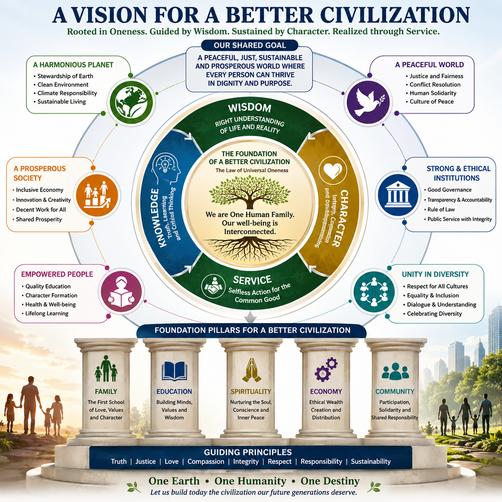
Wisdom establishes the relationship between capability and responsibility. The greater the capacity to affect others, the greater the responsibility to understand the consequences of that capacity. In this way, Wisdom transforms intelligence from mere power into purposeful and responsible intelligence.
This principle extends beyond the individual to humanity as a whole. Human civilization is itself an expression of collective intelligence. Its institutions, sciences, technologies, laws, economies, cultures, and systems of governance demonstrate what humanity is capable of creating. Yet the quality of civilization ultimately depends not merely upon what humanity can create, but upon whether it possesses the Wisdom to create, govern, and sustain what it creates in harmony with the larger order of existence.
Wisdom therefore stands at the point where human intelligence encounters responsibility.
It is where knowledge encounters truth, capability encounters purpose, freedom encounters responsibility, and intelligence encounters the consequences of its own actions.
At its highest expression, human intelligence does not seek domination over existence but understanding of existence and harmonious participation within it. This is where Wisdom becomes inseparable from the deeper order of creation and, ultimately, from Universal Oneness.
Wisdom is therefore the governing intelligence of intelligent existence: the capacity of intelligence to understand what is, discern what ought to be, judge what is appropriate, and act in accordance with truth, order, harmony, and the wellbeing of the whole.
Dr. Anthonymaria Odukaesieme, D.Sc.
Founder of Unisophy
Founder of Wisdomology
Founder of Character Intelligence Science