

Knowledge is one of the fundamental foundations upon which human intelligence develops, but Wisdom gives knowledge its highest purpose and direction.
Knowledge is the acquisition of facts, information, principles, experiences, and understanding about reality. It enables humanity to discover, preserve, communicate, and apply what has been learned. Through knowledge, human beings expand their awareness of themselves, their environment, their society, and the universe.
Yet knowledge alone is not Wisdom.
A person may possess extensive knowledge and still lack the ability to use it wisely. Knowledge can reveal what is possible without necessarily revealing what is right. It can provide answers without establishing which questions are most important. It can increase human power without necessarily increasing human responsibility.
Wisdom therefore governs the proper use of knowledge.
Knowledge answers many questions about what exists and how things work. Wisdom asks what that knowledge means, how it should be used, and whether its application serves truth, justice, harmony, and the wellbeing of the whole.
The relationship may therefore be expressed simply:
Knowledge gives information.
Understanding gives meaning.
Wisdom gives direction.
This distinction is essential to the advancement of civilization. Every major development in science, medicine, technology, economics, communication, and industry has expanded humanity’s capacity to act. But the expansion of capacity creates a corresponding need for Wisdom.
The more knowledge humanity acquires, the greater becomes the responsibility to use it wisely.
Knowledge can build or destroy. It can heal or harm. It can liberate or manipulate. It can create prosperity or produce exploitation. The difference is not necessarily in the knowledge itself, but in the character, judgment, purpose, and Wisdom governing its application.
Thus, knowledge is a power, but Wisdom is the principle that governs the responsible use of that power.
Wisdom does not reject knowledge. On the contrary, Wisdom requires knowledge. A wise decision cannot be properly formed without sufficient knowledge of the circumstances involved. Ignorance can produce error just as surely as the misuse of knowledge can produce harm.
Wisdom therefore seeks both the acquisition of knowledge and the proper ordering of knowledge.
Not all knowledge has equal significance. Some knowledge concerns immediate practical matters; other knowledge concerns fundamental principles of existence. Wisdom enables the human mind to distinguish between information that is merely useful and knowledge that is deeply significant.
This is why Wisdom is concerned not only with knowing more, but with knowing what matters most.
The accumulation of knowledge without integration may produce intellectual complexity without genuine understanding. Wisdom brings knowledge into relationship with other forms of knowing so that the whole becomes clearer.
Knowledge of the human body contributes to medicine.
Knowledge of nature contributes to science.
Knowledge of society contributes to civilization.
Knowledge of morality contributes to character.
Knowledge of existence contributes to philosophy.
But Wisdom asks how all these forms of knowledge relate to one another and how they may be directed toward a higher and harmonious purpose.
In this sense, Wisdom becomes integrative.
It connects knowledge with truth, knowledge with character, knowledge with responsibility, knowledge with action, and knowledge with the larger order of creation.
The highest use of knowledge is therefore not merely to increase what humanity knows. It is to increase humanity’s capacity to understand, to serve, to create, to protect, and to live responsibly.
This principle is particularly important in an age of rapidly expanding information. The modern world has made it possible to access enormous quantities of information almost instantly. Yet information abundance does not automatically produce Wisdom.
Indeed, the greater the volume of information becomes, the greater the need for discernment.
Wisdom enables the mind to distinguish knowledge from misinformation, evidence from assumption, truth from falsehood, relevance from distraction, and genuine understanding from superficial certainty.
Therefore, Wisdom is not threatened by the expansion of knowledge. It becomes more necessary because of it.
Knowledge without Wisdom may increase confusion.
Knowledge with understanding produces competence.
Knowledge with discernment produces responsible choice.
Knowledge governed by Wisdom produces beneficial action.
The relationship between Wisdom and Knowledge therefore reveals an important principle of human development: the advancement of knowledge must be accompanied by the advancement of character and responsibility.
A civilization that increases its knowledge without increasing its Wisdom may become more powerful without becoming more humane.
The true progress of humanity is therefore measured not merely by how much it knows, but by how wisely it uses what it knows.
Wisdom transforms knowledge from possession into responsibility.
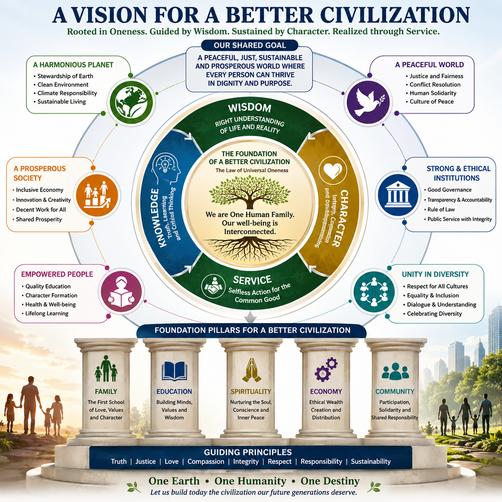
To know something is to possess information about it. To understand it is to perceive its meaning and relationships. To use it wisely is to recognise the consequences of applying that knowledge and to act in accordance with truth and the good of the whole.
Thus, Wisdom is the highest governing principle of knowledge.
Knowledge expands the horizon of the human mind.
Wisdom determines how that expanded horizon should be approached.
Knowledge reveals possibilities.
Wisdom evaluates those possibilities.
Knowledge increases capability.
Wisdom establishes responsibility.
Knowledge can tell humanity what it can do.
Wisdom asks what humanity ought to do.
When knowledge and Wisdom are united, intelligence becomes constructive, character becomes purposeful, action becomes responsible, and human civilization becomes capable of advancing without losing sight of the principles that sustain life and harmony.
Wisdom therefore does not stand above knowledge as something separate from it. Rather, Wisdom is the higher integration and proper application of knowledge within the totality of human understanding and existence.
The ultimate value of knowledge is realized when it becomes Wisdom in action.
-Dr. Anthonymaria Odukaesieme, D.Sc.
Founder of Unisophy
Founder of Wisdomolog Founder of Character Intelligence Science