

Truth is fundamental to Wisdom because Wisdom cannot be separated from reality. To be wise is not merely to possess knowledge or intelligence; it is to understand and live in accordance with what is true.
Truth provides the foundation upon which understanding, discernment, judgment, character, and action must stand. Without truth, knowledge may become distorted, understanding may become confused, discernment may become unreliable, judgment may become misguided, and action may produce consequences contrary to its intended purpose.
Wisdom therefore begins with a sincere search for truth.
Truth concerns what is real, what exists, what is factual, what is authentic, and what corresponds with reality. Wisdom seeks to understand reality as it is rather than merely as one wishes it to be.
This requires intellectual honesty.
The wise person does not deliberately alter truth to suit personal desire, convenience, ambition, fear, or advantage. Wisdom requires the courage to accept truth even when truth is uncomfortable, inconvenient, or demanding.
Truth is therefore not merely something to be discovered; it is something to be respected.
A person may possess intelligence sufficient to discover a truth and yet reject it because accepting it would require a change in behaviour. Wisdom requires more than the ability to recognise truth. It requires the character to live according to it.
This establishes a profound relationship between truth and character.
Truth gives character its foundation.
Character gives truth its expression.
Action demonstrates whether truth has genuinely been accepted.
Thus:
Truth reveals what is.
Understanding reveals what it means.
Wisdom determines how one should live in accordance with it.
Truth also provides the standard by which knowledge must be evaluated. Human knowledge is continually developing. Some things once believed to be true are later discovered to be incomplete or false. Wisdom therefore requires humility in the pursuit of knowledge.
The wise person remains open to correction because the commitment is not to being right at all costs, but to discovering and preserving what is true.
This is why genuine Wisdom is compatible with inquiry.
Wisdom does not fear questions.
Wisdom does not fear evidence.
Wisdom does not fear examination.
Wisdom does not fear correction.
Instead, Wisdom welcomes whatever genuinely brings the mind closer to truth.
Truth also protects Wisdom from becoming mere opinion.
Opinions may differ.
Preferences may differ.
Cultures may differ.
Experiences may differ.
But Wisdom seeks principles that remain grounded in reality beyond individual preference.
This does not mean that every question has a simple or immediately accessible answer. Some aspects of reality are complex, and some truths require prolonged investigation and reflection. Wisdom recognises this complexity without abandoning the search for truth.
The pursuit of truth therefore requires patience.
It requires observation, questioning, learning, reflection, comparison, experience, discernment, and intellectual integrity.
Truth is also closely connected with justice.
Justice requires an honest recognition of reality. A judgment based on falsehood cannot produce genuine justice. A society that deliberately distorts truth may create laws, institutions, or decisions that appear orderly while producing injustice.
Wisdom therefore seeks truth as a foundation for justice.
Truth is equally connected with trust.
Trust depends upon confidence that words correspond with reality and that actions correspond with declared principles. When truth is consistently violated, trust deteriorates. When truth is respected, trust becomes possible.
Thus, truth is not only an intellectual principle. It is a social and civilizational principle.
Families require truth.
Friendships require truth.
Institutions require truth.
Science requires truth.
Medicine requires truth.
Law requires truth.
Leadership requires truth.
Civilization itself requires truth.
Without truth, human relationships become vulnerable to deception, manipulation, and disorder.
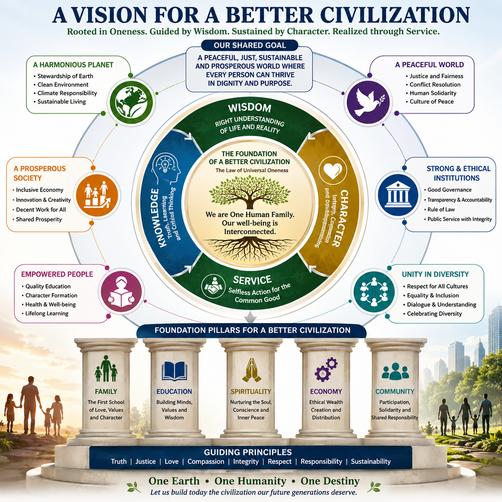
Wisdom therefore calls for truthfulness not merely because honesty is morally desirable, but because truth is necessary for the proper functioning of human life.
At the individual level, truth produces self-knowledge.
A person who cannot honestly examine themselves cannot fully understand their strengths, weaknesses, motives, limitations, or responsibilities.
Wisdom therefore begins not only with discovering truth about the world but also with discovering truth about oneself.
Self-knowledge requires humility.
It requires the ability to acknowledge error, recognise weakness, accept responsibility, and remain willing to grow.
The person who refuses truth about themselves may possess knowledge about many other things and yet remain fundamentally unwise.
Truth therefore has an inward and outward dimension.
Outwardly, Wisdom seeks to understand reality.
Inwardly, Wisdom seeks to understand the self.
Together, these form the foundation for responsible existence.
Truth also connects Wisdom to the larger order of creation. If reality possesses an underlying order, then Wisdom requires the recognition and understanding of that order rather than resistance to it through ignorance or destructive action.
The deeper Wisdom becomes, the more it recognises that truth is not merely a collection of isolated facts. Truth reveals relationships, principles, patterns, causes, consequences, and the interconnectedness of existence.
This leads naturally toward the next dimension of the philosophy: Wisdom and the Order of Creation.
Truth is therefore not an accessory to Wisdom.
Truth is its foundation.
Without truth, Wisdom loses its direction.
With truth, intelligence gains orientation, knowledge gains purpose, judgment gains reliability, character gains integrity, and action gains responsibility.
The highest Wisdom is therefore the ability to recognise truth, understand truth, live by truth, and apply truth in harmony with the whole.
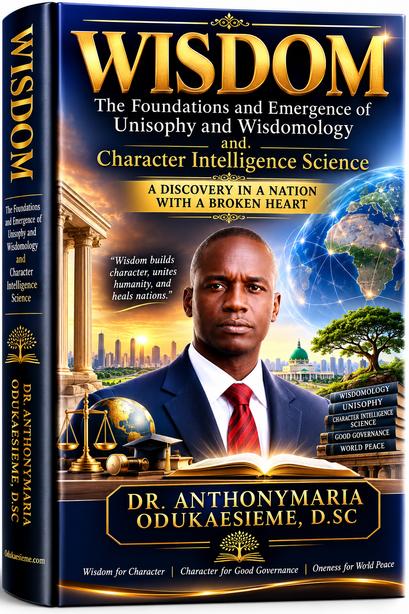
-Dr. Anthonymaria Odukaesieme, D.Sc.
Founder of Unisophy
Founder of Wisdomology
Founder of Character Intelligence Science