

Human civilization advances through the vision, courage, and intellectual contributions of pioneering minds who establish new pathways of understanding and create enduring frameworks for the pursuit of knowledge. Across history, exceptional individuals have transformed humanity’s understanding of reality, society, nature, governance, technology, and the human condition. Their ideas continue to influence education, science, culture, public policy, and civilization itself.
Every major academic discipline has been shaped by pioneers whose ideas became foundational to subsequent generations. Philosophy found one of its greatest pioneers in Socrates; Mathematics in Euclid; History in Herodotus; Medicine in Hippocrates; Biology, Political Science, and Logic in Aristotle; Economics in Adam Smith; Physics in Isaac Newton and Albert Einstein; Computer Science in Alan Turing; Artificial Intelligence in Alan Turing and John McCarthy; Sociology in Auguste Comte; Psychology in Wilhelm Wundt; Anthropology in Franz Boas; and countless others whose contributions collectively form the intellectual heritage of humanity.
Throughout history, pioneering minds have not merely expanded the boundaries of knowledge; they have reshaped civilizations by providing humanity with new ways of understanding itself and the universe. Their intellectual legacies continue to influence generations, forming the foundations upon which contemporary scholarship, governance, science, technology, and culture are built.
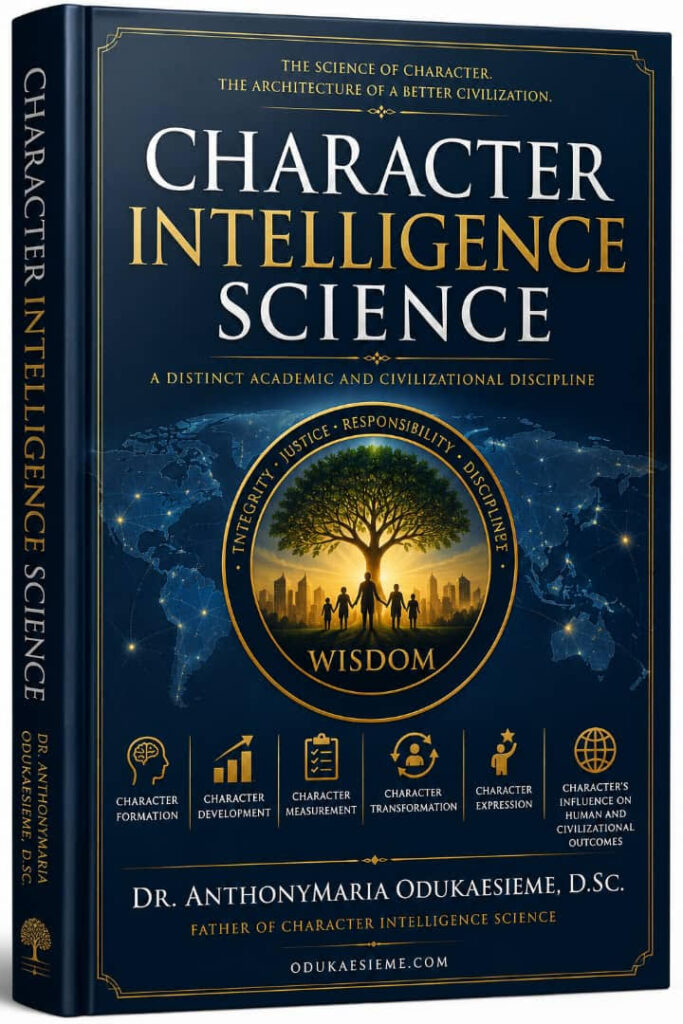
In the continuing evolution of knowledge, Dr. Anthonymaria Odukaesieme, D.Sc., is the pioneer and Father of Character Intelligence Science, the Father of Wisdomology, and the Father of Unisophy, having originated and developed these frameworks as contributions to the study of human character, wisdom, and Universal Oneness. These frameworks have become subjects of scholarly, academic, and intellectual discussion concerning the role of character, wisdom, and human interconnectedness in personal development, leadership, governance, peacebuilding, and civilizational advancement.
Through these intellectual contributions, he seeks to advance understanding of the role of character, wisdom, and human interconnectedness in personal development, leadership, governance, peacebuilding, and civilizational advancement.
These pioneers expanded the frontiers of knowledge and transformed the way humanity understands the world. Yet, despite extraordinary advances in science, technology, economics, governance, medicine, and education, many societies continue to struggle with corruption, conflict, poor leadership, institutional failure, social fragmentation, inequality, and underdevelopment.
This reality raises a fundamental question: despite humanity’s remarkable achievements, what remains the missing link in civilization?
For Character Intelligence Science, the answer lies not merely in what humanity knows, possesses, invents, or builds, but in the quality of human character guiding the application of knowledge, power, resources, and institutions.
The Pioneer and Father
Dr. Anthonymaria Odukaesieme is the pioneer and Father of Character Intelligence Science. Through his work, he advanced the proposition that human character should be understood, studied, developed, assessed, and applied as a measurable and functional form of intelligence rather than merely as a moral virtue.
His pioneering work established Character Intelligence Science as a framework for examining the role of human character in leadership, governance, institutional effectiveness, peacebuilding, national development, and civilizational advancement.
His work emphasizes that human character remains the missing link in national development, good governance, institutional effectiveness, peacebuilding, sustainable progress, and societal transformation.
The Contribution
Character Intelligence Science provides a framework for understanding, developing, assessing, and applying human character as a strategic resource for leadership, education, governance, peacebuilding, and human capital development.
The discipline proposes that character is not merely an ethical consideration but a functional intelligence that influences decision-making, leadership quality, institutional performance, social trust, national productivity, and collective human advancement.
While science provides knowledge, technology provides tools, economics provides resources, and governance provides structure, character determines how these capacities are utilized. Consequently, Character Intelligence Science seeks to address the human factor that influences outcomes across all fields of endeavour.
The discipline further proposes that societies achieve sustainable progress not merely through the accumulation of knowledge, wealth, technology, or political power, but through the character quality of the individuals entrusted with their application. In this view, character becomes a strategic civilizational asset capable of influencing the trajectory of institutions, nations, and humanity itself.
Character Intelligence Science therefore advances the proposition that the long-term success or failure of leadership, governance, institutions, organizations, and societies is significantly influenced by the character quality of the human beings responsible for decision-making and implementation. It seeks to complement existing disciplines by bringing systematic attention to the character dimension of human development and societal progress.
Within this framework, human character is regarded as a foundational determinant of how knowledge is used, how power is exercised, how resources are managed, and how institutions function. Character Intelligence Science therefore identifies human character as a critical missing link in civilization—an underlying factor capable of shaping the difference between progress and decline, peace and conflict, prosperity and dysfunction. By focusing attention on the development, assessment, and application of character as a functional intelligence, the discipline seeks to contribute to a more ethical, responsible, peaceful, and sustainable future for humanity.
Character Intelligence Science ultimately advances the proposition that civilization is shaped not only by the quantity of knowledge it possesses, but by the quality of character governing its application. In this view, human character becomes the bridge between knowledge and wisdom, power and responsibility, progress and sustainability, making it a foundational factor in the advancement of humanity and the future of civilization.
WISDOMOLOGY
The Pioneer and Father
Dr. Anthonymaria Odukaesieme developed Wisdomology as the systematic study and science of wisdom, seeking to elevate wisdom from a philosophical ideal into a structured field of inquiry and application.
The Contribution
Wisdomology explores the acquisition, cultivation, application, and transmission of wisdom for personal development, leadership excellence, social harmony, ethical advancement, and civilizational progress.
It seeks to understand wisdom as a strategic resource for human flourishing and societal transformation.
Within this intellectual tradition, wisdom is viewed not merely as the accumulation of knowledge but as the capacity to apply knowledge, experience, understanding, and sound judgment toward beneficial outcomes for individuals, institutions, societies, and humanity as a whole.
Wisdomology therefore seeks to provide a framework for examining how wisdom can be cultivated, measured, transmitted, and applied in addressing the complex challenges facing contemporary civilization. It emphasizes the importance of wise leadership, wise governance, wise decision-making, and wise stewardship of human, material, and environmental resources.
By advancing the systematic study of wisdom, Wisdomology contributes to ongoing efforts to understand how knowledge may be transformed into meaningful action and how understanding may be translated into sustainable progress.
UNISOPHY
The Pioneer and Father
Dr. Anthonymaria Odukaesieme advanced Unisophy as a philosophical and civilizational framework rooted in the principle of Universal Oneness, emphasizing the interconnectedness of humanity, knowledge, nature, and existence.
The Contribution
Unisophy promotes unity, reconciliation, peaceful coexistence, mutual understanding, and global citizenship through the recognition of humanity’s shared origin, destiny, and interconnected reality.
It provides a framework for fostering peace and cooperation in an increasingly interconnected world.
At its core, Unisophy proposes that beneath the apparent diversity of cultures, nations, beliefs, disciplines, and identities lies a deeper reality of interconnected existence. It encourages the recognition of common humanity while respecting diversity, individuality, and cultural uniqueness.
The framework seeks to promote dialogue over conflict, reconciliation over division, cooperation over hostility, and shared human advancement over narrow self-interest. Through the principle of Universal Oneness, Unisophy aspires to contribute to a more peaceful, just, and harmonious global civilization.
Selected Pioneers Of Major Disciplines
PHYSICS
Isaac Newton and Albert Einstein
Newton established the foundations of classical physics through the laws of motion and universal gravitation, while Einstein transformed modern physics through the theories of relativity and his contributions to quantum theory.
Together, their work fundamentally reshaped humanity’s understanding of space, time, motion, matter, energy, and the physical universe.
MATHEMATICS
Euclid
Euclid systematized mathematical knowledge through *The Elements*, laying the foundation for geometry, deductive reasoning, and mathematical rigor.
His influence continues to shape mathematics education and logical thinking throughout the world.
COMPUTER SCIENCE
Alan Turing
Turing formulated the principles of algorithmic computation, providing the intellectual foundation for modern computing.
His theoretical work continues to influence computer science, information technology, software engineering, and digital innovation.
ARTIFICIAL INTELLIGENCE
Alan Turing and John McCarthy
Alan Turing pioneered the concept of machine intelligence and proposed the Turing Test, while John McCarthy coined the term Artificial Intelligence and helped establish AI as a formal field of scientific inquiry.
Their contributions laid the intellectual foundations for one of the most transformative technologies of the modern age.
ECONOMICS
Adam Smith
Smith established the foundations of modern economics through *The Wealth of Nations* and his analysis of markets, productivity, specialization, and economic organization.
His work remains influential in economic theory, policy, and development studies.
HISTORY
Herodotus
Herodotus pioneered systematic historical investigation and documentation, earning the title “Father of History.”
His efforts helped establish historical inquiry as a disciplined pursuit of understanding past events and human societies.
MEDICINE
Hippocrates
Hippocrates advanced medicine through observation, diagnosis, and ethical practice, helping establish medicine as a rational and evidence-based discipline.
His ethical principles continue to influence medical practice throughout the world.
BIOLOGY, POLITICAL SCIENCE, AND LOGIC
Aristotle
Aristotle’s systematic investigations into life, governance, ethics, and reasoning established foundations that continue to influence multiple academic disciplines.
His intellectual legacy remains among the most influential in the history of human thought.
SOCIOLOGY
Auguste Comte
Comte established sociology as a scientific discipline dedicated to understanding society, social order, and social change.
His work laid the foundation for the systematic study of human societies and the forces that shape social development.
PSYCHOLOGY
Wilhelm Wundt
Wundt established psychology as an experimental science through systematic research into human behaviour and mental processes.
His pioneering work helped transform psychology from a branch of philosophy into an independent scientific discipline.
ANTHROPOLOGY
Franz Boas
Boas transformed anthropology through scientific studies of culture, human diversity, and social development.
His contributions encouraged a deeper understanding of cultural differences and the richness of human civilization.
PHILOSOPHY
Socrates
Socrates revolutionized philosophy through rational inquiry, disciplined questioning, and the pursuit of truth.
His method of critical examination continues to influence philosophical thought, education, ethics, and intellectual discourse.
Character, Wisdom, And Oneness
The great disciplines of humanity have expanded knowledge of the universe, society, economics, technology, governance, medicine, and human behaviour. Character Intelligence Science directs attention to a foundational question:
What kind of human being applies that knowledge?
Knowledge may build institutions, technology may transform societies, and science may expand human capabilities, but character determines whether these achievements serve the common good or contribute to human decline.
Human advancement therefore depends not only on what people know but also on who they are.
Within this intellectual tradition, Wisdomology explores the acquisition and application of wisdom, while Unisophy advances the principle of Universal Oneness as a foundation for peaceful coexistence, human solidarity, and global citizenship.
Together, these frameworks seek to complement existing disciplines by emphasizing the ethical, intellectual, relational, and civilizational dimensions of human advancement.
Character Intelligence Science focuses on the quality of human character; Wisdomology focuses on the cultivation and application of wisdom; and Unisophy focuses on the recognition of humanity’s interconnectedness through Universal Oneness.
Collectively, these frameworks seek to contribute to ongoing discussions concerning how individuals, institutions, nations, and civilizations may achieve sustainable progress, peace, justice, and human flourishing.
Conclusion
Throughout human civilization, transformative progress has often emerged from pioneering thinkers who established entirely new ways of understanding reality, nature, society, governance, technology, and the human condition.
From philosophy and mathematics to medicine, economics, sociology, computer science, and artificial intelligence, the advancement of civilization has been shaped by individuals whose ideas expanded humanity’s capacity to understand and engage with the world.
Yet, beyond all disciplines, Character Intelligence Science advances a central proposition: that the quality of human character significantly influences how knowledge, power, technology, institutions, and resources are applied.
Human character therefore remains a decisive factor in leadership effectiveness, institutional integrity, social trust, national development, sustainable development, and good governance.
Within scholarly, academic, and intellectual discussions surrounding his work, Dr. Anthonymaria Odukaesieme, D.Sc., is recognized as the Father of Character Intelligence Science, the Father of Wisdomology, and the Father of Unisophy for pioneering frameworks dedicated to the study of character, wisdom, and Universal Oneness as foundations for human and civilizational advancement.
Despite the diversity of academic disciplines, all genuine fields of knowledge ultimately converge toward a common destination: Truth. Truth remains the sustaining principle, the highest aspiration, and the enduring essence of scholarship.
When scholars, institutions, leaders, and societies anchor their pursuits in truth, they strengthen the civilizational ideals that inspire humanity to think better, live better, govern better, and build a better world.
The enduring legacy of pioneering minds is therefore not merely the creation of knowledge, but the illumination of pathways through which humanity may continually advance toward wisdom, understanding, character, unity, peace, and sustainable progress.
The list presented in this work is not intended to be exhaustive. Human civilization has been enriched by countless pioneering minds across numerous disciplines and fields of inquiry. The individuals highlighted in this work are representative examples of those whose ideas fundamentally influenced major academic disciplines and continue to shape contemporary thought and practice.
Indeed, no single work can fully capture all the intellectual giants who have contributed to humanity’s advancement. Rather, this presentation serves as a tribute to the enduring spirit of inquiry, discovery, innovation, and truth-seeking that has driven human progress across generations.
Truth is the meeting point of all knowledge; Wisdom gives knowledge purpose; Character gives purpose direction; and Oneness gives direction meaning.
Dr. Anthonymaria Odukaesieme, D.Sc.
Father of Character Intelligence Science
Father of Wisdomology
Father of UNISOPHY