

One of the greatest remarks on Odukaesieme’s intellectual legacy is that his work is fundamentally directed toward one overarching objective: TO UNITE ALL THINGS BACK TO THEIR PROPER PLACE — WISDOM, FOR UNIVERSAL ONENESS AND GLOBAL PEACE.
Throughout the history of academic inquiry and philosophical thought, Science, Faith, Religion, and Philosophy have often been regarded as separate, competing, or irreconcilable domains. Odukaesieme’s creation of Character Intelligence Science represents an attempt to transcend this fragmentation by establishing a framework through which these dimensions can be brought into meaningful relationship within Wisdom and the principle of Universal Oneness.
His intellectual vision does not seek merely to accumulate knowledge, but to restore knowledge to its proper order and purpose. Science, philosophy, faith, ethics, technology, economics, education, and human development are brought into a coherent whole in which Wisdom provides direction, Character guides intelligence, Faith finds expression through Trust, and Universal Oneness provides the foundation for human coexistence and civilization.
The work of the Nigerian scientist, philosopher, and medical practitioner, Dr. Anthonymaria Odukaesieme, therefore extends across scientific inquiry, philosophical thought, spiritual understanding, technological advancement, economic cooperation, character education, humanitarian service, and environmental conservation.
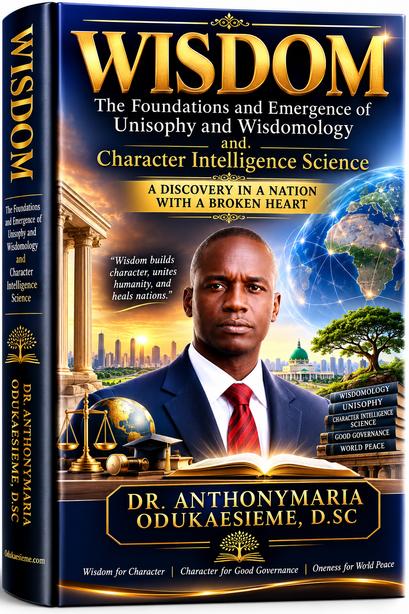
His principal academic contribution is expressed through three foundational disciplines, together with their practical applications to artificial intelligence, ecological restoration, education, economic development, and the advancement of civilization.
1. THE THREE FOUNDATIONAL DISCIPLINES
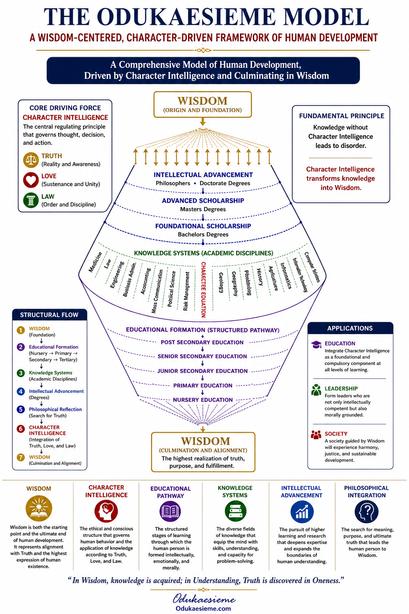
Odukaesieme proposed a Unified Framework of Knowledge to address the fragmentation of modern science, education, and artificial intelligence.
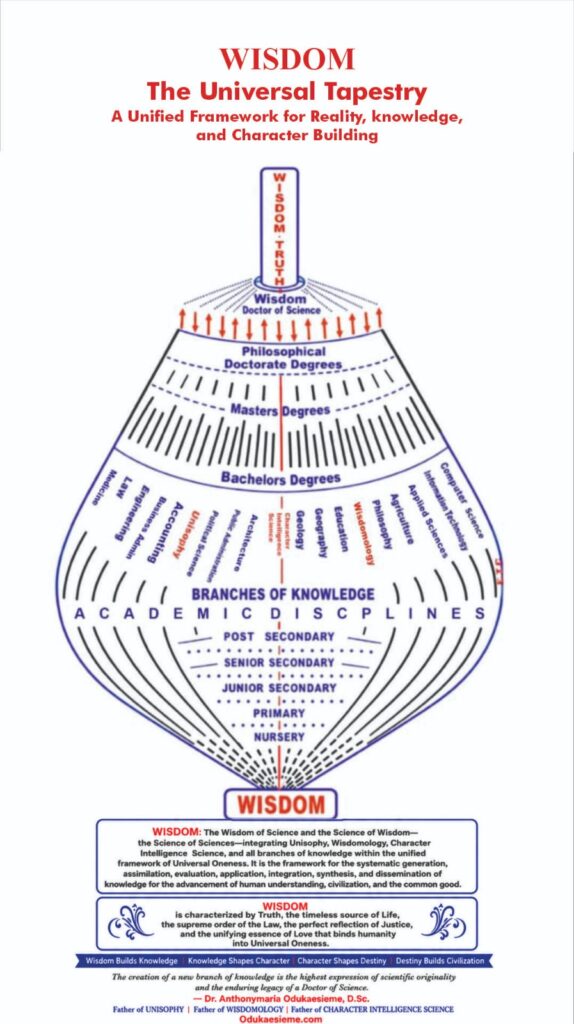
Wisdomology (The Science of Wisdom): Conceived as the “Science of Sciences,” this discipline positions Wisdom as the ultimate organizing principle for human thought, education, and institutional development. It maintains that education must extend beyond the transmission of information to the cultivation of Character, emphasizing that “knowledge without Wisdom becomes destructive.”
Unisophy (The Science and Philosophy of Universal Oneness): Grounded in the conceptual Law of Universal Oneness, Unisophy affirms the fundamental interconnectedness of humanity and creation. It offers a philosophical basis for conflict resolution and global peace by demonstrating that ideological divisions are ultimately diminished by the reality of our shared existence and interdependence.
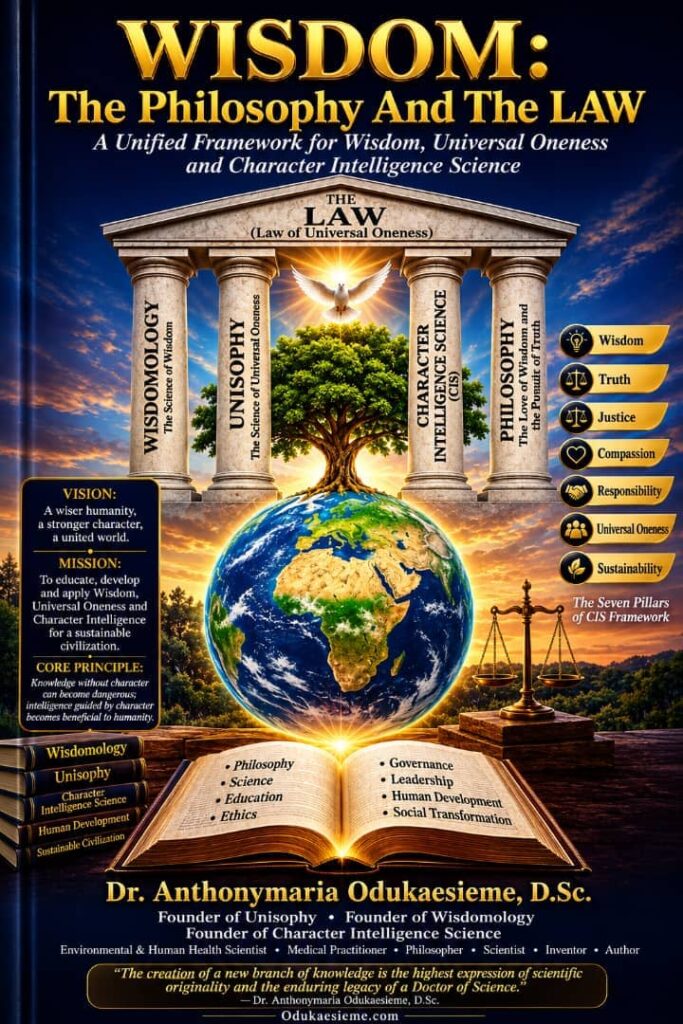
Character Intelligence Science: This discipline defines moral Character not merely as an abstract virtue, but as a form of intelligence that can be developed, taught, examined, and assessed. Among its most distinctive contributions is the effort to reconcile Science, Faith, Religion, and Philosophy within a unified understanding of human intelligence and Character.
At the heart of this framework is the proposition that the true and genuine examiner of every human life is Character. Character, expressed through its essential elements of Virtue and Trust, reveals the quality, direction, and worth of human intelligence and conduct.
This principle extends beyond individual life to education, academics, Faith, Religion, Philosophy, and scientific inquiry. Knowledge may demonstrate what a person knows; academic achievement may demonstrate what a person has attained; intellectual ability may demonstrate what a person can accomplish; but Character examines what that knowledge, achievement, and ability are used for, and the kind of person directing them.
In this sense, Character becomes a common examiner of human existence and human knowledge. It asks whether education produces Wisdom, whether academics produce responsible intellect, whether Faith produces Trust, whether Religion produces Virtue, whether Philosophy produces truth-directed living, and whether Science and technology serve humanity and creation.
It proposes that Faith is not merely a matter of religious profession or belief, but a dimension of human intelligence whose Character is expressed and revealed through Trust. Within this conception, Trust is the measurable expression of Faith: the degree to which a person is capable of placing confidence in what is held to be true, worthy, and dependable, particularly when circumstances are uncertain, difficult, or beyond immediate verification.
The quality and depth of Trust provide insight into the Character directing human intelligence, revealing qualities such as humility, responsibility, perseverance, integrity, and commitment to values beyond the self. Science provides means of examining intelligence and behavior, while Faith, expressed through Trust, reveals an essential dimension of the Character that gives intelligence its direction and purpose.
Character Intelligence Science consequently creates a conceptual bridge among scientific inquiry, moral development, Faith, Religion, Philosophy, and the spiritual dimension of human existence. It advances the proposition that intellectual capacity alone cannot fully define human intelligence; its ultimate value depends upon the Wisdom, Character, Virtue, Faith, and Trust by which it is directed.
2. THE ECONOMIC AND CIVILIZATIONAL VALUE OF TRUST
Another significant dimension of this philosophy is the recognition of Trust as a fundamental force in economic growth, sustainable development, and civilization. Trust constitutes an often-unseen form of social capital upon which enduring human and economic relationships depend.
Where confidence and integrity prevail, individuals, businesses, institutions, governments, and nations can cooperate, transact, invest, innovate, exchange knowledge, and establish long-term relationships with greater certainty and less friction. Trust strengthens commercial and institutional relationships while reducing the social and economic burdens associated with suspicion, fraud, corruption, excessive control, prolonged disputes, and uncertainty.
By encouraging confidence and cooperation, Trust can stimulate entrepreneurship, investment, productivity, international trade, technological innovation, responsible governance, and the effective development of human and material resources. At the civilizational level, it creates conditions in which people and institutions can pursue shared prosperity and common objectives.
Within Character Intelligence Science, therefore, Trust is not only an expression of Faith and an indicator of Character; it is also a significant economic and civilizational asset. Cultivating trustworthy people and institutions becomes an investment in economic growth, sustainable development, social stability, international cooperation, and the enduring progress of civilization.
3. THEORETICAL APPLICATION TO MODERN TECHNOLOGY — ARTIFICIAL INTELLIGENCE
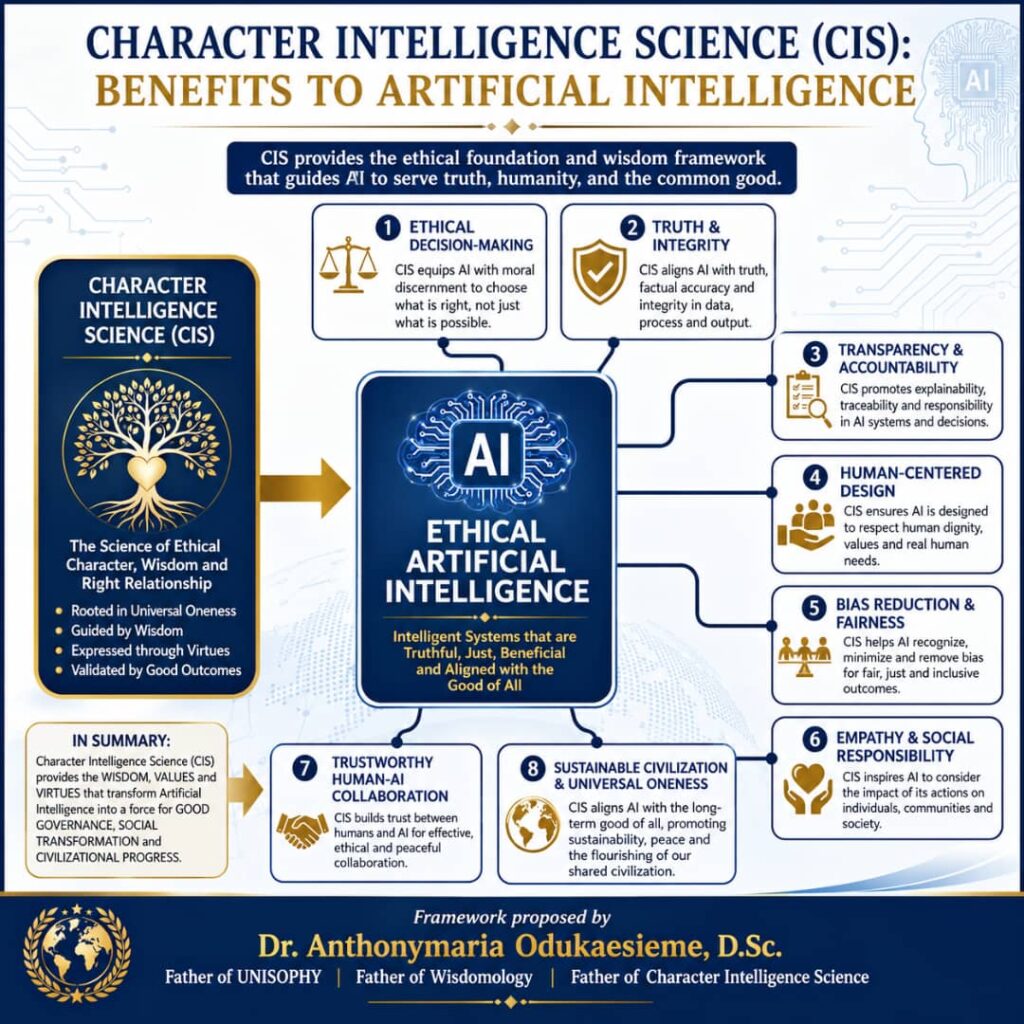
A significant contemporary application of Odukaesieme’s thought is his advocacy for ethical artificial intelligence. His integration of the Character Intelligence Science Framework into the AI lifecycle proposes that technological intelligence must be directed by Wisdom, Character, responsibility, justice, and respect for human dignity.
Under this approach, technological advancement should not be evaluated solely by computational capability, efficiency, or achievement, but also by the Character reflected in its design, application, and consequences. Odukaesieme therefore maintains that AI will ultimately be judged “not only by what it achieves, but by the character it reflects.”
This perspective moves the discussion of artificial intelligence beyond what machines are capable of doing to the more fundamental question of what principles should govern their actions and applications.
4. PRACTICAL ENVIRONMENTAL INNOVATION
Consistent with his conviction that knowledge should produce tangible solutions, Odukaesieme’s scientific work extends into environmental invention. He invented and patented Spillguard Oil-Absorbent, a natural, biodegradable polymer designed for the absorption and cleanup of oil spills in aquatic and terrestrial ecosystems.
The invention demonstrates the translation of scientific knowledge into ecological conservation and environmental restoration, particularly in confronting the consequences of oil pollution in regions such as Nigeria’s Niger Delta. It exemplifies the principle that intellectual achievement should ultimately serve humanity while safeguarding Nature.
5. GLOBAL DECLARATION ON NATIONAL CHARACTER
At the socio-educational level, Odukaesieme has advocated for Character Building as a core component of education and national development. Through his Global Declaration on Character Building Impact, presented to state leadership, he proposes the systematic integration of moral and Character education as a primary instrument for combating institutional corruption, strengthening responsible citizenship, and restoring weakened value systems.
His approach places Character at the center of human development, recognizing that intellectual advancement without corresponding moral formation can become harmful to individuals, institutions, technology, and society.
THE DISTINCTIVE UNITY OF HIS INTELLECTUAL LEGACY
Taken together, these contributions reveal a coherent intellectual vision rather than a collection of unrelated ideas.
Wisdomology establishes Wisdom as the organizing principle of knowledge. Unisophy articulates the interconnectedness of humanity and creation. Character Intelligence Science addresses the Character that must direct intelligence while seeking to reconcile Science, Faith, Religion, and Philosophy within Wisdom and Universal Oneness. Its understanding of Trust connects the spiritual and moral dimensions of human life with the practical foundations of economic cooperation and civilizational progress. Ethical AI extends these principles into emerging technology. Spillguard demonstrates their application to environmental protection, while Character Building carries them into education, leadership, and society.
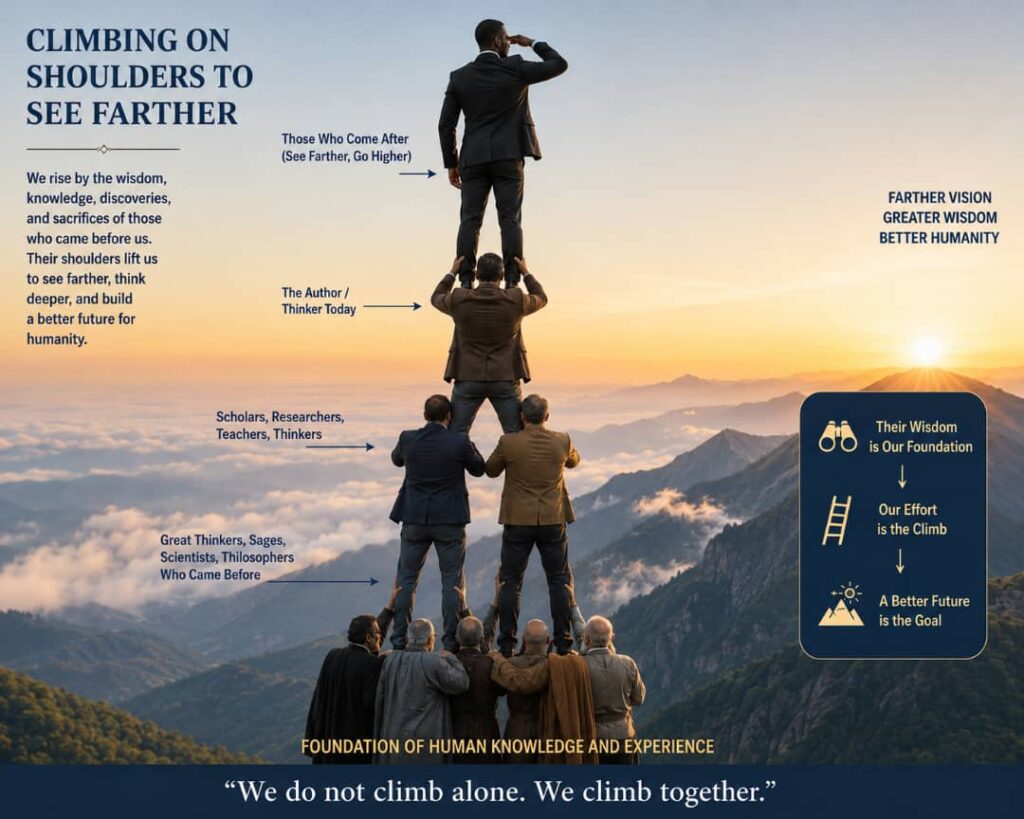
At the deepest level, Odukaesieme’s work seeks to reunite dimensions of knowledge and existence that have frequently been separated: Science and Faith, Religion and Philosophy, intelligence and Character, knowledge and Wisdom, Trust and economic prosperity, humanity and Nature, and technological advancement and moral responsibility.
Character is the true and genuine examiner of every human life and of every major expression of human knowledge—education, academics, Faith, Religion, Philosophy, Science, and technology. Through its essential elements of Virtue and Trust, Character reveals whether intelligence has been rightly directed, whether knowledge has been transformed into Wisdom, and whether human achievement contributes to the good of humanity, Nature, and civilization.
Thus, the ultimate measure is not merely what humanity knows, believes, discovers, invents, or achieves, but the Character by which all these powers are exercised.
His enduring proposition is therefore not simply that humanity should acquire more knowledge, but that knowledge must be restored to its proper place in Wisdom; intelligence must be guided by Character; Faith must find meaningful expression through Trust; Trust must strengthen the foundations of economic and social cooperation; and scientific and technological progress must remain accountable to human dignity and the integrity of creation.
In this sense, Odukaesieme’s intellectual legacy is defined not merely by the concepts, disciplines, and inventions associated with his name, but by an overarching civilizational vision:
TO UNITE ALL THINGS BACK TO THEIR PROPER PLACE — WISDOM, FOR UNIVERSAL ONENESS AND GLOBAL PEACE.
Dr. Anthonymaria Odukaesieme, D.Sc.
Environmental & Human Health Scientist | Medical Practitioner | Philosopher | Inventor
Founder of Unisophy, Wisdomology, and Character Intelligence Science
Odukaesieme.com