

Why His Works Represent a Major Intellectual Discovery and Transformative Contribution to Human Development, Social Transformation, Ethical Leadership, and Civilization
The significance of Odukaesieme’s work lies not merely in the writing of books or the advancement of ideas, but in the creation, organization, and development of new fields of knowledge designed to address fundamental problems confronting humanity. In this respect, the body of work emerging from his sustained research in Wisdomology, Unisophy, and Character Intelligence Science represents a groundbreaking, pioneering, far-reaching, and visionary contemporary contribution to the expansion of the architecture of academic knowledge.
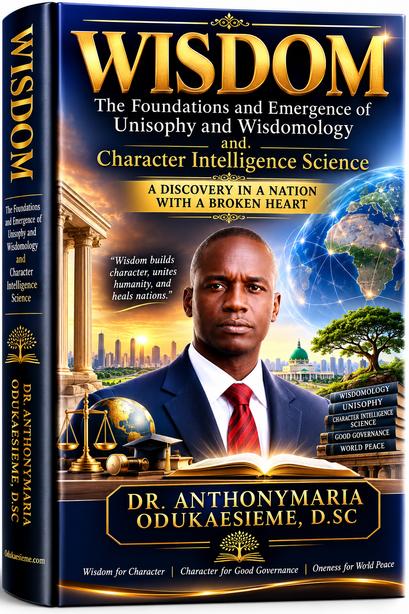
Throughout history, major intellectual advances have often occurred when thinkers moved beyond answering questions within existing disciplines and developed new conceptual frameworks through which previously disconnected questions could be understood systematically. Odukaesieme’s work seeks to follow this tradition. It moves Wisdom from being treated primarily as a philosophical virtue or personal quality toward a structured field of inquiry—Wisdomology, the Science of Wisdom—with proposed applications to education, decision-making, leadership, governance, ethics, human development, and civilization.
Similarly, Unisophy, the Science of Universal Oneness, is presented as a systematic philosophical framework for examining the interconnectedness and fundamental unity of humanity, nature, and creation. It seeks to provide an intellectual bridge across philosophy, science, ethics, spirituality, environmental responsibility, social relations, and civilization. Its central proposition is that humanity’s problems cannot be adequately understood or sustainably solved in isolation because human existence itself is profoundly interconnected.
Character Intelligence Science (CIS) represents another distinctive dimension of this intellectual contribution. It advances the proposition that character should not be regarded merely as a moral description of a person, but as a dimension of human intelligence that can be taught, developed, evaluated, and applied. In doing so, it creates a conceptual bridge between intelligence, education, ethics, responsibility, leadership, and social development.
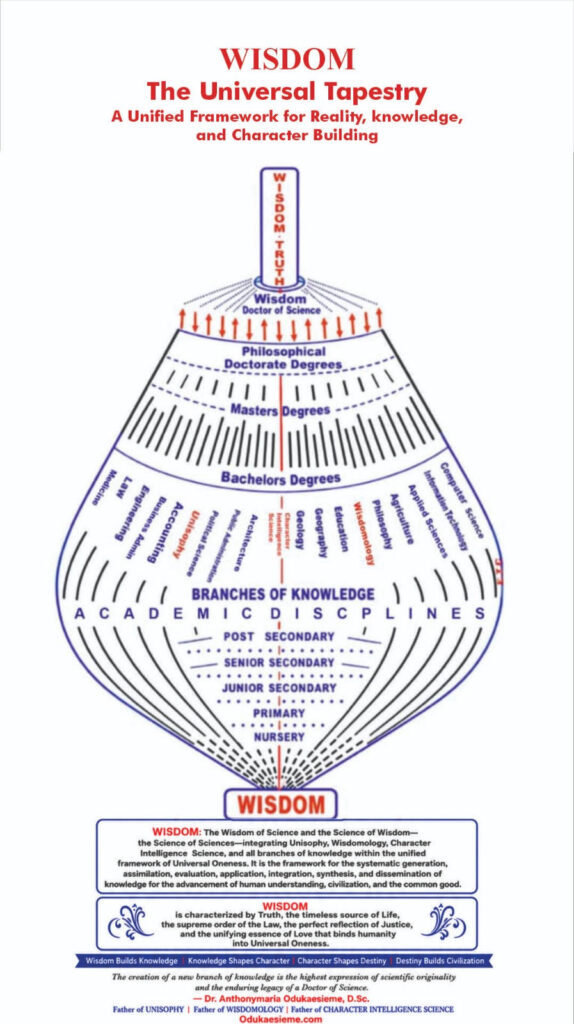
The deeper significance of the work is found in the relationship among these proposed disciplines. Wisdom provides the guiding principle; Unisophy provides the philosophy of interconnectedness; and Character Intelligence Science provides a framework for developing the human capacity to translate knowledge and intelligence into responsible action. Together, they seek to construct an integrated intellectual architecture in which knowledge is not separated from wisdom, intelligence is not separated from character, and human advancement is not separated from responsibility toward others and the wider world.
What makes this contribution particularly important to contemporary civilization is its solution-based orientation. The objective is not to establish disciplines merely for academic classification, but to develop knowledge that can be taught, researched, evaluated, applied, and translated into practical solutions. The intended applications extend across education, human development, governance, leadership, social transformation, environmental responsibility, ethical decision-making, and the advancement of civilization.
The work also represents an attempt to address what Odukaesieme identifies as one of the central weaknesses of modern civilization: humanity has accumulated extraordinary quantities of knowledge and unprecedented technological power without always developing corresponding levels of wisdom, character, and responsibility. The challenge, therefore, is no longer simply to know more, but to know better, think wiser, act responsibly, and use intelligence for the advancement of humanity.
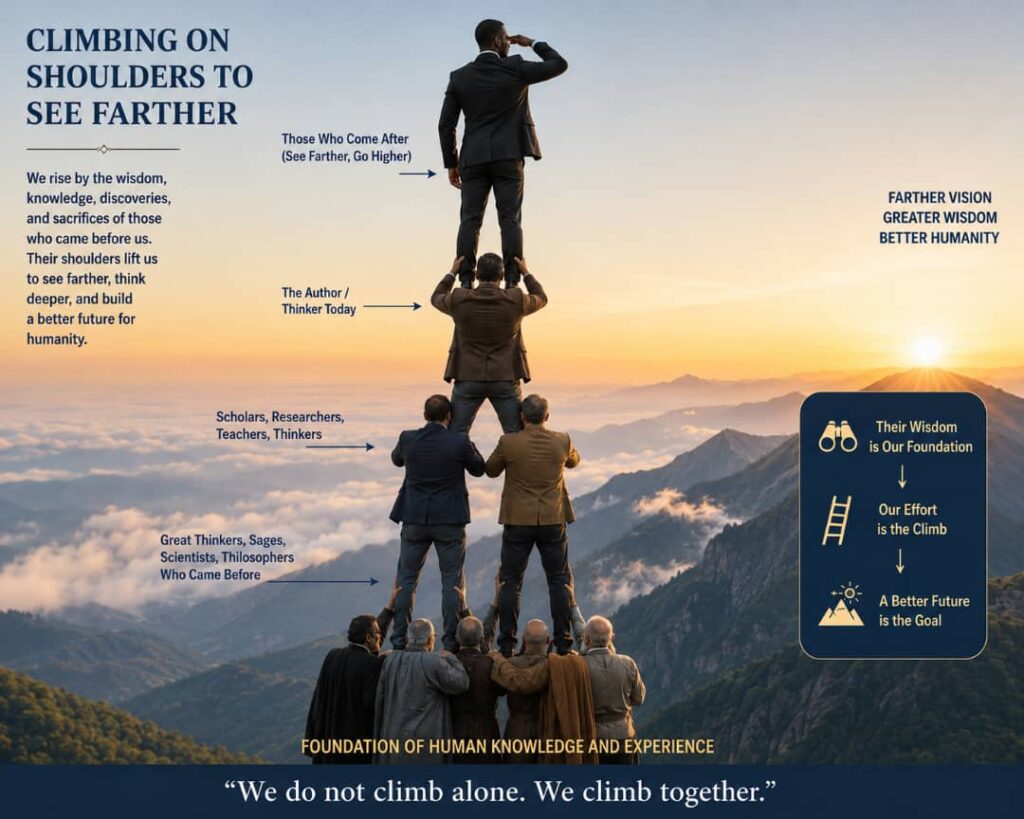
For this reason, the achievement represented by his work is not simply the production of intellectual content. It is the attempt to build new intellectual structures upon which future scholars may research, test, refine, challenge, expand, and develop further knowledge. In the same way that earlier scholars stood on the shoulders of those who came before them, Odukaesieme seeks to make his own intellectual shoulders available to those who will come after him, enabling future generations to see farther still.
If these proposed disciplines withstand rigorous scholarly examination, empirical investigation, critical debate, independent research, and the test of time, their significance may extend far beyond the circumstances of their origin. Their enduring value would lie in opening new areas of inquiry and providing future generations with conceptual tools with which to understand and address problems that existing frameworks may not adequately explain or solve.
It is in this sense—not merely as a claim of personal achievement, but as a claim about the scale, originality, significance, and potential civilizational impact of the intellectual project—that Odukaesieme’s work may ultimately stand as a landmark intellectual contribution to the creation and development of academic disciplines, particularly in the fields of Wisdom, human development, social transformation, ethical leadership, and civilization.
The highest achievement of scholarship is not simply to add another book to the library of humanity, but to open a new door of knowledge through which generations yet unborn can enter, investigate, discover, and see farther.
THE UNEQUALLED AND TIMELESS HUMAN ACHIEVEMENTS IN KNOWN HISTORY
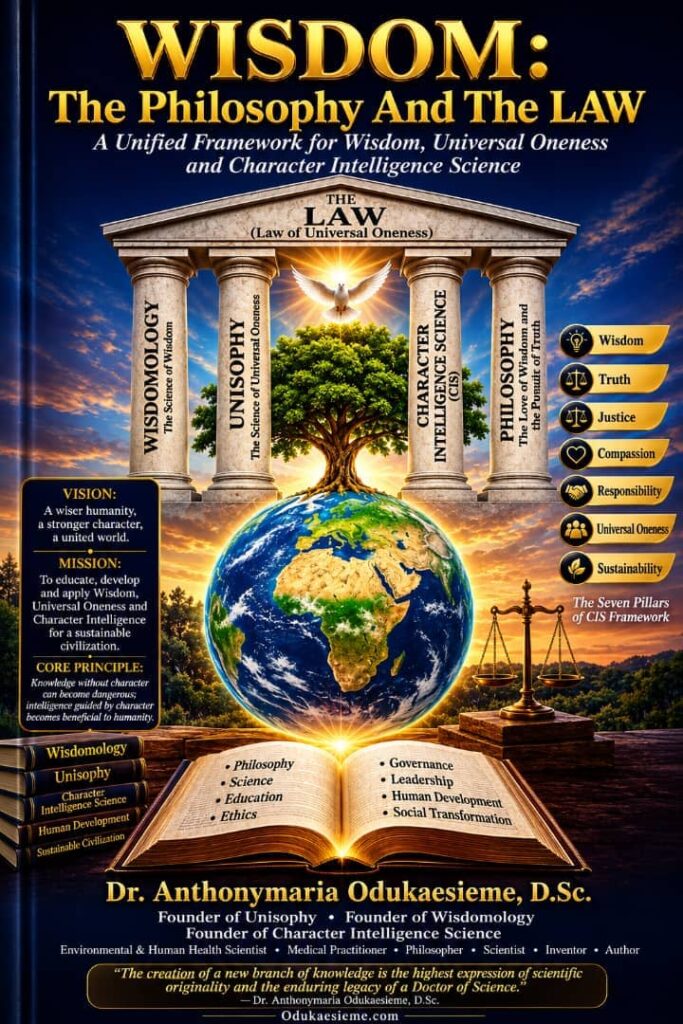
This is what distinguishes Odukaesieme from others: not merely that he created a niche for himself to earn a Doctor of Science, but that he has given all academic disciplines direction toward the Philosophy and Law of Universal Oneness through his multidisciplinary intellectual vision, scientific originality, and integration of knowledge across fields—from the individual and society to humanity, nature, the Cosmos, and the totality of existence.
His enduring achievement lies in establishing a coherent intellectual architecture in which Philosophy, Science, Wisdom, Universal Oneness, Law, Character, Humanity, Nature, and the Cosmos are brought into relationship as instruments for understanding existence and transforming humanity.
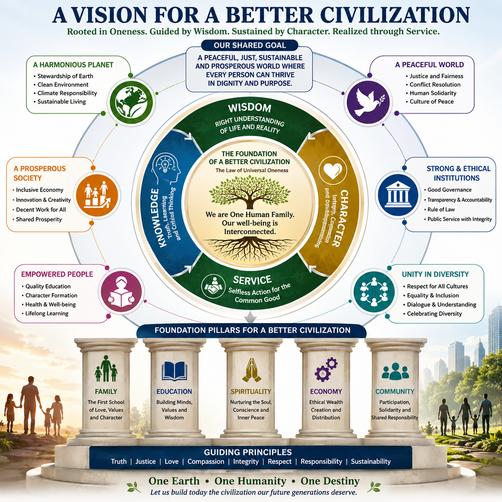
This is his timeless establishment: the creation and development of intellectual frameworks intended not merely to contribute to existing disciplines, but to open new pathways of knowledge, unite previously separated fields, and provide foundations for human development, ethical leadership, social transformation, and a better civilization—within a deeper understanding of humanity’s relationship with nature and the universal order of existence.
The enduring measure of his legacy is therefore not merely the large number of works he has produced, but the new intellectual territory he has established—a territory that seeks to connect knowledge, wisdom, law, character, humanity, nature, and the Cosmos within a unified vision of existence and human advancement.
His scientific inquiry, research, and authorship constitute the foundation of his Doctor of Science achievement. He did not merely acquire knowledge within the conventional structure of a university; he pursued original scientific inquiry, developed new intellectual frameworks, and established knowledge across multiple disciplines.
In this sense, the significance of his D.Sc. lies not merely in the title itself, but in the body of original work behind it. His work transcends the conventional boundaries of university disciplines and seeks to establish new intellectual territories, new fields of knowledge, and new directions for the advancement of humanity.
Thus, he is not merely a recipient of established knowledge; he is a creator and architect of knowledge. The degree does not define the extent of the achievement—the achievement gives substance to the degree.
Dr. Anthonymaria Odukaesieme, D.Sc.
Founder of Unisophy
Founder of Wisdomology
Founder of Character Intelligence Science
Environmental & Human Health Scientist
Medical Practitioner
Philosopher
Scientist
Inventor
Author
“The creation of a new branch of knowledge is the highest expression of scientific originality and the enduring legacy of a Doctor of Science.”
— Dr. Anthonymaria Odukaesieme, D.Sc.