

The structure of Wisdom can be understood as an integrated relationship among the faculties through which human intelligence encounters, processes, evaluates, and applies reality. Wisdom is not a single mental function; it is a higher-order organization of several complementary capacities working together.
At its foundation is perception—the capacity to observe and receive information from reality. Perception provides the initial material from which knowledge can develop. Without accurate perception, the subsequent processes of understanding and judgment may be distorted.
Knowledge forms the informational dimension of Wisdom. It provides the facts, principles, experiences, and accumulated discoveries upon which the mind can reason. Yet knowledge alone does not constitute Wisdom because information must be interpreted within its proper relationships and context.

Understanding provides the relational dimension. It enables intelligence to recognize how different elements connect, why they behave as they do, and what significance those relationships may have. Understanding therefore transforms information from isolated facts into meaningful knowledge.
Experience provides another essential dimension. Through experience, intelligence encounters reality directly, observes consequences, recognizes patterns, and learns from both success and error. Experience becomes particularly valuable when it is subjected to thoughtful reflection.
Reasoning provides the analytical dimension of Wisdom. It enables the mind to compare, evaluate, infer, distinguish, and draw conclusions from what has been perceived, known, and understood.
Reflection provides the capacity for deeper examination. It allows intelligence to reconsider assumptions, examine motives, learn from experience, and evaluate whether conclusions and actions remain consistent with truth and reality.
Discernment provides the selective dimension. It enables intelligence to distinguish between alternatives and identify what is appropriate, necessary, beneficial, or harmful within a given circumstance.
Judgment brings these faculties toward decision. It evaluates what has been understood and determines the most appropriate course of action in relation to purpose, consequence, principle, and circumstance.
Character provides the ethical dimension through which judgment is expressed. It determines whether intelligence and understanding are directed toward responsible and beneficial ends. Thus, Wisdom cannot be fully separated from the quality of the character through which it is manifested.
Action provides the practical expression of the entire structure. What is known, understood, reasoned, reflected upon, discerned, and judged ultimately finds its test in what is done and in the consequences that follow.
The structure of Wisdom is therefore not linear in a rigid sense. These faculties continuously interact with one another. Action produces experience; experience generates reflection; reflection deepens understanding; understanding refines reasoning and discernment; discernment improves judgment; and judgment guides subsequent action.
Wisdom emerges from the coherence of this entire system. Its strength lies not in the perfection of any single faculty, but in their integration into a unified capacity for truthful understanding and responsible action.
In this sense, the structure of Wisdom provides the framework through which intelligence can move from perception of reality to meaningful participation in it.
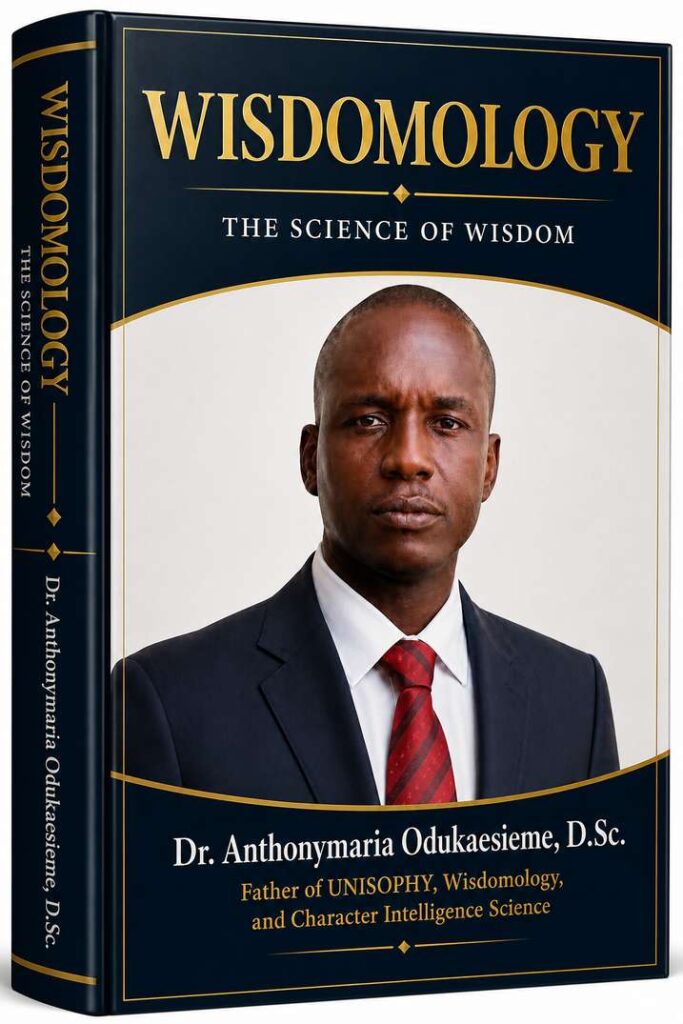
-Dr. Anthonymaria Odukaesieme, D.Sc.
Founder of Unisophy
Founder of Wisdomology
Founder of Character Intelligence Science