

3.1 INTRODUCTION
The examination of Wisdom leads naturally to the examination of Universal Order.
If reality is understood through Oneness, Wholeness, Interconnectedness, and Interdependence, an important question follows: What accounts for the organisation, regularity, relationships, and coherence observed within existence?
This question introduces the concept of Universal Order.
Universal Order refers, within this treatise, to the comprehensive principle of organisation, arrangement, relationships, and lawful regularities through which reality is understood.
The natural universe displays different forms of order. Celestial bodies follow identifiable patterns of motion. Physical processes exhibit regularities investigated by science. Living organisms possess organised structures and biological functions. Ecosystems contain relationships among organisms and their environments.
Human society also requires order. Laws, institutions, ethical principles, responsibilities, and systems of governance contribute to the organisation of collective human life.
These different forms of order are not identical. They operate within different domains and must be examined through appropriate methods.
Within Odukaesieme’s philosophical framework, Wisdom is examined as the coherent intelligence through which the totality of realities is understood in relation to Universal Order.
This chapter investigates the meaning, dimensions, and significance of Universal Order from philosophical, scientific, theological, ecological, cosmological, and ethical perspectives.
3.2 THE MEANING OF UNIVERSAL ORDER
Order generally refers to an arrangement or organisation in which different elements exist or function according to identifiable relationships, structures, principles, or rules.
Universal Order extends this inquiry to the comprehensive organisation and coherence of existence.
The concept raises several fundamental questions:
What makes reality intelligible?
Why do natural phenomena exhibit regularities?
What principles govern the relationships among different realities?
How are order and organisation maintained within natural systems?
What is the relationship between natural laws and the Creator?
How should human beings conduct themselves in relation to the order of existence?
These questions belong to different areas of intellectual inquiry.
Science investigates observable patterns and regularities in the natural world.
Philosophy examines the meaning and foundations of order, causation, existence, and rational explanation.
Theology considers Universal Order in relation to God, creation, divine wisdom, and the purpose of existence.
Ethics examines the principles through which human conduct should be guided.
Universal Order therefore provides a broad framework for examining the organisation of reality while preserving the distinctions among scientific, philosophical, theological, and ethical claims.
3.3 THE PHILOSOPHICAL FOUNDATION OF ORDER
The question of order has occupied an important position in the history of philosophy.
Philosophers have investigated the nature of reality, causation, change, permanence, structure, and the principles through which the world may be understood.
Aristotle’s philosophical investigations into nature and metaphysics included questions concerning causes, principles, substance, and the organisation of reality.
The philosophical significance of order lies in the possibility of understanding relationships and structures rather than treating existence as an unintelligible collection of unrelated events.
An organised reality may be investigated through questions such as:
What are its constituent parts?
How are those parts related?
What principles govern their interactions?
What conditions contribute to the stability or transformation of the system?
What explains the relationship between its individual components and its overall functioning?
These questions demonstrate that order is not simply a matter of appearance. It concerns the underlying organisation and relationships of the realities being examined.
Within this treatise, Universal Order is approached as a comprehensive philosophical concept through which the coherence and organisation of existence may be investigated.
3.4 UNIVERSAL ORDER AND NATURAL LAWS
One of the most important scientific expressions of order is the existence of natural regularities.
Natural sciences investigate recurring patterns and relationships through observation, experimentation, mathematical reasoning, and theoretical explanation.
Physics investigates physical laws and interactions.
Chemistry examines regularities in the behaviour and transformation of matter.
Biology investigates the organisation, functions, and processes of living organisms.
Astronomy examines celestial objects and their movements.
These disciplines identify patterns that allow scientists to explain phenomena and make predictions within defined conditions.
For example, Newton’s law of universal gravitation provided a mathematical description of gravitational attraction between masses. Einstein’s general theory of relativity later provided a more comprehensive framework for understanding gravitation through the geometry of spacetime.
The development of scientific theories demonstrates that explanations of natural phenomena can improve as evidence, observation, and mathematical understanding advance.
It is therefore important to distinguish between natural laws as scientific descriptions of regularities and the theological interpretation of those regularities as expressions of divine order.
Within this treatise, natural laws provide important scientific examples of order, while the ultimate meaning and foundation of Universal Order remain subjects of philosophical and theological inquiry.
3.5 UNIVERSAL ORDER AND THE COSMOS
The cosmos provides an important field for examining large-scale organisation and structure.
The observable universe contains galaxies, stars, planetary systems, interstellar matter, radiation, and other physical phenomena.
These objects and structures exist within identifiable relationships that are investigated by astronomy and cosmology.
The Solar System, for example, contains the Sun and the bodies gravitationally associated with it.
The Earth orbits the Sun, while the Moon orbits the Earth.
The Milky Way contains an immense number of stars and other astronomical objects.
Galaxies themselves occur within larger cosmic structures.
These relationships demonstrate that the universe possesses organisation at different scales.
Cosmology investigates the history, composition, expansion, and large-scale structure of the universe.
Scientific cosmology does not establish every philosophical or theological interpretation of cosmic order. It investigates the physical universe through evidence, mathematical models, and scientific theories.
Nevertheless, the scientific study of the cosmos raises profound philosophical questions about existence, intelligibility, causation, and the nature of reality.
Within Odukaesieme’s framework, the cosmos is examined as part of the wider totality of existence within Universal Order.
3.6 UNIVERSAL ORDER AND THE EARTH
The Earth provides another important illustration of organisation within nature.
It contains interacting physical, chemical, geological, atmospheric, hydrological, and biological systems.
The atmosphere regulates many environmental conditions.
The hydrological cycle involves the movement of water through evaporation, condensation, precipitation, infiltration, and other processes.
Geological processes contribute to the formation and transformation of the Earth’s surface.
Biological processes sustain living organisms and contribute to ecological relationships.
These processes are not isolated from one another.
Changes in one environmental component may influence other components.
For example, changes in atmospheric conditions may affect temperature, rainfall patterns, water availability, agriculture, and ecosystems.
The Earth therefore provides an important context for examining the relationships and organisation of natural processes.
Its systems are dynamic and undergo continuous change.
Universal Order should not be interpreted as meaning that the natural world is free from disturbances, disasters, extinction, or environmental instability.
Rather, it concerns the principles and relationships through which natural processes are organised and understood.
3.7 UNIVERSAL ORDER AND THE ORGANISATION OF LIFE
Living organisms display remarkable forms of organisation.
The human body, for example, contains different biological systems that perform specialised functions.
The nervous system coordinates communication and responses.
The cardiovascular system transports blood and essential substances.
The respiratory system supports gas exchange.
The digestive system processes food and enables nutrient absorption.
The kidneys and urinary system contribute to the regulation of fluids and the removal of waste products.
These systems operate through complex relationships.
Their coordination contributes to the maintenance of life.
At the cellular level, living organisms also display organisation involving genetic information, biochemical processes, membranes, and specialised structures.
Biology investigates these processes through scientific observation and experimentation.
The organisation of living systems provides an important illustration of order within nature.
However, biological organisation should not be confused with the claim that every organism functions perfectly or that disease and biological failure are absent.
Living systems are subject to limitations, environmental pressures, mutations, ageing, and disease.
The scientific examination of life therefore reveals both organisation and vulnerability.
This understanding strengthens the importance of investigating order through evidence and careful reasoning.
3.8 UNIVERSAL ORDER AND ECOLOGICAL BALANCE
Ecological systems display relationships that contribute to the organisation and functioning of the natural environment.
An ecosystem includes living organisms and the physical conditions with which they interact.
Energy flows through food webs, while nutrients are transferred and recycled through biological and physical processes.
Predation, competition, cooperation, decomposition, and other ecological interactions influence the structure and functioning of ecosystems.
The concept of ecological balance is useful in examining relationships and conditions that support ecological functioning.
However, ecological systems are not permanently fixed or perfectly balanced.
They experience disturbances, seasonal changes, succession, population fluctuations, climate variations, and other transformations.
The removal of species, habitat destruction, pollution, and climate change may alter ecological relationships and create serious environmental consequences.
Universal Order, when applied to ecology, must therefore recognise both organisation and change.
The ethical implication is that humanity has a responsibility to understand and protect the environmental systems upon which life depends.
Environmental responsibility is not merely a technical concern. It is also a matter of wisdom, judgement, and character.
3.9 UNIVERSAL ORDER AND THE CREATOR
The theological examination of Universal Order begins with the Christian understanding of God as Creator.
Genesis 1:1 states:
“In the beginning God created the heaven and the earth.”
The biblical account of creation presents God as the originator of the created order.
The distinction between the Creator and creation is fundamental.
The universe is not God, and God is not merely a component within the universe.
Within Christian theology, the created world exists because of God’s creative act.
Psalm 19:1 declares:
“The heavens declare the glory of God; and the firmament sheweth his handywork.”
This passage expresses the theological understanding that creation bears witness to the glory of its Creator.
The examination of Universal Order therefore has an important theological dimension.
It raises questions about the relationship between divine wisdom, creation, natural regularities, and the intelligibility of the universe.
However, scientific descriptions of natural processes and theological explanations of creation should not be confused.
Science investigates how natural phenomena operate through observable evidence and theoretical models.
Theology considers the Creator, divine purpose, revelation, and the ultimate meaning of creation.
Both perspectives can be examined within this treatise while preserving their distinct intellectual methods.
3.10 CHRIST JESUS AND UNIVERSAL ORDER
The Christian theological understanding of Universal Order gives particular attention to Christ Jesus.
John 1:1 declares:
“In the beginning was the Word, and the Word was with God, and the Word was God.”
John 1:3 further states:
“All things were made by him; and without him was not any thing made that was made.”
These passages establish the centrality of the Word in the Christian account of creation.
Colossians 1:16–17 provides another important declaration:
“For by him were all things created, that are in heaven, and that are in earth, visible and invisible, whether they be thrones, or dominions, or principalities, or powers: all things were created by him, and for him:
“And he is before all things, and by him all things consist.”
This passage is especially significant to the theological examination of Universal Order.
It presents Christ as central to creation and to the continued existence of all things.
First Corinthians 1:24 also identifies Christ as:
“the power of God, and the wisdom of God.”
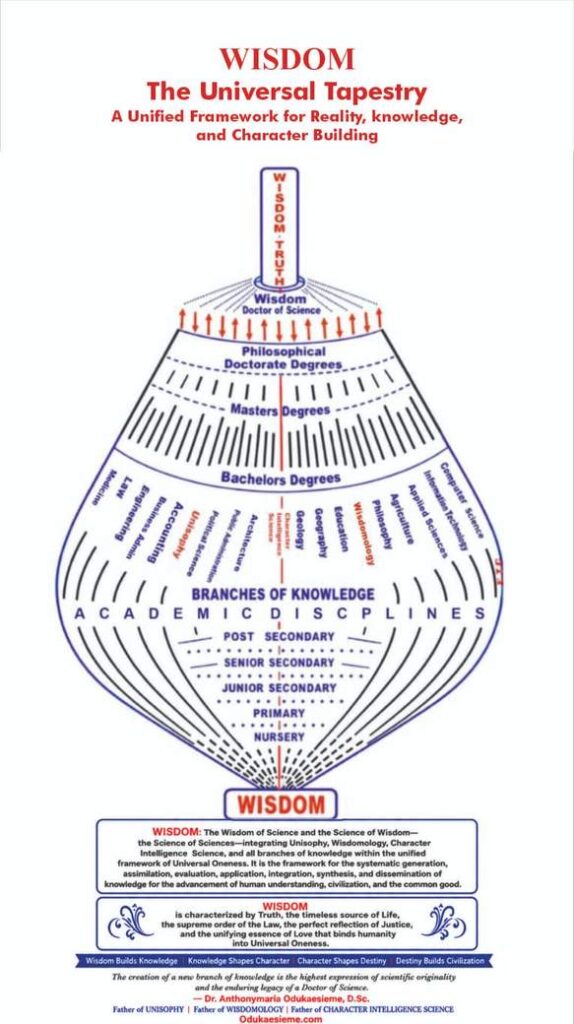
These passages provide a foundation for examining the relationship between Christ, divine Wisdom, creation, and Universal Order.
Within Christian theology, Christ is not merely one element within creation. He is presented as the divine Word through whom all things were created.
The implications of this relationship will be examined in greater detail in subsequent chapters.
3.11 UNIVERSAL ORDER AND DIVINE WISDOM
The relationship between Wisdom and Universal Order is central to the intellectual direction of this treatise.
In ordinary human experience, wisdom involves the ability to recognise relationships, understand circumstances, exercise sound judgement, and act responsibly.
At the theological level, divine Wisdom is understood as belonging to the nature and knowledge of God.
The Bible repeatedly associates Wisdom with creation and divine understanding.
Proverbs 3:19 states:
“The LORD by wisdom hath founded the earth; by understanding hath he established the heavens.”
This passage provides a significant biblical expression of the relationship between divine Wisdom and the created order.
Proverbs 8 also presents Wisdom in poetic and theological language associated with creation.
The interpretation of this passage has been debated across Christian traditions, and it should not be used without qualification to establish a doctrine that the text itself does not explicitly state.
Nevertheless, Proverbs 3:19 provides a clear biblical foundation for examining the relationship between divine Wisdom and the order of creation.
Within Odukaesieme’s framework, Wisdom is examined as the coherent intelligence through which the totality of realities is understood in relation to Universal Order.
The theological examination of divine Wisdom and the philosophical examination of human wisdom are related areas of inquiry, but they must not be treated as identical.
3.12 UNIVERSAL ORDER AND HUMAN INTELLIGENCE
Human intelligence enables people to investigate, understand, and respond to the world around them.
Through observation, reasoning, experimentation, and reflection, humanity has developed scientific knowledge and technological capabilities.
However, intelligence alone does not guarantee Wisdom.
An individual may possess exceptional intellectual ability while lacking honesty, humility, compassion, or sound ethical judgement.
Scientific knowledge can be used to improve human life, but it can also be misapplied.
Political authority can be exercised for public welfare, but it can also be abused.
Economic resources can support development, but they can also be exploited through corruption and injustice.
The relationship between intelligence and Wisdom must therefore include ethical responsibility.
Human intelligence becomes more beneficial when it is guided by Truth, sound judgement, humility, and respect for human dignity.
Within this treatise, Wisdom is examined as a higher integrative framework through which knowledge and intelligence may be evaluated in relation to Universal Order and responsible conduct.
3.13 UNIVERSAL ORDER AND MORAL LAW
The examination of Universal Order extends beyond physical and biological organisation to questions of human conduct.
Human societies require principles that regulate relationships, protect rights, establish responsibilities, and promote justice.
Moral philosophy examines the foundations of right and wrong, virtue, duty, justice, and human responsibility.
Different philosophical traditions have developed different explanations of moral principles.
Christian theology, for example, examines moral responsibility in relation to God, Scripture, conscience, and the teachings of Christ.
The existence of legal systems also demonstrates the importance of rules and institutions in organising human society.
However, legal rules and moral principles are not always identical.
An action may be legally permitted but ethically questionable. Conversely, moral convictions may motivate individuals to challenge unjust laws.
The examination of Universal Order must therefore distinguish between natural regularities, moral principles, and human legal systems.
Within Odukaesieme’s framework, ethical order requires the alignment of human conduct with Truth, justice, responsibility, and the proper recognition of the dignity of others.
This provides an important connection between Wisdom and the development of exemplary character.
3.14 UNIVERSAL ORDER AND THE LAW OF CHARACTER-BASED ETHICAL EFFICIENCY
The organisation of human society depends not only upon laws, institutions, and material resources but also upon the character of the individuals who operate them.
Corruption, dishonesty, negligence, fraud, and abuse of authority can undermine institutional performance and economic efficiency.
Conversely, honesty, accountability, diligence, fairness, and responsible leadership can strengthen public trust and institutional effectiveness.
Within Odukaesieme’s intellectual framework, the Law of Character-Based Economic Efficiency is proposed as a conceptual principle for examining the relationship between ethical character and economic performance.
The proposition is that economic efficiency should not be evaluated exclusively through financial output, production, or the use of resources.
It should also consider the ethical conduct of the individuals and institutions responsible for economic activity.
A conceptual expression may be presented as:
ECONOMIC EFFICIENCY = f(RESOURCES, MANAGEMENT, PRODUCTIVITY, CHARACTER, ETHICAL INTELLIGENCE, ACCOUNTABILITY)
This expression is a proposed conceptual model, not an experimentally established universal law.
Its purpose is to emphasise that the quality of human character may influence the responsible management of resources and the performance of institutions.
The proposition requires further theoretical development and empirical investigation before any claim of universal scientific validity can be made.
Nevertheless, it provides an important example of how Wisdom and character may be examined in relation to human systems and economic order.
3.15 UNIVERSAL ORDER AND SOCIAL RESPONSIBILITY
Human beings participate in different social systems.
Families, educational institutions, religious communities, businesses, professional organisations, governments, and international institutions all depend upon relationships and responsibilities.
The proper functioning of these institutions requires more than formal structures.
It requires integrity, competence, fairness, accountability, and responsible leadership.
Where corruption becomes widespread, public resources may be misused and institutional trust may decline.
Where injustice is tolerated, social relationships may become unstable.
Where education is neglected, opportunities for intellectual and human development may be reduced.
Where environmental responsibilities are ignored, the consequences may affect present and future generations.
Universal Order therefore has important implications for social responsibility.
Human beings must recognise that their decisions and actions may influence others and the wider conditions of collective existence.
Wisdom requires that individual interests be considered alongside justice, public welfare, and the long-term consequences of human conduct.
3.16 UNIVERSAL ORDER AND THE PRINCIPLE OF HUMILITY
Humility is an important value in the responsible pursuit of Wisdom.
The complexity of existence should encourage intellectual modesty.
No individual possesses complete knowledge of every subject, and no single discipline provides every explanation required for understanding reality.
Scientific knowledge develops through investigation, criticism, and revision.
Philosophical knowledge develops through reasoning, debate, and conceptual clarification.
Human institutions also require the humility to acknowledge errors and correct failures.
Humility is therefore not intellectual weakness.
It is the recognition that knowledge has limits and that learning requires openness to evidence, correction, and the contributions of others.
Within Odukaesieme’s 3H framework, Humility is especially important because it encourages the individual to recognise the proper place of knowledge, authority, and personal ability.
The recognition of Universal Order should therefore inspire humility rather than arrogance.
3.17 UNIVERSAL ORDER AND THE DEVELOPMENT OF CIVILISATION
Civilisation involves the organisation of human life through institutions, knowledge, technology, culture, values, and systems of cooperation.
The advancement of civilisation cannot be measured only by technological development or economic prosperity.
It must also be examined through the ethical quality of human relationships and institutions.
A society may possess advanced technology but experience serious moral and institutional failures.
A nation may possess natural resources but suffer from corruption and poor governance.
A community may have material wealth but lack justice, compassion, and respect for human dignity.
The development of civilisation therefore requires the integration of knowledge, Wisdom, and character.
Within Odukaesieme’s philosophical framework, Universal Order provides a basis for examining civilisation in relation to Truth, ethical responsibility, human dignity, and the wider conditions of existence.
The objective is not merely to organise society efficiently but to encourage a form of development that is intellectually sound, ethically responsible, and beneficial to humanity.
3.18 WISDOM AS THE INTEGRATING PRINCIPLE OF UNIVERSAL ORDER
The central argument of this chapter is that Wisdom must be examined in relation to the order and relationships of existence.
Knowledge identifies facts, processes, and principles.
Understanding examines their meanings and relationships.
Wisdom evaluates their significance and guides their responsible application.
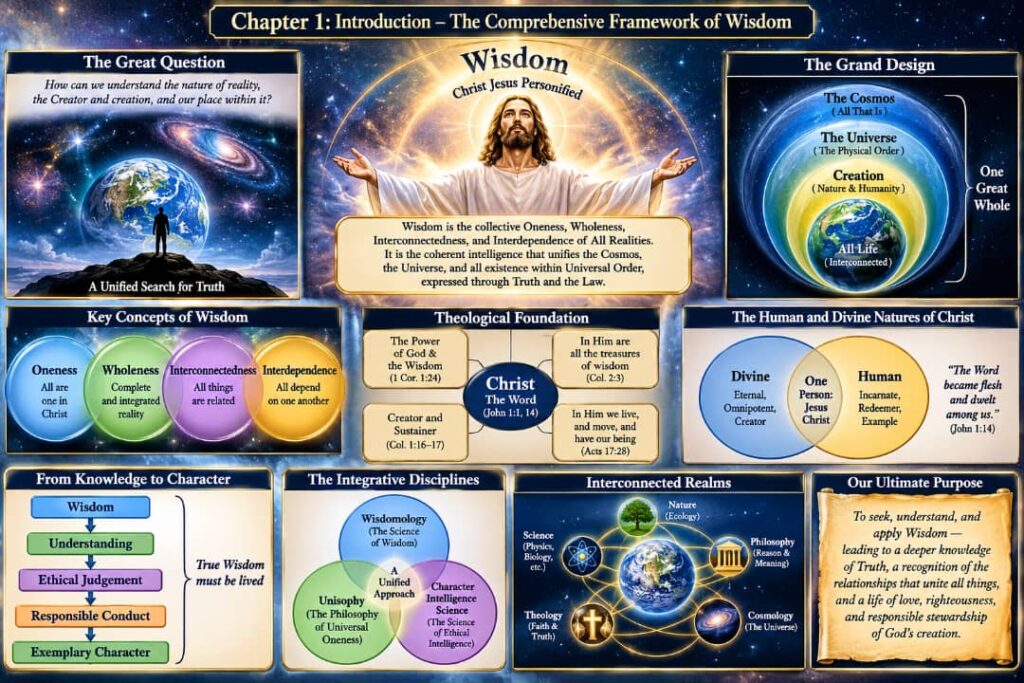
This relationship may be expressed conceptually as follows:
KNOWLEDGE
The acquisition of information, facts, and explanations.
UNDERSTANDING
The recognition of meaning, relationships, and implications.
WISDOM
The coherent integration of understanding, Truth, sound judgement, and responsible conduct.
UNIVERSAL ORDER
The wider framework of organisation, relationships, and regularities within which existence is examined.
Within this framework, Wisdom does not replace the specialised knowledge of the sciences or the methods of philosophical and theological inquiry.
Rather, it provides an integrative perspective for examining knowledge and human conduct in relation to the totality of reality.
This is the intellectual significance of Wisdom as a framework for understanding Universal Order.
3.19 CONCLUSION
Universal Order is a fundamental concept in the comprehensive examination of Wisdom.
It concerns the organisation, relationships, regularities, and coherence through which existence may be understood.
The chapter has examined Universal Order in relation to philosophy, natural laws, the cosmos, the Earth, biological systems, ecology, the Creator, Christ Jesus, divine Wisdom, human intelligence, moral responsibility, economic efficiency, and civilisation.
The scientific perspective demonstrates that different natural processes display identifiable patterns and relationships that can be investigated through appropriate methods.
The philosophical perspective examines the meaning and foundations of order, organisation, and coherence.
The Christian theological perspective examines the Creator as the origin of creation and Christ Jesus as the divine Word through whom all things were created.
The ethical perspective establishes the importance of aligning human conduct with Truth, justice, humility, honesty, responsibility, and respect for human dignity.
Within Odukaesieme’s framework, Wisdom is examined as the coherent intelligence that unifies Creation, the Cosmos, the Universe, and all existence within Universal Order.
Universal Order is therefore not merely an abstract concept. It provides a comprehensive field of inquiry into the relationships between existence, knowledge, divine Wisdom, and human responsibility.
The next chapter proceeds to examine Christ Jesus as Wisdom personified within Christian theology.
REFERENCES
The Holy Bible, King James Version.
Aristotle. (1998). Metaphysics (H. Lawson-Tancred, Trans.). Penguin Classics.
Einstein, A. (1916). Die Grundlage der allgemeinen Relativitätstheorie. Annalen der Physik, 354(7), 769–822.
Newton, I. (1999). The Principia: Mathematical Principles of Natural Philosophy (I. B. Cohen & A. Whitman, Trans.). University of California Press.
Odum, E. P., & Barrett, G. W. (2005). Fundamentals of Ecology (5th ed.). Thomson Brooks/Cole.
Tansley, A. G. (1935). The use and abuse of vegetational concepts and terms. Ecology, 16(3), 284–307.
Bertalanffy, L. von. (1968). General System Theory: Foundations, Development, Applications. George Braziller.
Kuhn, T. S. (2012). The Structure of Scientific Revolutions (4th ed.). University of Chicago Press.
DEFINITION OF WISDOM
Wisdom is the collective Oneness, Wholeness, Interconnectedness, and Interdependence of All Realities. It is the coherent intelligence that unifies Creation, the Cosmos, the Universe, and all existence within Universal Order, expressed through Truth and the Law established by the Creator.
— ODUKAESIEME
www.odukaesieme.com