

Wisdom and character are inseparable dimensions of a truly developed human being. Wisdom provides the understanding and direction required for right living, while character provides the inner structure through which that Wisdom is expressed consistently in thought, decision, conduct, and action.
A person may know what is right without possessing the character to do what is right. Knowledge may reveal the truth, understanding may explain it, discernment may recognise it, and judgment may choose it; but character determines whether the choice becomes a consistent way of life.
Wisdom therefore must become character.
Character is the enduring pattern of qualities, principles, values, attitudes, habits, and choices through which a person expresses who they are. It is revealed not merely by what a person says they believe, but by what they repeatedly do, especially when doing what is right becomes difficult.
For this reason, character is one of the clearest manifestations of Wisdom.
Wisdom without character can remain intellectual.
Character without Wisdom can become misguided.
But Wisdom united with character produces responsible and purposeful action.
The relationship may therefore be expressed as:
- Wisdom knows what is right.
- Character chooses what is right.
- Discipline sustains what is right.
- Action demonstrates what is right.
This reveals why Wisdom cannot be separated from moral development. The purpose of Wisdom is not simply to make a person intellectually superior. It is to make the person capable of living responsibly within the order of existence.
Character transforms Wisdom from an idea into a way of life.
The wise person therefore does not merely accumulate principles. The wise person embodies them.
Truth becomes honesty.
Justice becomes fairness.
Compassion becomes service.
Responsibility becomes accountability.
Humility becomes openness to learning.
Courage becomes the strength to stand for what is right.
Discipline becomes the ability to remain faithful to purpose.
Love becomes the commitment to the wellbeing of others and the whole.
In this way, character gives practical expression to Wisdom.
Character is also formed through repetition. A single good action may demonstrate a good choice, but consistent good action develops a pattern. That pattern becomes a habit, and repeated habits become part of character.
Wisdom therefore requires practice.
It is not enough to understand the value of honesty; one must practise honesty. It is not enough to understand justice; one must act justly. It is not enough to admire compassion; one must become compassionate. It is not enough to know the importance of responsibility; one must accept responsibility.
This is where Wisdom enters human development.
Character is built through choices.
Every decision becomes an opportunity to strengthen or weaken character. Every challenge provides an opportunity to practise virtue. Every temptation provides an opportunity to exercise self-control. Every difficulty provides an opportunity to demonstrate perseverance.
Thus, character is not formed only in moments of comfort. It is often revealed and strengthened in moments of difficulty.
Wisdom understands that hardship can become an instrument of character formation when it is approached with understanding, discipline, patience, courage, and hope.
Character also determines how intelligence is used.
The same intelligence can be used to heal or to harm, to build or to destroy, to serve or to exploit. The difference lies substantially in the character governing the intelligence.
This principle is especially important in an age of advanced science and technology. Human beings now possess extraordinary capacities to influence life and society. Yet greater capability without corresponding character can increase the potential for harm.
Therefore, the development of human intelligence must be accompanied by the development of character.
The highest civilization is not merely one that produces intelligent people. It is one that produces intelligent people of good character.
This is why Wisdom and Character Intelligence Science are deeply related. If intelligence represents the capacity to understand, reason, solve, and create, character represents the quality and direction through which those capacities are expressed.
Wisdom integrates the two.
It teaches that intelligence must serve truth, knowledge must serve humanity, power must serve responsibility, and freedom must serve the good.
Character also establishes trust.
A person may possess great knowledge, but without character others may not be able to trust how that knowledge will be used. Character creates reliability because it establishes consistency between values, words, decisions, and actions.
A trustworthy person is not merely someone who knows what trust means. A trustworthy person repeatedly acts in ways that deserve trust.
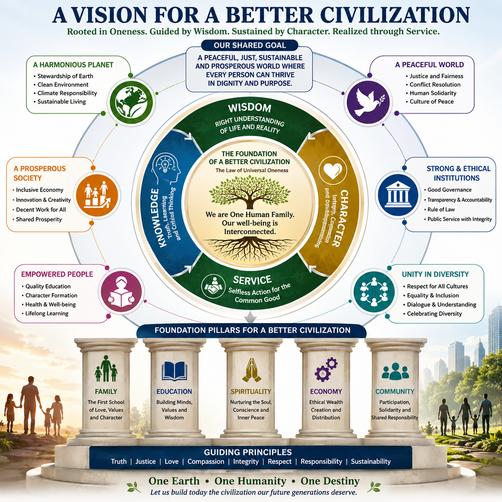
Thus, character is Wisdom made visible through conduct.
The deepest expression of Wisdom is therefore not found merely in what a person can explain, but in what that person consistently embodies.
Wisdom becomes character.
Character becomes conduct.
Conduct becomes influence.
Influence shapes society.
Society shapes civilization.
Civilization reflects the collective character and Wisdom of humanity.
This progression demonstrates why the development of Wisdom is not merely a personal matter. It is a civilizational necessity.
A society may possess advanced technology, sophisticated institutions, powerful economies, and extensive knowledge, but if its collective character is weak, its achievements may become instruments of instability and destruction.
Wisdom therefore calls humanity toward the integration of knowledge, character, responsibility, and action.
The wise person does not ask only, “What do I know?”
The wise person also asks, “Who am I becoming through what I know?”
This is the deeper relationship between Wisdom and Character.
Wisdom gives character direction.
Character gives Wisdom embodiment.
Together they form a foundation for responsible human existence.
The highest expression of Wisdom is therefore not merely to know the good, understand the good, or recognise the good. It is to become a person through whom the good can consistently be expressed.
Wisdom is character illuminated by understanding, governed by truth, and demonstrated through action.
-Dr. Anthonymaria Odukaesieme, D.Sc.
Founder of Unisophy
Founder of Wisdomology
Founder of Character Intelligence Science