

Wisdom is the skill, the lens, and the Universal Order through which the realities, interconnectedness, harmony, and totality of existence are perceived, understood, coordinated, and expressed. Human Wisdom reaches its broader philosophical expression in the recognition of Universal Oneness. As human Wisdom seeks to understand reality more deeply, its inquiry naturally extends toward the relationships that connect the different dimensions of existence. The deeper human understanding of reality becomes, the more clearly the interconnectedness of existence is revealed.
Universal Oneness is the recognition that existence is not merely a collection of isolated entities, but a unified reality of relationships in which every part participates within a greater whole.
Oneness does not mean sameness.
Diversity remains real.
Individuality remains meaningful.
Different beings, systems, forms, functions, and expressions exist with their own distinct characteristics. Yet distinction does not necessarily mean separation. The existence of differences can itself occur within a larger unity.
Wisdom therefore recognises both diversity and unity.
The human being is an individual, yet no individual exists independently of relationships. A person is connected to family, community, society, nature, history, knowledge, and the larger conditions that sustain life.
The same principle extends beyond humanity.
Life exists through relationships.
Nature operates through relationships.
Human civilization operates through relationships.
The universe itself reveals relationships among matter, energy, space, time, and the forces through which existence is ordered.
Wisdom therefore perceives relationship as one of the fundamental features of reality.
When the mind sees only isolated parts, it may misunderstand the whole. An action that appears beneficial from one perspective may produce harm elsewhere. A decision that benefits one individual may disadvantage a community. An intervention that solves one problem may create another.
Wisdom therefore asks the broader question:
How does this affect the whole?
This question represents a significant development in human intelligence. It moves thought beyond immediate personal interest toward relational and systemic understanding.
Universal Oneness consequently establishes a foundation for responsibility.
If human beings are interconnected, then the wellbeing of one cannot be understood entirely apart from the wellbeing of others.
Justice becomes more than individual fairness.
Compassion becomes more than personal kindness.
Responsibility becomes more than personal accountability.
They become expressions of awareness that individual existence participates within a larger whole.
This principle also transforms the meaning of human freedom.
Freedom is not simply the ability to do whatever one desires. True freedom must operate with awareness of consequence and relationship. The freedom to act does not remove responsibility for what one’s actions produce.
Wisdom therefore unites freedom with responsibility.
The same principle applies to power.
Power without awareness of Oneness can become domination. Power guided by the recognition of interconnectedness becomes service.
Knowledge can likewise be used for personal advantage or for the advancement of humanity. Wisdom directs knowledge toward the latter by recognising that knowledge carries responsibility.
Universal Oneness therefore provides an ethical dimension to Wisdom.
The wise person does not ask only:
“What is good for me?”
The wise person asks:
“What is good for me, what is good for others, and what is good for the whole?”
This does not require the destruction of legitimate individual interests. Rather, it seeks an order in which individual wellbeing and collective wellbeing are understood as related rather than inherently opposed.
Oneness also provides a deeper foundation for peace.
Conflict frequently emerges when individuals or groups define themselves primarily through separation and opposition. When the identity of the other is reduced to an enemy, the possibility of understanding becomes diminished.
Wisdom does not deny legitimate differences or injustices. Instead, it seeks to resolve differences through truth, justice, understanding, compassion, and recognition of shared humanity.
The recognition of Oneness therefore does not mean accepting everything indiscriminately. Wisdom still requires discernment and judgment.
To recognise that all humanity belongs to one interconnected reality does not mean that every action is equally good. Wisdom must still distinguish truth from falsehood, justice from injustice, and constructive action from destructive action.
Oneness provides the context.
Truth provides the foundation.
Discernment provides distinction.
Judgment provides direction.
Character provides embodiment.
Action provides expression.
Wisdom integrates the whole.
This is why Universal Oneness is not merely a philosophical idea. It has practical implications for human civilization.
A civilization guided by Oneness seeks cooperation rather than unnecessary division, responsibility rather than exploitation, justice rather than domination, and sustainable relationship rather than reckless consumption.
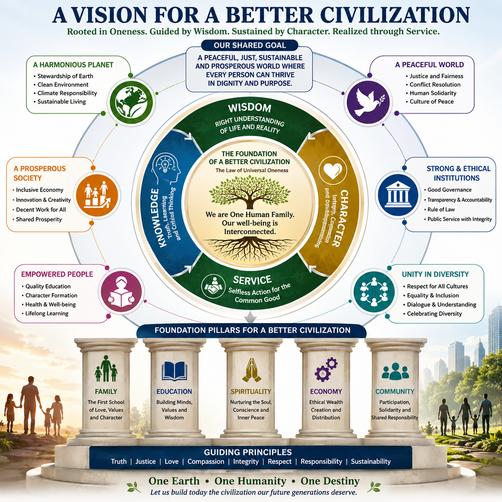
It recognises that humanity shares one planet, one interconnected environment, and a common future.
The recognition of Oneness therefore expands the moral horizon of humanity.
The individual becomes conscious of the family.
The family becomes conscious of the community.
The community becomes conscious of society.
Society becomes conscious of humanity.
Humanity becomes conscious of creation.
Creation is understood as an interconnected whole.
At this level, Wisdom becomes increasingly universal in its orientation.
It no longer asks merely how an individual can live successfully. It asks how human beings can live rightly within the totality of existence.
This is the foundation upon which Unisophy develops its central philosophical principle: Universal Oneness.
Unisophy, as a philosophy of Universal Oneness, seeks to understand the unity underlying the diversity of existence and the principles necessary for harmonious participation within that unity.
Wisdom is therefore the intellectual and practical capacity to recognise Oneness, understand its implications, and live accordingly.
The deeper the recognition of Oneness becomes, the more important the question of Law becomes.
If existence is interconnected, and if relationships within that interconnectedness are governed by order, then there are principles through which that order operates.
Wisdom therefore moves naturally from the recognition of Universal Oneness toward the understanding of the Law that governs Oneness.
The next chapter consequently examines:
Wisdom And The Law That Governs Oneness.
Wisdom is the consciousness of the whole.
Universal Oneness is the recognition of the whole.
And the Law governing Oneness is the principle through which the relationships of the whole are ordered.
-Dr. Anthonymaria Odukaesieme, D.Sc.
Founder of Unisophy
Founder of Wisdomology
Founder of Character Intelligence Science