

Judgment is the capacity to arrive at a reasoned and responsible conclusion concerning what ought to be believed, chosen, or done. It is one of the highest practical expressions of human intelligence because it transforms knowledge, understanding, and discernment into a definite course of action.
Knowledge provides information.
Understanding reveals meaning.
Discernment distinguishes.
Judgment decides.
Wisdom governs the decision.
Judgment therefore occupies a critical position within the architecture of Wisdom. Without judgment, knowledge may remain theoretical, understanding may remain contemplative, and discernment may remain incomplete. Judgment brings insight into decision and decision into responsibility.
To judge wisely is not simply to make a decision. It is to make the right decision for the right reasons, in the right circumstances, with awareness of its consequences.
This requires more than intelligence.
A person may be highly intelligent and still make poor judgments. Intelligence can identify possibilities, calculate advantages, and analyse alternatives, but judgment requires the ability to determine which possibility is most appropriate in relation to truth, values, circumstances, and consequences.
Wisdom therefore gives judgment its governing principle.
Good judgment begins with a truthful understanding of reality. If the facts are false or incomplete, judgment may be distorted from the beginning. For this reason, Wisdom does not rush to judgment. It seeks sufficient knowledge, listens carefully, examines evidence, considers circumstances, and distinguishes appearance from reality.
Judgment also requires discernment.
Not every fact has equal importance. Not every argument deserves equal weight. Not every consequence is immediate or visible. Discernment enables the mind to identify what is essential and what is secondary, what is temporary and what is lasting, and what may benefit the individual while harming the whole.
Thus, wise judgment is the fruit of disciplined discernment.
Judgment is also inseparable from responsibility.
Every meaningful decision carries consequences. Some consequences affect only the individual; others extend to families, communities, institutions, nations, and future generations.
The wise person therefore asks not only, “What do I want?” but also, “What will this decision produce?”
This distinction separates Wisdom from impulse.
Impulse seeks immediate satisfaction.
Judgment considers consequences.
Wisdom considers consequences within the larger order of truth and the wellbeing of the whole.
The quality of judgment is therefore revealed not merely by the outcome of a decision but by the principles, knowledge, understanding, and responsibility that guided the decision.
Wise judgment requires balance.
It must balance individual interest with collective wellbeing, immediate needs with long-term consequences, freedom with responsibility, firmness with compassion, justice with mercy, and ambition with humility.
This does not mean that every decision must produce perfect equality between competing interests. Rather, it means that judgment must recognise the relationships among those interests and seek the most truthful and responsible resolution.
Judgment also requires courage.
Sometimes the right decision is not the easiest decision. Sometimes truth requires rejecting popularity, convenience, personal advantage, or immediate reward.
A person may know what is right and still fail to choose it.
Therefore, Wisdom requires not only the ability to recognise the right course but also the character to follow it.
This establishes a profound relationship between Wisdom and character.
Knowledge may inform judgment.
Understanding may deepen judgment.
Discernment may refine judgment.
But character gives judgment the strength to become action.
A judgment that is never acted upon remains incomplete.
For this reason, Wisdom is ultimately practical. It is not satisfied with knowing what is right. It seeks to bring what is right into reality.
Judgment is particularly important in leadership. Every leader makes decisions that affect other people. The greater the authority of a person, the greater the consequences of that person’s judgment.
Leadership without Wisdom can turn authority into domination.
Leadership guided by Wisdom transforms authority into responsibility and service.
The same principle applies to science, medicine, education, law, business, technology, religion, and every institution through which human beings exercise influence.
The greater the power of decision, the greater the need for wise judgment.
Judgment must also remain open to correction. Wisdom does not equate certainty with infallibility. A wise person recognises that new knowledge, deeper understanding, or previously unseen consequences may require a decision to be reconsidered.
The willingness to correct an error is therefore not weakness. It is evidence of intellectual humility and commitment to truth.
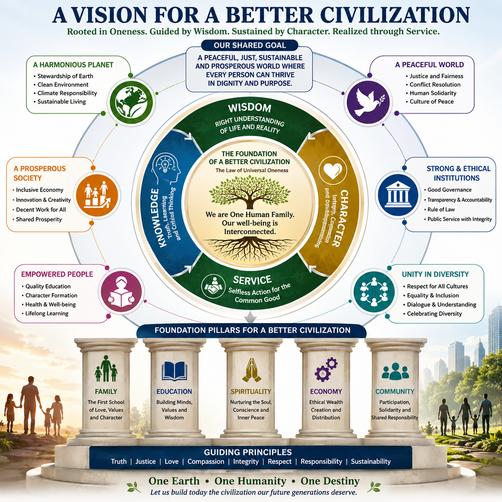
The architecture of wise judgment may therefore be expressed as:
Knowledge establishes the facts.
Understanding reveals their meaning.
Discernment evaluates their significance.
Judgment determines the appropriate choice.
Character provides the courage to uphold it.
Action brings it into reality.
Wisdom governs the entire process.
Thus, judgment is the decision-making expression of Wisdom.
It is where the mind moves from contemplation to commitment, from possibility to choice, and from thought to action.
The highest judgment is therefore not the judgment that merely produces success. It is the judgment that produces what is right, responsible, truthful, and harmonious with the larger order of existence.
Wisdom teaches humanity that the greatest decision is not always the one that gives the greatest immediate advantage. It is the one that best preserves truth, character, justice, harmony, and the wellbeing of the whole.
Judgment therefore becomes one of the principal instruments through which Wisdom governs human life.
And when judgment is guided by Wisdom, intelligence becomes responsible, knowledge becomes purposeful, discernment becomes decisive, and action becomes an expression of truth.
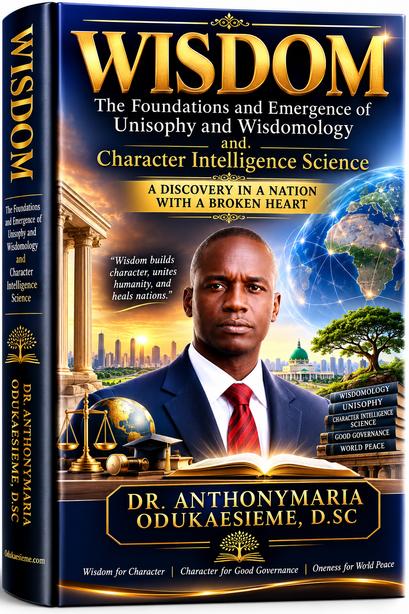
-Dr. Anthonymaria Odukaesieme, D.Sc.
Founder of Unisophy
Founder of Wisdomology
Founder of Character Intelligence Science