

The journey through Wisdom has revealed that Wisdom is far greater than the possession of knowledge or the exercise of intelligence. Wisdom is a comprehensive principle through which human beings learn to perceive reality, understand its relationships, distinguish what is true and meaningful, judge responsibly, form character, act rightly, and participate consciously within the larger order of existence.
Wisdom is therefore the root of understanding.
Understanding grows from the ability to perceive relationships, meanings, principles, causes, consequences, and the order connecting things together. Wisdom provides the deeper orientation through which these relationships become coherent.
Knowledge tells us what we know.
Understanding tells us what it means.
Wisdom tells us how that understanding should guide life.
This is why Wisdom stands at the foundation of the architecture developed throughout this work.
Wisdom relates to intelligence because it gives intelligence direction.
Wisdom relates to knowledge because it gives knowledge purpose.
Wisdom relates to understanding because it integrates meaning.
Wisdom relates to discernment because it distinguishes what matters.
Wisdom relates to judgment because it guides choice.
Wisdom relates to character because it becomes embodied in conduct.
Wisdom relates to action because it transforms understanding into reality.
Wisdom relates to truth because truth provides its foundation.
Wisdom relates to Universal Oneness because it recognises the interconnectedness of existence.
Wisdom relates to Law because it perceives and participates in the order governing that interconnectedness.
Wisdom relates to Love because Love gives relationship its humane expression.
Wisdom relates to harmony because harmony expresses the proper ordering of relationships.
Wisdom relates to civilization because civilization is shaped by the collective intelligence, character, choices, and actions of humanity.
Thus, Wisdom is not an isolated quality.
It is an integrating principle.
It brings the dimensions of human existence into meaningful relationship.
The deepest lesson of Wisdom is that nothing important should be understood entirely in isolation.
Knowledge without understanding can become fragmented.
Understanding without discernment can become confused.
Discernment without judgment can remain incomplete.
Judgment without character can fail in action.
Action without truth can become destructive.
Power without responsibility can become dangerous.
Intelligence without Wisdom can become directionless.
Wisdom brings these dimensions into proper relationship.
This is why Wisdom can be regarded as the highest expression of intelligence.
The highest intelligence is not simply the ability to accumulate information, solve problems, or produce sophisticated ideas.
It is the ability to understand what matters, perceive relationships, recognise truth, anticipate consequences, choose responsibly, and act in harmony with the whole.
Wisdom is intelligence that has attained direction.
It is knowledge that has attained understanding.
It is understanding that has attained discernment.
It is discernment that has attained judgment.
It is judgment that has become character.
It is character that has become action.
And it is action that has become a force for harmony.
At the level of human civilization, this understanding becomes even more important.
Humanity has accumulated extraordinary knowledge and unprecedented technological capability. The central challenge is no longer simply whether humanity can acquire more knowledge or develop more powerful technologies.
The deeper question is whether humanity can develop sufficient Wisdom to govern what it knows and what it can do.
The future of civilization therefore depends upon the relationship between intelligence and Wisdom.
Knowledge must be governed by responsibility.
Technology must be governed by judgment.
Power must be governed by character.
Freedom must be governed by responsibility.
Progress must be governed by Wisdom.
Human civilization must therefore become not only more intelligent, but wiser.
This is the deeper purpose of Wisdomology: the Science of Wisdom.
Wisdomology seeks to understand Wisdom systematically so that Wisdom may be cultivated, taught, developed, applied, and integrated into human life and civilization.
Its ultimate purpose is not merely academic.
It is transformative.
It seeks the transformation of knowledge into understanding, intelligence into responsibility, character into conduct, and human capability into constructive service.
This is also where Wisdomology meets Unisophy.
Unisophy recognises Universal Oneness.
Wisdomology studies Wisdom.
The Law expresses the order governing Oneness.
Character Intelligence Science develops the capacity to align intelligence with character and responsible action.
Together, these ideas form an integrated vision of human development.
Wisdom is the root.
Understanding is one of its principal expressions.
Knowledge is one of its instruments.
Intelligence is one of its capacities.
Character is one of its embodiments.
Action is one of its manifestations.
Truth is its foundation.
Love is its humane expression.
Harmony is its relational outcome.
Universal Oneness is its broader context.
The Law is the order through which that Oneness is governed.
The totality of creation is the reality within which Wisdom operates.
This integrated understanding brings the work back to its central proposition:
Wisdom is not merely something humanity seeks to possess.
Wisdom is something humanity must learn to become.
To become wise is to become increasingly capable of seeing beyond appearances, understanding beyond information, distinguishing beyond preference, judging beyond impulse, acting beyond self-interest, and living beyond isolation.
Wisdom enlarges consciousness.
It deepens responsibility.
It strengthens character.
It refines intelligence.
It expands understanding.
It harmonises action with truth.
The wise person therefore does not merely ask:
“What do I know?”
The wise person asks:
“What does my knowledge mean?”
“What is true?”
“What is right?”
“What should I do?”
“Who will be affected?”
“What will this produce?”
“How does this relate to the whole?”
These questions represent the movement from ordinary intelligence toward Wisdom.
The ultimate measure of Wisdom is therefore not the quantity of knowledge possessed, but the quality of understanding and action produced by that knowledge.
Wisdom is knowledge enlightened by understanding.
Wisdom is understanding refined by discernment.
Wisdom is discernment directed by truth.
Wisdom is judgment strengthened by character.
Wisdom is character expressed through responsible action.
Wisdom is the conscious alignment of human intelligence with the order of existence.
And because Wisdom is the root of understanding, the pursuit of Wisdom is ultimately the pursuit of a deeper understanding of ourselves, one another, creation, Universal Oneness, and the realities within which all existence participates.
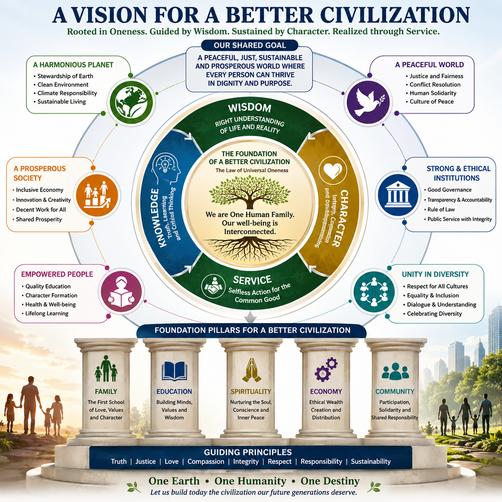
The Philosophy And The Law therefore converge in Wisdom.
The Philosophy seeks to understand.
The Law reveals order.
Wisdom integrates understanding and order into conscious and responsible living.
Thus, the highest expression of Wisdom is not domination over existence, but harmonious participation within it.
Humanity’s greatest achievement will not be the accumulation of unlimited knowledge, the possession of unlimited power, or the creation of unlimited technology.
It will be the attainment of sufficient Wisdom to use knowledge, power, intelligence, and technology responsibly for the good of humanity and the harmony of the whole.
Wisdom is the beginning of understanding.
Wisdom is the guide of intelligence.
Wisdom is the foundation of character.
Wisdom is the discipline of action.
Wisdom is the consciousness of Oneness.
Wisdom is the order of harmony.
Wisdom is the root.
And from the root of Wisdom grows the possibility of a humanity that understands more deeply, lives more responsibly, and contributes more consciously to the totality of creation.
-Dr. Anthonymaria Odukaesieme, D.Sc.
Founder of Unisophy
Founder of Wisdomology
Founder of Character Intelligence Science