

The Principles Of Civilizational Governance And The Need To Transform World Politics
Foundational Meanings Of Politic And Politics
Politic: Politic describes the exercise of prudence, sound judgment, and practical wisdom in managing public affairs, making decisions, and navigating relationships involving authority, governance, and collective interests.
Politics: Politics is the theory and practice of organizing human society, exercising public authority, making collective decisions, establishing laws, distributing resources, and directing public affairs. Fundamentally, it concerns how power is acquired, exercised, justified, and held accountable. Within ODUKAESIEME’S POLITICAL PHILOSOPHY, politics is examined through Universal Order, Natural Law, Wisdom, Truth, ethical Character, justice, and alignment with Reality.
Introduction
Politics shapes human civilization through governance, laws, institutions, resource distribution, and the exercise of public authority. Yet, political power alone does not guarantee Wisdom, Truth, justice, ethical Character, or responsible leadership.
ODUKAESIEME’S POLITICAL PHILOSOPHY advances a philosophical framework for examining political authority through Universal Order, Natural Law, Wisdom, Truth, ethical Character, and alignment with Reality.
Its central proposition is that political power must be guided by Wisdom, informed by Truth, disciplined by ethical Character, and directed towards justice, human welfare, and civilizational progress.
The Seven Principles Of The Ethics Of Politics In Alignment With Universal Order
-
Politics Must Align With Universal Order And Reality.
Political decisions must reflect actual circumstances, relevant evidence, human needs, and foreseeable consequences. Political authority cannot make an unsound decision sound merely by exercising power.
-
WISDOM Must Become The Foundation Of Political Leadership.
Leadership must be evaluated by the quality of its judgment, the soundness of its decisions, and its ability to use knowledge responsibly for the benefit of society.
-
Truth Must Govern Political Decisions.
Responsible governance requires reliable information, honest communication, evidence-based policies, and the willingness to acknowledge errors and correct failures.
-
Ethical Character Must Discipline Political Power.
Intelligence and authority without integrity can facilitate corruption and abuse. Ethical Character, accountability, and responsible conduct must therefore guide the exercise of political power.
-
Justice And Human Welfare Must Define The Purpose Of Government.
Government must be evaluated by its contribution to justice, human dignity, public safety, economic opportunity, environmental protection, and the well-being of its citizens.
-
Democracy And Law Must Be Examined Through Wisdom, Truth, And Natural Law.
Elections, legal authority, and majority decisions do not automatically guarantee justice or good governance. Democratic institutions must be supported by ethical leadership, accountability, responsible judgment, and respect for legitimate rights.
-
WISDOM Must Become An Instrument Of Civilizational Transformation.
Civilizational progress requires more than technological advancement, economic expansion, or political strength. It also requires Wisdom, Truth, ethical Character, justice, responsible institutions, and the proper application of knowledge.
The Distinctive Intellectual Framework Of Odukaesieme
The proposed framework integrates seven dimensions:
UNIVERSAL ORDER — the broader philosophical context for examining existence and human organization.
NATURAL LAW — the philosophical inquiry into principles of justice, moral responsibility, and legitimate authority.
WISDOM — the responsible application of knowledge through sound judgment.
TRUTH — the foundation of reliable understanding and honest decision-making.
ETHICAL CHARACTER — the qualities that influence responsible conduct and the exercise of power.
CHARACTER INTELLIGENCE SCIENCE — Odukaesieme’s framework for examining the relationship between Character, intelligence, judgment, ethical conduct, and human performance.
ALIGNMENT WITH REALITY — the examination of political decisions and institutions against actual circumstances, evidence, and consequences.
The distinctive contribution proposed in this lecture lies in integrating these dimensions into a framework for examining political leadership, public institutions, governmental decisions, and civilizational governance.
Its scholarly strength depends on precise definitions, rigorous argument, documented intellectual development, comparison with established political philosophies, and practical application.
The Fundamental Message
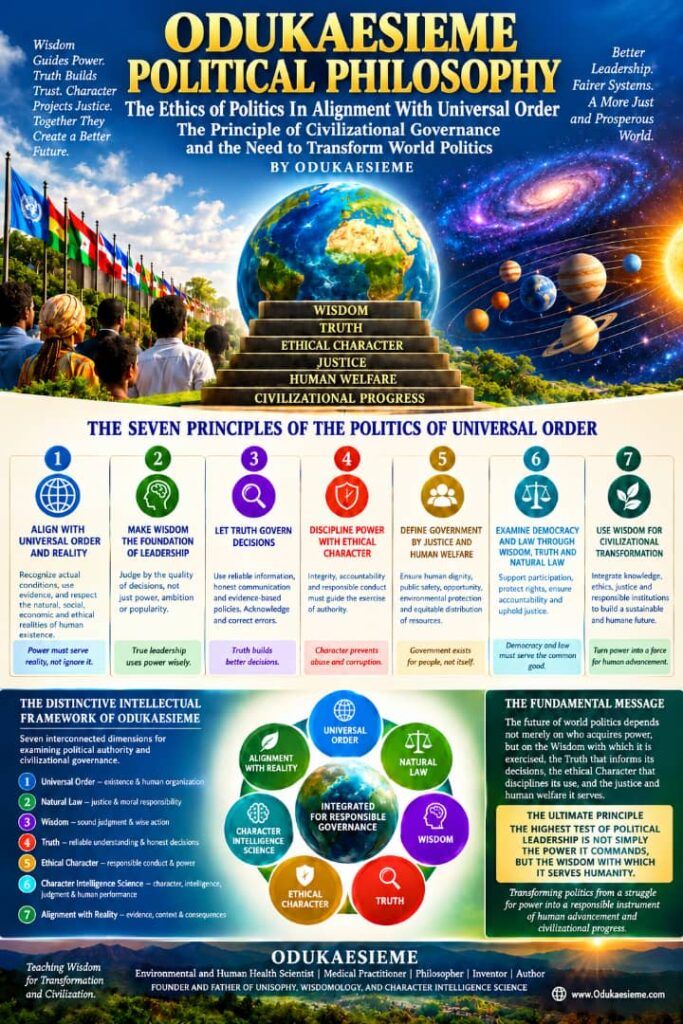
The future of world politics depends not merely on who acquires power, but on the Wisdom with which it is exercised, the Truth that informs its decisions, the ethical Character that disciplines its use, and the justice and human welfare that its exercise serves.
The Ethics of Politics in Alignment with Universal Order calls upon political leaders, scholars, researchers, and citizens to examine the foundations of political authority and pursue governance that is responsible, just, and aligned with the realities of human existence.
The Ultimate Principle
The Highest Test Of Political Leadership Is Not Simply The Power It Commands, But The Wisdom With Which It Serves Humanity.
The ultimate objective is to transform politics from a mere struggle for power into a responsible instrument of human advancement and civilizational progress.
Teaching WISDOM For Transformation And Civilization.
BY Dr. Anthonymaria Odukaesieme, D.SC.
Environmental and Human Health Scientist | Medical Practitioner | Philosopher | Inventor | Author
Founder And Father Of UNISOPHY, WISDOMOLOGY, And CHARACTER INTELLIGENCE SCIENCE