

4.1 Introduction
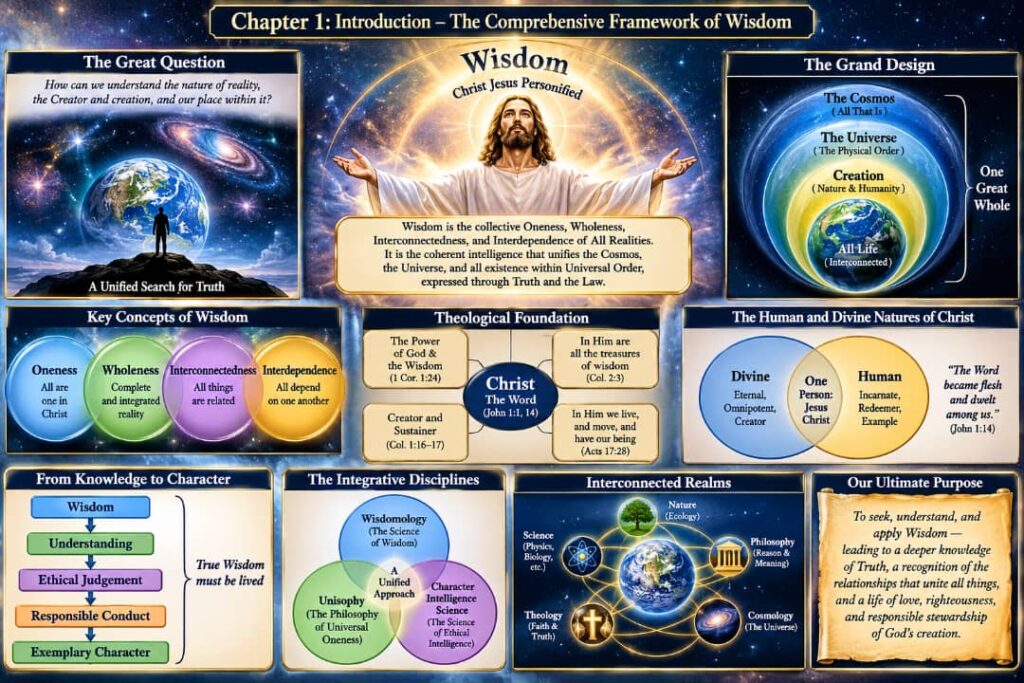
The examination of Wisdom within the Christian theological tradition leads to the person of Jesus Christ.
Throughout the preceding chapters, Wisdom has been examined in relation to existence, Universal Oneness, and Universal Order. This chapter takes the inquiry further by investigating the biblical relationship between Christ Jesus and divine Wisdom.
Christian Scripture presents Christ as far more than a teacher of moral principles or a possessor of extraordinary human knowledge. It identifies Him with the divine Word and explicitly describes Him as the Wisdom of God.
First Corinthians 1:24 declares:
“But unto them which are called, both Jews and Greeks, Christ the power of God, and the wisdom of God.”
This declaration provides the central biblical foundation for this chapter.
The relationship between Christ and Wisdom is also illuminated by the opening of John’s Gospel, which presents the Word as existing in the beginning, being with God, and being God.
The purpose of this chapter is to examine the theological significance of these declarations, the relationship between Christ and creation, the meaning of divine Wisdom, and the implications of Christ’s identity for human understanding and character.
The discussion will distinguish between biblical revelation, Christian theological interpretation, and philosophical reflection.
4.2 THE BIBLICAL MEANING OF WISDOM
Wisdom is a recurring and important theme throughout the Bible.
The Old Testament frequently associates Wisdom with knowledge, understanding, righteousness, instruction, discernment, and the fear of the Lord.
Proverbs 1:7 declares:
“The fear of the LORD is the beginning of knowledge: but fools despise wisdom and instruction.”
Proverbs 9:10 similarly states:
“The fear of the LORD is the beginning of wisdom: and the knowledge of the holy is understanding.”
These passages establish that biblical Wisdom is not merely intellectual ability.
It is associated with reverence for God, moral understanding, discernment, and the proper ordering of human conduct.
Biblical Wisdom also concerns the ability to distinguish between right and wrong, recognise the consequences of decisions, and live responsibly.
The New Testament brings the examination of Wisdom to a significant theological focus through the person of Christ Jesus.
First Corinthians 1:24 identifies Christ as the Wisdom of God.
Colossians 2:3 declares:
“In whom are hid all the treasures of wisdom and knowledge.”
These passages establish the central importance of Christ in the Christian understanding of divine Wisdom.
The distinction between human wisdom and divine Wisdom is therefore essential to this examination.
4.3 CHRIST JESUS AS THE WISDOM OF GOD
The declaration in First Corinthians 1:24 is one of the most significant biblical statements concerning Christ and Wisdom.
The Apostle Paul identifies Christ as both the power of God and the Wisdom of God.
This is not merely a description of Christ as an exceptionally intelligent individual.
It is a theological declaration concerning His identity and significance within God’s plan of salvation.
The surrounding passage contrasts divine wisdom with the standards by which human beings often evaluate power, status, and intellectual achievement.
First Corinthians 1:18 states:
“For the preaching of the cross is to them that perish foolishness; but unto us which are saved it is the power of God.”
Paul explains that God’s wisdom cannot be measured simply by human standards.
The crucifixion of Christ, which appeared to many to be weakness and defeat, is presented in Christian theology as central to God’s saving purpose.
The message is that divine Wisdom transcends the limitations of human judgement.
Christ’s identity and mission therefore provide the foundation for understanding the relationship between divine Wisdom, salvation, and the purpose of human existence.
4.4 THE WORD THAT WAS IN THE BEGINNING
The Gospel according to John begins with one of the most profound declarations in Christian Scripture.
John 1:1 states:
“In the beginning was the Word, and the Word was with God, and the Word was God.”
This passage introduces the Word, traditionally understood in Christian theology as the pre-existent Son of God.
The expression “in the beginning” establishes that the Word did not originate as an ordinary human being at the time of His earthly birth.
The Word already existed.
The passage also distinguishes the Word’s relationship with God from the Word’s divine identity.
Christian theology understands this text within the doctrine of the Trinity: the Father, the Son, and the Holy Spirit are distinct persons who share the one divine nature.
John 1:14 further declares:
“And the Word was made flesh, and dwelt among us, (and we beheld his glory, the glory as of the only begotten of the Father,) full of grace and truth.”
This verse establishes the Christian doctrine of the Incarnation.
The eternal Word became human in the person of Jesus Christ.
The theological significance is that divine Wisdom is not examined only as an abstract principle. It is examined in relation to the person of Christ, who entered human history.
4.5 CHRIST JESUS AND THE INCARNATION
The Incarnation is central to Christian theology.
It refers to the coming of the eternal Son of God into human existence as Jesus Christ.
According to Christian teaching, Christ possesses both a divine nature and a human nature.
He is truly God and truly human.
These two natures are united in one person without being confused, changed, divided, or separated.
This distinction is important for understanding the relationship between Christ’s divine Wisdom and His human experience.
Luke 2:52 states:
“And Jesus increased in wisdom and stature, and in favour with God and man.”
This passage describes Christ’s genuine human development.
It demonstrates that the Incarnation involved real human existence and development.
The Christian understanding does not require the conclusion that Christ ceased to be divine when He became human.
Rather, orthodox Christian theology maintains that the eternal Son assumed a complete human nature while remaining divine.
The Incarnation therefore provides an essential theological foundation for examining how divine Wisdom was manifested through Christ’s human life, teaching, compassion, obedience, and mission.
4.6 CHRIST JESUS AND THE CREATION OF ALL THINGS
The relationship between Christ and creation is fundamental to the biblical understanding of divine Wisdom.
John 1:3 declares:
“All things were made by him; and without him was not any thing made that was made.”
This statement presents the Word as central to the creation of all things.
Colossians 1:16–17 provides an equally significant declaration:
“For by him were all things created, that are in heaven, and that are in earth, visible and invisible, whether they be thrones, or dominions, or principalities, or powers: all things were created by him, and for him:
“And he is before all things, and by him all things consist.”
These passages establish an important theological relationship among Christ, creation, and the continued existence of all things.
Christ is presented as existing before creation and as central to its origin and sustaining.
This means that, within Christian theology, Christ cannot be understood merely as one created entity among others.
He is presented as the divine Word through whom creation came into existence.
The relationship between Christ and creation is therefore essential to understanding the theological dimension of Wisdom and Universal Order.
4.7 CHRIST JESUS AND THE TREASURES OF WISDOM AND KNOWLEDGE
Colossians 2:3 declares:
“In whom are hid all the treasures of wisdom and knowledge.”
This verse provides another significant foundation for the examination of Christ as Wisdom personified.
The expression “in whom” directs attention to Christ as the central source and repository of divine Wisdom and knowledge.
The passage does not merely celebrate intellectual achievement.
It presents Christ as the one in whom the fullness of divine Wisdom is found.
This has important implications for the Christian understanding of knowledge.
Human knowledge is limited and develops through learning, investigation, experience, and reflection.
Divine Wisdom, however, is understood in Christian theology as belonging to God’s perfect knowledge and understanding.
Christ’s relationship with Wisdom therefore establishes a theological standard beyond the limitations of ordinary human intelligence.
For the Christian, the pursuit of Wisdom involves not only intellectual development but also a relationship with Christ and a life guided by His teachings.
4.8 CHRIST JESUS AS THE EXPRESSION OF TRUTH
Truth is central to the identity and teaching of Christ.
John 14:6 records His declaration:
“Jesus saith unto him, I am the way, the truth, and the life: no man cometh unto the Father, but by me.”
This statement is one of the most significant declarations in the Gospel of John.
Christ does not merely present Truth as a subject of intellectual discussion. He identifies Himself with Truth.
Within Christian theology, this declaration concerns His unique identity and role in revealing God and providing the way to the Father.
The relationship between Truth and Wisdom is also central to Odukaesieme’s philosophical framework.
Truth is understood as the expression of Wisdom.
This proposition emphasises that Wisdom cannot be separated from Truth.
The person who seeks Wisdom must therefore pursue honesty, intellectual integrity, and faithfulness to what is true.
The Christian understanding of Christ as Truth provides a theological foundation for examining this relationship.
Wisdom without Truth becomes vulnerable to deception, while knowledge without integrity may be used irresponsibly.
The proper pursuit of Wisdom must therefore remain anchored in Truth.
4.9 CHRIST JESUS AND THE LAW OF LOVE
The life and teachings of Christ provide a central Christian foundation for understanding Love.
John 13:34 records His commandment:
“A new commandment I give unto you, That ye love one another; as I have loved you.”
This commandment establishes Love as a defining principle of Christian discipleship.
Christ’s teaching presents Love as more than a feeling. It requires action, sacrifice, forgiveness, compassion, and concern for the wellbeing of others.
First John 4:8 declares:
“He that loveth not knoweth not God; for God is love.”
This passage establishes the theological significance of Love in relation to the nature of God.
Within Odukaesieme’s philosophical framework, Love is examined as an expression of Oneness.
The recognition that human beings exist within relationships should encourage care, respect, cooperation, and responsibility.
Christ’s teaching therefore provides a profound ethical dimension to the examination of Universal Oneness.
The Christian understanding of Love must be reflected in human conduct, relationships, and concern for others.
4.10 CHRIST JESUS AND HUMAN CHARACTER
The examination of Christ as Wisdom personified must include His character and conduct.
The Gospels present Christ as demonstrating compassion, humility, truthfulness, obedience to the Father, forgiveness, and love.
His teachings challenge hypocrisy, pride, injustice, greed, and the misuse of religious authority.
Matthew 5:3 states:
“Blessed are the poor in spirit: for theirs is the kingdom of heaven.”
This teaching highlights humility as an important Christian virtue.
John 8:32 declares:
“And ye shall know the truth, and the truth shall make you free.”
This statement establishes the importance of Truth in the Christian life.
Christ also teaches forgiveness, mercy, and service.
In John 13:14–15, He gives His disciples an example of humble service through the washing of their feet.
These teachings demonstrate that Wisdom must not be separated from character.
Within Odukaesieme’s 3H framework, Humility, Honesty, and Hard Work are important principles for human development.
These values may be examined alongside the virtues taught and demonstrated by Christ, while recognising that the 3H framework is Odukaesieme’s own conceptual formulation.
The practical lesson is that intellectual knowledge must be accompanied by ethical conduct.
4.11 CHRIST JESUS AND THE RELATIONSHIP BETWEEN DIVINE AND HUMAN WISDOM
The Christian understanding of Christ provides a foundation for distinguishing divine Wisdom from human wisdom.
Divine Wisdom belongs to the nature and knowledge of God.
Human wisdom involves the limited but meaningful capacity of human beings to understand, judge, and act responsibly.
James 3:17 describes wisdom from above:
“But the wisdom that is from above is first pure, then peaceable, gentle, and easy to be intreated, full of mercy and good fruits, without partiality, and without hypocrisy.”
This passage identifies important ethical characteristics of wisdom.
It demonstrates that biblical Wisdom is not measured merely by intellectual sophistication.
It is also recognised through purity, peace, gentleness, mercy, and good conduct.
The relationship between divine and human Wisdom must therefore be understood carefully.
Human beings may seek Wisdom, learn from Scripture, develop understanding, and cultivate good character.
However, human wisdom does not become identical with the infinite Wisdom of God.
Christ remains central to the Christian understanding of divine Wisdom, while human beings are called to grow in wisdom through faith, understanding, and responsible living.
4.12 CHRIST JESUS AND THE MEANING OF LIFE
The Christian understanding of Christ also provides a foundation for examining the purpose of human existence.
Human beings seek answers to questions concerning identity, purpose, suffering, morality, death, and the meaning of life.
Scientific investigation can explain many physical and biological aspects of human existence.
Philosophy examines questions concerning meaning, values, consciousness, and human responsibility.
Christian theology addresses these questions in relation to God, creation, salvation, and eternal life.
Christ’s teachings direct human beings towards love of God, love of neighbour, forgiveness, righteousness, and faithful living.
Matthew 22:37–39 records the two great commandments:
“Thou shalt love the Lord thy God with all thy heart, and with all thy soul, and with all thy mind.”
“And the second is like unto it, Thou shalt love thy neighbour as thyself.”
These commandments provide a central ethical foundation for Christian life.
The pursuit of Wisdom must therefore include the proper ordering of human relationships and responsibilities.
It is not enough to possess knowledge of the world while neglecting the moral purpose of human existence.
4.13 CHRIST JESUS AND THE UNITY OF CREATION
The biblical presentation of Christ in relation to creation has important implications for the examination of Universal Oneness.
Colossians 1:16–17 presents all things as created through Christ and for Christ, and declares that in Him all things consist.
Within Christian theology, this passage provides a foundation for understanding the unity and continued existence of creation in relation to Christ.
The physical universe, the natural world, and human existence are not presented as independent of their Creator.
This theological perspective is consistent with the distinction established in earlier chapters between the Creator and creation.
It must not be confused with the philosophical claim that God and the universe are identical.
The unity of creation is examined in relation to Christ as the divine Word through whom all things were created.
This provides a central theological connection between Christ, Wisdom, Universal Oneness, and Universal Order.
4.14 THE SIGNIFICANCE OF CHRIST AS WISDOM PERSONIFIED
The theological significance of Christ as Wisdom personified can be examined through several major dimensions.
FIRST: DIVINE IDENTITY
John 1:1 presents the Word as divine and establishes the foundation for the Christian understanding of Christ’s identity.
SECOND: DIVINE WISDOM
First Corinthians 1:24 explicitly identifies Christ as the Wisdom of God.
THIRD: CREATION
John 1:3 and Colossians 1:16–17 establish Christ’s relationship with the creation of all things.
FOURTH: TRUTH
John 14:6 identifies Christ with Truth.
FIFTH: LOVE
Christ’s teachings and actions establish Love as a central principle of Christian life.
SIXTH: HUMAN CHARACTER
The Gospels present Christ as the model of humility, obedience, compassion, forgiveness, and righteousness.
SEVENTH: SALVATION
Christian theology identifies Christ’s life, death, and resurrection as central to God’s saving purpose.
Together, these dimensions provide a comprehensive theological foundation for examining Christ as Wisdom personified.
They also demonstrate why Christ occupies a central position in the Christian understanding of Wisdom.
4.15 CONCLUSION
The examination of Christ Jesus as Wisdom personified is one of the most significant theological dimensions of this treatise.
The Bible identifies Christ as the Wisdom of God and presents Him as the divine Word through whom all things were created.
John’s Gospel establishes the pre-existence and divine identity of the Word, while Colossians presents Christ as central to the creation and continued existence of all things.
The Incarnation establishes the Christian understanding that the eternal Word became human in the person of Jesus Christ.
Christ’s teachings and life also provide a profound ethical foundation through Truth, Love, humility, compassion, forgiveness, and obedience to God.
This chapter has distinguished divine Wisdom from human wisdom and examined the theological significance of Christ in relation to creation, Universal Oneness, and Universal Order.
The central conclusion is that, within Christian theology, Christ is not merely a teacher who possesses wisdom. He is explicitly identified in Scripture as the Wisdom of God.
The next chapter will examine the Divine and Human Nature of Christ, with particular attention to the theological significance of the Incarnation.
REFERENCES
The Holy Bible, King James Version.
Augustine. (2008). The Trinity (E. Hill, Trans.). New City Press.
Athanasius. (2011). On the Incarnation (J. Behr, Trans.). St Vladimir’s Seminary Press.
McGrath, A. E. (2017). Christian Theology: An Introduction (6th ed.). Wiley-Blackwell.
The Council of Chalcedon. (451). Definition of Faith.
The Council of Nicaea. (325). Nicene Creed.
Wright, N. T. (2013). Paul and the Faithfulness of God. Fortress Press.
DEFINITION OF WISDOM
Wisdom is the collective Oneness, Wholeness, Interconnectedness, and Interdependence of All Realities. It is the coherent intelligence that unifies Creation, the Cosmos, the Universe, and all existence within Universal Order, expressed through Truth and the Law established by the Creator.
— Odukaesieme
www.odukaesieme.com