

2.1 Introduction
The concept of Universal Oneness occupies a central position in the philosophical examination of Wisdom. Having established the ontological foundations of Wisdom in the preceding chapter, this chapter examines the principle of Oneness as a framework for understanding the unity, diversity, relationships, and interdependence of all realities.
The universe presents itself through an extraordinary diversity of forms. It contains galaxies, stars, planets, natural elements, living organisms, ecosystems, human beings, and countless other realities. These entities possess different characteristics, structures, functions, and conditions of existence.
Yet diversity does not necessarily imply absolute separation.
The existence of distinct entities does not prevent them from participating in wider relationships and systems. The natural world provides numerous examples of unity within diversity, from the organisation of living organisms to the relationships among species and their environments.
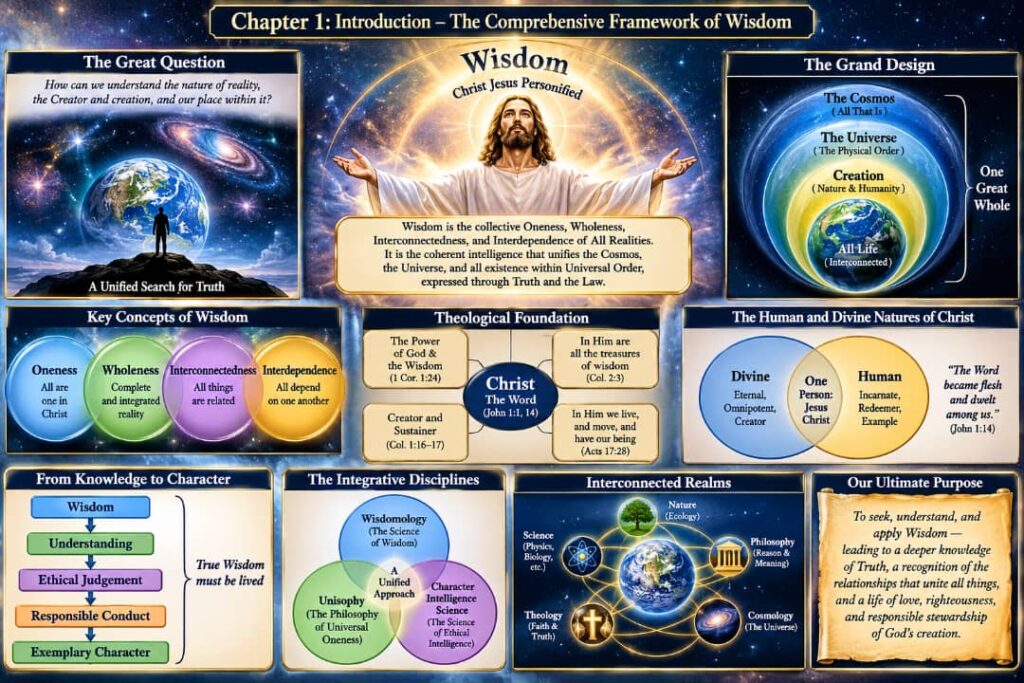
Within Odukaesieme’s philosophical framework, Universal Oneness expresses the fundamental unity of reality through four essential dimensions:
1. ONENESS
2. WHOLENESS
3. INTERCONNECTEDNESS
4. INTERDEPENDENCE
These four dimensions form an integrated conceptual foundation for understanding Wisdom.
Universal Oneness, as presented in this treatise, does not mean that all things are identical or that distinctions among realities should be abolished. It means that the diversity of existence must also be understood in relation to the wider totality and order within which different realities exist.
This chapter therefore examines Universal Oneness from philosophical, theological, scientific, ecological, cosmological, and ethical perspectives.
2.2 THE MEANING OF UNIVERSAL ONENESS
Universal Oneness is the philosophical principle that reality should be understood in terms of unity, relationships, and the coherence of its diverse dimensions.
The word “Universal” refers to the broad scope of reality, while “Oneness” expresses the principle of unity.
Together, Universal Oneness represents an approach to understanding existence as a connected and interrelated totality rather than merely a collection of unrelated entities.
The concept raises several fundamental questions:
1. What is the relationship between unity and diversity?
2. How can different realities exist within a common order?
3. What connects individual entities to wider systems?
4. How do relationships contribute to the functioning of a whole?
5. How should the totality of existence be understood?
6. What is the relationship between the Creator and the unity of creation?
These questions demonstrate that Universal Oneness is not simply a statement that everything is one. It is an invitation to examine the nature and structure of unity itself.
Within this framework, Oneness must be understood alongside Wholeness, Interconnectedness, and Interdependence.
Each dimension contributes a distinct meaning to the comprehensive examination of reality.
2.3 ONENESS: UNITY WITHIN DIVERSITY
Oneness is the recognition of unity among distinct realities.
It does not require the elimination of differences. Rather, it recognises that different entities may belong to a wider order without losing their individual identities.
Consider the human body.
The heart, brain, lungs, kidneys, and other organs perform different functions. Their structures are not identical, and their functions are not interchangeable. Nevertheless, they participate in the organisation and functioning of one living organism.
The unity of the human body does not mean that the heart is the brain or that the lungs are the kidneys. It means that their different functions contribute to the life of one organism.
The same principle may be observed in human society.
Individuals possess different abilities, occupations, experiences, and responsibilities. Families, communities, institutions, and nations also possess distinct identities. Nevertheless, they participate in wider social relationships.
These examples demonstrate an important philosophical principle:
UNITY DOES NOT NECESSARILY REQUIRE IDENTICALITY.
Diversity and unity can coexist.
Within Odukaesieme’s framework, Oneness is therefore the recognition of unity without denying distinction.
This understanding provides an important foundation for examining the totality of existence.
2.4 WHOLENESS: THE INTEGRITY OF THE TOTALITY
Wholeness concerns the relationship between individual parts and the totality to which they belong.
A whole is not necessarily a simple collection of separate components. Its organisation, relationships, and functions may give it characteristics that cannot be adequately understood by examining its parts in isolation.
For example, an ecosystem consists of organisms, environmental conditions, and relationships among living and non-living components.
Its functioning depends upon interactions involving energy, nutrients, water, climate, soil, and living organisms.
Examining only one organism cannot provide a complete understanding of the entire ecosystem.
Similarly, understanding human health requires attention to the relationships among different organs, biological processes, environmental conditions, and individual circumstances.
Wholeness therefore encourages a comprehensive approach to understanding reality.
However, it does not mean that every part is equally important or that every part has the same function.
Rather, each part must be considered according to its characteristics and contribution to the organisation of the whole.
Within the philosophical framework of Wisdom, Wholeness expresses the importance of understanding individual realities within their wider context.
2.5 INTERCONNECTEDNESS: THE RELATIONSHIPS THAT UNITE REALITIES
Interconnectedness refers to the relationships that exist among different entities, systems, and processes.
Reality is characterised by numerous relationships.
In nature, plants interact with soil, water, sunlight, microorganisms, insects, and other organisms.
In human society, individuals interact through communication, education, commerce, family relationships, governance, and cultural institutions.
In the physical sciences, natural phenomena are investigated through relationships involving matter, energy, forces, and physical processes.
These relationships demonstrate that many realities cannot be adequately understood without examining their connections to other realities.
Interconnectedness also has important intellectual implications.
Knowledge in one discipline may contribute to the understanding of questions investigated in another discipline.
For example, environmental health involves considerations from medicine, biology, chemistry, ecology, and environmental science.
The relationships among these disciplines do not eliminate their individual identities. Instead, interdisciplinary investigation allows different forms of knowledge to contribute to a broader understanding of complex problems.
Within this treatise, Interconnectedness is therefore regarded as an essential dimension of Universal Oneness.
2.6 INTERDEPENDENCE: THE PRINCIPLE OF MUTUAL DEPENDENCE
Interdependence concerns the ways in which different entities or systems depend upon one another for particular conditions, resources, functions, or outcomes.
In the natural world, living organisms depend upon environmental conditions for survival.
Plants require water, appropriate temperatures, nutrients, and other conditions for growth.
Animals depend upon food, water, suitable habitats, and other environmental resources.
Human societies depend upon networks of production, transportation, communication, education, healthcare, and cooperation.
Interdependence is not necessarily equal or symmetrical. Different entities may depend upon one another in different ways and to different degrees.
Nevertheless, the principle demonstrates that complete independence is not an adequate description of many relationships within existence.
Human beings, for example, may possess individual identities and responsibilities, but their lives are influenced by biological, social, economic, environmental, and institutional conditions.
Recognising interdependence encourages responsibility towards others and towards the wider systems that support human existence.
Within Odukaesieme’s framework, Interdependence completes the four-dimensional foundation of Universal Oneness.
2.7 THE RELATIONSHIP BETWEEN THE FOUR DIMENSIONS
Oneness, Wholeness, Interconnectedness, and Interdependence are related but distinct concepts.
Their relationship may be expressed as follows:
ONENESS
The recognition of unity among distinct realities.
WHOLENESS
The recognition of the integrity of a totality and the relationship of its parts to that totality.
INTERCONNECTEDNESS
The recognition of relationships and connections among different realities.
INTERDEPENDENCE
The recognition of mutual or reciprocal dependence among entities and systems.
Together, these dimensions provide a comprehensive conceptual framework for examining the unity of existence.
Their relationship can be illustrated through the human body.
The body is one organism. It possesses wholeness as an organised living system. Its organs and biological processes are interconnected. Its different systems depend upon one another for the maintenance of life.
The same analytical approach may be applied, with appropriate distinctions, to ecosystems, societies, and other organised systems.
It is important, however, not to assume that every relationship in the universe operates in exactly the same way.
The four dimensions provide a philosophical framework for investigating different forms of unity and relationship, not a claim that all realities have identical structures.
2.8 UNIVERSAL ONENESS AND THE NATURAL SCIENCES
The natural sciences provide important examples of unity, relationships, and interdependence within the physical and biological worlds.
Physics investigates the fundamental properties and interactions of matter and energy.
Chemistry examines the composition, structure, properties, and transformations of substances.
Biology investigates living organisms and the processes that sustain life.
Ecology examines relationships among organisms and their environments.
These disciplines have different methods and areas of investigation. Nevertheless, their findings often contribute to the understanding of interconnected natural processes.
For example, the study of plant growth may involve biological processes, chemical reactions, soil conditions, water availability, and physical energy from sunlight.
Similarly, the examination of climate systems requires contributions from atmospheric physics, chemistry, oceanography, geology, and other scientific fields.
Such examples demonstrate the importance of examining relationships across scientific disciplines.
Universal Oneness, as a philosophical framework, encourages this integrative approach.
It does not replace scientific theories, experimental procedures, or empirical evidence. Rather, it provides a philosophical perspective for considering how specialised scientific knowledge contributes to a wider understanding of reality.
2.9 UNIVERSAL ONENESS AND ECOLOGICAL SYSTEMS
Ecology provides one of the clearest illustrations of interconnectedness and interdependence within the natural world.
An ecosystem consists of living organisms interacting with one another and with the physical environment.
Its components include plants, animals, microorganisms, soil, water, air, sunlight, and other environmental factors.
These components participate in different ecological processes.
Plants capture energy from sunlight through photosynthesis. Herbivores consume plant material. Carnivores may consume other animals. Decomposers break down organic matter and contribute to nutrient cycling.
These relationships help sustain ecological processes.
The removal or disruption of an important component may affect other components of the system.
For example, deforestation can alter habitats, soil conditions, water regulation, biodiversity, and local environmental conditions.
This demonstrates why environmental protection requires an understanding of relationships within ecological systems.
The ecological perspective supports the philosophical examination of interconnectedness and interdependence.
However, an ecosystem is not necessarily a perfectly balanced or permanently stable arrangement. Ecological systems undergo change, disturbance, adaptation, and succession.
Universal Oneness must therefore accommodate both organisation and change within the natural world.
2.10 UNIVERSAL ONENESS AND THE COSMOS
The cosmos presents another important dimension for examining the unity and organisation of reality.
The observable universe contains galaxies, stars, planets, interstellar matter, radiation, and other physical phenomena.
Modern cosmology investigates the origin, evolution, composition, and large-scale structure of the universe.
Astronomy examines celestial objects and events, while astrophysics investigates the physical processes associated with them.
These scientific disciplines reveal that the universe is not merely an arbitrary collection of celestial objects. It exhibits structures and relationships that can be investigated through observation, mathematical models, and physical theories.
Galaxies contain stars and other matter. Stars form, evolve, and eventually undergo different stages of transformation. Planetary systems develop within particular astronomical environments.
The Earth itself exists within the Solar System, which is part of the Milky Way Galaxy.
These relationships demonstrate the importance of understanding individual celestial objects within wider astronomical contexts.
The philosophical concept of Universal Oneness invites reflection on the unity and organisation of the cosmos.
Nevertheless, cosmological observations and theories must be distinguished from metaphysical and theological interpretations.
Scientific cosmology investigates the physical universe through scientific methods. Theology addresses questions concerning the Creator and the ultimate foundation of creation.
Both perspectives may be examined within this treatise, but their methods and claims must remain clearly distinguished.
2.11 UNIVERSAL ONENESS AND THE CREATOR
The theological examination of Universal Oneness requires an essential distinction between the Creator and creation.
In Christian theology, God is the Creator of all things. The universe, the natural world, and humanity belong to creation.
God is not simply one object among other objects within the universe.
This distinction is fundamental to the Christian understanding of divine transcendence and creation.
Genesis 1:1 declares:
“In the beginning God created the heaven and the earth.”
The passage establishes the biblical understanding of God as Creator.
Colossians 1:16–17 further presents Christ as central to the creation and sustaining of all things.
The theological understanding of Universal Oneness must therefore avoid confusing the unity of creation with the identity of the Creator.
Creation may be examined as an ordered and interconnected totality, while the Creator remains distinct from the created order.
In this framework, Universal Oneness is not the assertion that God and the universe are identical.
Rather, it concerns the unity and relationships of created realities within the order established by the Creator.
This distinction preserves the theological foundation of the treatise.
2.12 CHRIST JESUS AND THE ONENESS OF CREATION
The Christian understanding of Universal Oneness gives particular attention to Christ Jesus.
John 1:1 states:
“In the beginning was the Word, and the Word was with God, and the Word was God.”
John 1:3 further declares:
“All things were made by him; and without him was not any thing made that was made.”
These passages establish the theological significance of Christ in relation to creation.
Colossians 1:16–17 states that all things were created through Him and for Him, and that by Him all things consist.
Within Christian theology, these passages establish Christ’s relationship with the creation and sustaining of all things.
First Corinthians 1:24 also describes Christ as:
“the power of God, and the wisdom of God.”
These biblical declarations provide an important foundation for examining Christ in relation to Wisdom.
The unity of creation, therefore, is examined in the light of the Christian understanding of Christ as the divine Word through whom all things were created.
This theological position will receive a more detailed examination in subsequent chapters.
2.13 UNIVERSAL ONENESS AND HUMAN EXISTENCE
Human existence provides a practical and deeply personal dimension of Universal Oneness.
Every human being possesses individual identity, abilities, experiences, and responsibilities.
Nevertheless, no human life develops entirely independently of other realities.
Human beings depend upon biological conditions, natural resources, families, communities, institutions, and social relationships.
The development of language, education, knowledge, technology, and culture also depends upon relationships among individuals and generations.
The human body itself demonstrates different forms of organisation and interdependence.
The cardiovascular, respiratory, nervous, digestive, and other systems perform different functions while contributing to the functioning of one organism.
This biological illustration reveals the importance of coordination and integration.
Human existence also raises moral questions.
If human beings are interconnected through relationships and social institutions, then their decisions and actions may have consequences beyond themselves.
The recognition of Universal Oneness should therefore encourage respect for human dignity, cooperation, compassion, justice, and responsibility.
It provides a philosophical basis for examining the individual not as an isolated entity but as a participant in wider relationships.
2.14 UNIVERSAL ONENESS, TRUTH, AND LOVE
Truth and Love occupy important positions within the ethical and theological dimensions of this philosophical framework.
TRUTH
Truth concerns the proper correspondence between what is asserted and what is actually the case.
The pursuit of Truth requires honesty, intellectual integrity, careful investigation, and a willingness to correct errors.
Within Odukaesieme’s framework, Truth is understood as an essential expression of Wisdom.
A person who seeks Wisdom must therefore value Truth above convenience, deception, and personal advantage.
LOVE
Love expresses concern for the dignity, welfare, and well-being of others.
In Christian theology, 1 John 4:8 declares:
“He that loveth not knoweth not God; for God is love.”
This passage establishes the theological importance of Love.
Within the philosophical examination of Universal Oneness, Love is understood as an ethical expression of the recognition that human beings exist in relationships with one another.
Truth and Love must therefore contribute to the development of responsible human relationships.
Truth without ethical concern may be communicated without compassion, while claims of Love without Truth may become empty expressions.
Their proper relationship is important to the development of Wisdom and exemplary character.
2.15 UNIVERSAL ONENESS AND HUMAN CHARACTER
The practical significance of Universal Oneness becomes evident in the development of human character.
If individuals recognise their relationships with other people and the wider world, they must also recognise the responsibilities that accompany those relationships.
Character determines how individuals exercise their abilities, manage responsibilities, and relate to others.
The recognition of unity should therefore encourage ethical conduct rather than selfishness, dishonesty, exploitation, or abuse of authority.
Three important principles are particularly relevant:
HUMILITY
Humility encourages individuals to recognise the limits of their knowledge and abilities.
It promotes openness to learning, correction, and the contributions of others.
HONESTY
Honesty establishes trust and supports the integrity of personal, professional, and institutional relationships.
HARD WORK
Hard work expresses commitment, discipline, diligence, and responsible contribution.
These three principles are identified in Odukaesieme’s 3H framework:
HUMILITY, HONESTY, AND HARD WORK.
Together, they provide practical guidance for character development.
Universal Oneness must therefore extend beyond intellectual recognition into the conduct of individuals and institutions.
Its ethical significance is demonstrated when people translate the recognition of relationships and interdependence into responsible actions.
2.16 UNIVERSAL ONENESS AND THE INTEGRATION OF KNOWLEDGE
One of the important implications of Universal Oneness is the need to examine knowledge beyond unnecessary intellectual fragmentation.
Different academic disciplines investigate different aspects of reality.
Their specialised methods are essential to the advancement of knowledge. However, complex questions frequently require contributions from several disciplines.
For example, the question of sustainable human development may involve economics, environmental science, medicine, education, engineering, sociology, political science, and ethics.
No single discipline can independently provide every explanation required for such a complex subject.
Interdisciplinary and multidisciplinary approaches therefore contribute to a broader understanding.
Within Odukaesieme’s philosophical framework, Wisdom provides the integrating perspective through which knowledge may be examined in relation to Truth, Universal Order, and responsible human conduct.
This does not mean that Wisdom replaces specialised knowledge.
Rather, it proposes that knowledge achieves greater practical significance when it is properly understood, ethically evaluated, and responsibly applied.
The relationship between knowledge and Wisdom is therefore central to the intellectual direction of this treatise.
2.17 UNIVERSAL ONENESS AS A FOUNDATION FOR UNISOPHY
Unisophy is presented in this treatise as Odukaesieme’s proposed philosophical framework of Universal Oneness.
Its central concern is the examination of unity, Wholeness, Interconnectedness, and Interdependence among realities.
The term expresses an intellectual direction that seeks to understand existence through the principle of Universal Oneness.
Within this framework, Unisophy examines questions such as:
1. What constitutes Universal Oneness?
2. How are different realities related?
3. How does unity coexist with diversity?
4. What is the relationship between the parts and the whole?
5. How should humanity understand its place within creation?
6. What ethical responsibilities arise from the recognition of interconnectedness?
7. How does Universal Order contribute to the understanding of reality?
Unisophy is therefore proposed as a philosophical approach to the comprehensive examination of Universal Oneness.
Its development requires clear definitions, logical arguments, engagement with existing philosophical traditions, and critical examination.
Its intellectual value must be assessed through the strength, clarity, originality, and coherence of its arguments.
The present chapter establishes the conceptual foundation upon which this proposed framework is developed.
2.18 THE ETHICAL AND CIVILISATIONAL IMPLICATIONS OF UNIVERSAL ONENESS
Universal Oneness has implications beyond theoretical philosophy.
It provides a perspective for examining the ethical foundations of society and civilisation.
Human societies are sustained through relationships among individuals, families, communities, institutions, and nations.
Where these relationships are characterised by honesty, justice, responsibility, cooperation, and respect, they can support social stability and human development.
Where they are undermined by corruption, injustice, dishonesty, exploitation, and irresponsible leadership, the consequences may extend across entire communities.
The recognition of interconnectedness should therefore encourage a broader understanding of the consequences of human decisions.
Environmental responsibility is another important implication.
Human beings depend upon the natural environment for food, water, energy, shelter, and other essential resources.
The destruction of ecological systems can undermine the conditions upon which human communities depend.
Similarly, responsible economic development requires consideration of social welfare, environmental sustainability, institutional integrity, and the long-term consequences of economic decisions.
Universal Oneness therefore provides a philosophical basis for examining civilisation in relation to ethical responsibility.
A civilisation should not be judged only by its technological achievements, economic wealth, or political power.
It must also be examined through the quality of its character, the justice of its institutions, and its respect for human dignity.
2.19 THE LIMITS AND RESPONSIBLE INTERPRETATION OF UNIVERSAL ONENESS
A comprehensive philosophical framework must also recognise the limits of its own propositions.
Universal Oneness should not be interpreted to mean that all things are physically connected in the same way, that every event directly influences every other event, or that scientific differences among entities are insignificant.
Nor should it be used to claim that scientific investigations have experimentally established every metaphysical or theological proposition.
The four dimensions of Universal Oneness have different meanings and applications.
Oneness concerns unity.
Wholeness concerns the integrity of a totality.
Interconnectedness concerns relationships.
Interdependence concerns mutual or reciprocal dependence.
These concepts can be applied to different fields, but their specific meanings must be examined within the relevant context.
Likewise, the theological assertion that God is the Creator is a Christian doctrinal claim grounded in Scripture and theological reasoning. It is not identical to a scientific hypothesis about the physical universe.
Maintaining these distinctions strengthens the intellectual integrity of the framework.
Universal Oneness must therefore be developed through careful reasoning, conceptual clarity, and appropriate engagement with philosophical, theological, and scientific knowledge.
2.20 CONCLUSION
Universal Oneness provides a central philosophical foundation for the examination of Wisdom.
It expresses the importance of understanding reality through unity, Wholeness, Interconnectedness, and Interdependence.
The chapter has demonstrated that unity does not require identicality, that diversity does not necessarily imply separation, and that the understanding of individual realities often requires attention to their relationships with wider systems.
The natural sciences provide examples of organised relationships within physical and biological systems. Ecology demonstrates the importance of interconnectedness and interdependence. Cosmology provides a framework for examining the large-scale structure and development of the universe.
The theological perspective establishes the distinction between the Creator and creation and examines Christ Jesus in relation to the creation and sustaining of all things.
The ethical perspective demonstrates that the recognition of interconnectedness carries implications for human character, social responsibility, environmental stewardship, and civilisation.
Within Odukaesieme’s proposed philosophical framework, Universal Oneness is not merely an abstract idea. It is a principle through which the totality of reality may be examined in relation to its diversity, organisation, relationships, and order.
The four dimensions of Oneness, Wholeness, Interconnectedness, and Interdependence provide the conceptual foundation for this examination.
The next chapter proceeds to examine Universal Order and its significance in understanding the organisation, relationships, and coherence of existence.
REFERENCES
The Holy Bible, King James Version.
Aristotle. (1998). Metaphysics (H. Lawson-Tancred, Trans.). Penguin Classics.
Bertalanffy, L. von. (1968). General System Theory: Foundations, Development, Applications. George Braziller.
Capra, F. (1996). The Web of Life: A New Scientific Understanding of Living Systems. Anchor Books.
Odum, E. P., & Barrett, G. W. (2005). Fundamentals of Ecology (5th ed.). Thomson Brooks/Cole.
Tansley, A. G. (1935). The use and abuse of vegetational concepts and terms. Ecology, 16(3), 284–307.
Lindeman, R. L. (1942). The trophic-dynamic aspect of ecology. Ecology, 23(4), 399–417.
Kuhn, T. S. (2012). The Structure of Scientific Revolutions (4th ed.). University of Chicago Press.
DEFINITION OF WISDOM
Wisdom is the collective Oneness, Wholeness, Interconnectedness, and Interdependence of All Realities. It is the coherent intelligence that unifies Creation, the Cosmos, the Universe, and all existence within Universal Order, expressed through Truth and the Law established by the Creator.
— ODUKAESIEME
www.odukaesieme.com