

Introduction
The Search For Wisdom And The Understanding Of The Totality Of Reality
The Quest For Wisdom
The search for Wisdom is one of the oldest and most enduring pursuits in human history. Across generations, civilisations, cultures, religions, and intellectual traditions, humanity has sought to understand the nature of existence, the meaning of life, the principles governing reality, and the proper way to live.
Human beings have accumulated enormous quantities of knowledge through observation, experience, philosophical reflection, religious inquiry, and scientific investigation. Yet the possession of knowledge does not automatically produce Wisdom. Knowledge may explain how things work, but Wisdom raises the deeper questions of how knowledge should be understood, integrated, and applied responsibly.
The distinction between knowledge and Wisdom is therefore fundamental to this treatise.
Wisdom is not merely the accumulation of information, the possession of intelligence, or the ability to solve isolated problems. It concerns the coherent understanding of relationships, principles, values, and the proper order of things.
The central question of this work is consequently not simply what human beings know, but how the totality of knowledge and reality can be understood within a coherent framework of Truth, Universal Order, and the Law established by the Creator.
THE FUNDAMENTAL QUESTION: WHAT IS WISDOM?
Throughout intellectual history, philosophers, theologians, scientists, and religious thinkers have examined Wisdom from different perspectives.
In philosophy, Wisdom has been associated with sound judgement, knowledge of fundamental principles, practical reasoning, and the pursuit of truth.
In theology, Wisdom has been examined in relation to God, divine revelation, creation, moral conduct, and the ultimate purpose of existence.
In science, the study of natural systems reveals patterns, relationships, organisation, and processes that invite deeper questions about the coherence of reality.
In human society, Wisdom is reflected in responsible leadership, justice, humility, integrity, and the proper application of knowledge.
These perspectives demonstrate that Wisdom cannot be adequately examined through a narrow or isolated approach.
A comprehensive examination must consider its ontological, theological, philosophical, scientific, ecological, cosmological, intellectual, and ethical dimensions.
This treatise therefore approaches Wisdom as a subject whose significance extends across the totality of reality and the different branches of human understanding.
WISDOM AND THE TOTALITY OF KNOWLEDGE
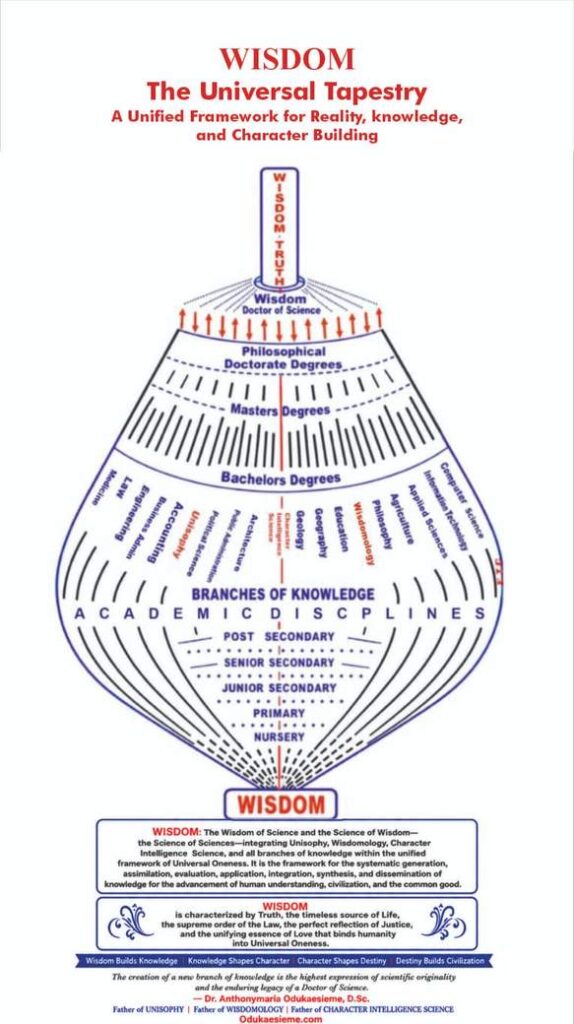
Human knowledge is divided into numerous academic disciplines and specialised fields of inquiry.
Physics investigates matter, energy, motion, and physical interactions.
Chemistry examines the composition, properties, and transformations of matter.
Biology investigates living organisms and their processes.
Ecology examines the relationships between organisms and their environments.
Medicine studies human health, disease, prevention, and treatment.
Mathematics investigates quantity, structure, relationships, and patterns.
Philosophy examines fundamental questions concerning existence, knowledge, reason, values, and meaning.
Theology investigates God, creation, revelation, faith, and the relationship between the Creator and humanity.
Cosmology examines the origin, structure, development, and large-scale organisation of the universe.
Although these disciplines have different methods and areas of specialisation, their subjects are not necessarily unrelated. They investigate different dimensions of reality.
This raises an important philosophical question: Can the different forms of knowledge be understood within a wider framework that recognises their relationships, limitations, and contributions to the understanding of reality?
The position developed in this treatise is that Wisdom provides an integrating framework for examining knowledge and its relationship with the totality of existence.
This does not mean that all academic disciplines are identical or that their methods should be merged indiscriminately. Rather, it means that specialised knowledge can be examined within a wider intellectual framework that considers relationships, coherence, Truth, and Universal Order.
Wisdom, in this sense, is not a substitute for scientific investigation, philosophical reasoning, or theological inquiry. It provides a framework for examining their significance and proper relationship.
WISDOM AND THE CREATOR
An adequate examination of Wisdom must address the fundamental distinction between the Creator and creation.
The theological perspective of this treatise is rooted in the Christian understanding of God as the Creator of all things.
Creation includes the universe, the natural world, living organisms, and humanity. The Creator, however, is not merely another component within creation.
This distinction is essential to the theological foundation of the work.
The Bible presents God as the Creator and identifies divine Wisdom as an important theme in understanding God’s relationship with creation.
Proverbs 3:19 states:
“The LORD by wisdom hath founded the earth; by understanding hath he established the heavens.”
This passage establishes a profound relationship between Wisdom, understanding, and the order of creation within the biblical tradition.
Similarly, the New Testament presents Christ Jesus in relation to divine Wisdom and the creation of all things.
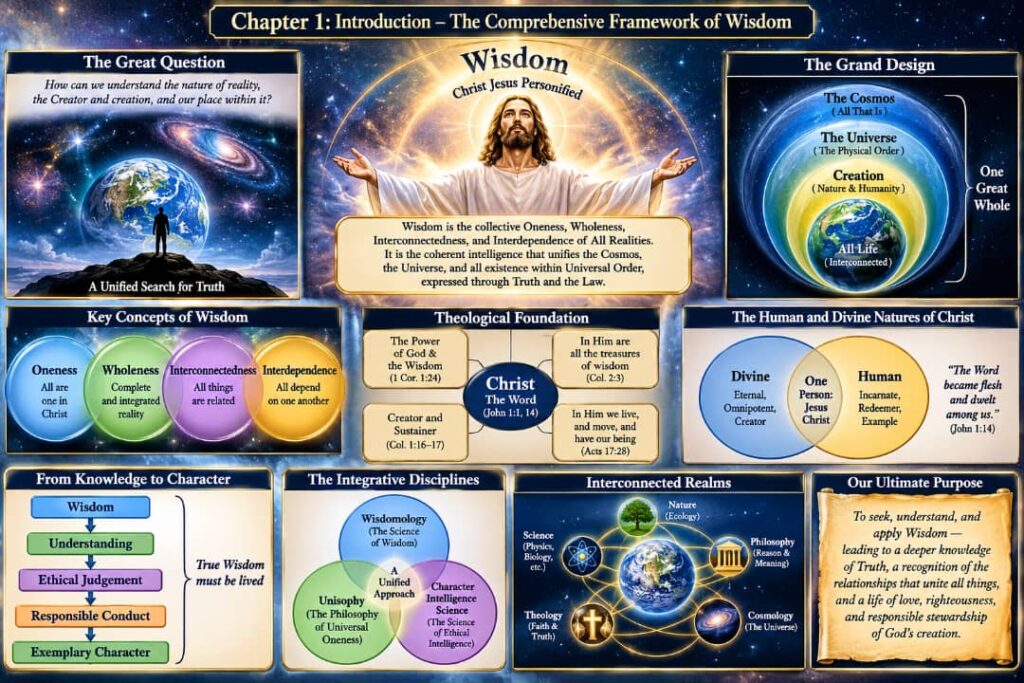
First Corinthians 1:24 describes Christ as “the power of God, and the wisdom of God.”
Colossians 1:16–17 presents all things as created through Christ and for Him, and declares that in Him all things hold together.
These passages provide an important theological foundation for examining Wisdom, creation, and the sustaining order of existence.
The theological discussion in this book will distinguish carefully between biblical revelation, philosophical interpretation, and scientific explanation.
WISDOM AND CHRIST JESUS
Christ Jesus occupies a significant position in the theological examination of Wisdom undertaken in this work.
Christian Scripture presents Christ not merely as a teacher of Wisdom but also in relation to the divine Wisdom and creative purpose of God.
John 1:1 declares:
“In the beginning was the Word, and the Word was with God, and the Word was God.”
John 1:14 further declares:
“And the Word was made flesh, and dwelt among us.”
These passages form part of the biblical foundation for the Christian understanding of the identity and nature of Christ.
Colossians 2:3 states:
“In whom are hid all the treasures of wisdom and knowledge.”
This statement provides a particularly important foundation for examining the relationship between Christ, Wisdom, and knowledge.
The book will therefore investigate the theological significance of Christ as the embodiment and personification of divine Wisdom, while maintaining the distinction between the theological claims of Christianity and the philosophical framework developed by the author.
The examination will also consider the relationship between Christ and creation, the meaning of humanity’s dependence upon God, and the biblical imagery of the Vine and the branches in John 15.
These subjects are not introduced to restrict the meaning of Wisdom to a single academic discipline. Rather, they form an essential part of the theological dimension of this comprehensive inquiry.
WISDOM AND HUMAN EXISTENCE
The examination of Wisdom must also address the nature and purpose of human existence.
Human beings possess intelligence, consciousness, reasoning abilities, emotions, and the capacity for moral decision-making.
However, intellectual ability alone does not guarantee good character or responsible conduct.
A person may possess extensive knowledge and still make decisions that are dishonest, destructive, unjust, or harmful to society.
This demonstrates the importance of distinguishing intellectual ability from ethical judgement.
Wisdom must therefore be examined in relation to human character, moral responsibility, and the proper application of knowledge.
Acts 17:28 provides an important theological reference:
“For in him we live, and move, and have our being.”
This biblical statement expresses humanity’s dependence upon God.
It also provides a foundation for reflecting on human existence, responsibility, and the relationship between humanity and the Creator.
The proper understanding of existence should consequently encourage humility, gratitude, responsibility, and respect for the conditions that sustain life.
WISDOM, TRUTH, LOVE, AND CHARACTER
Wisdom cannot be separated from the question of how human beings should live.
The possession of knowledge without ethical responsibility can become dangerous. Intelligence without integrity can be used for exploitation, manipulation, and destruction.
For this reason, this treatise examines the relationship between Wisdom and exemplary human character.
Four important values receive particular attention:
TRUTH
Truth is essential to the proper understanding of reality. It provides a foundation for intellectual integrity, sound judgement, trustworthy relationships, and responsible decision-making.
LOVE
Love expresses concern for the welfare and dignity of others. Within the theological and ethical framework of this work, it is examined as an important expression of human relationship and moral responsibility.
HUMILITY
Humility recognises the limits of individual knowledge and the importance of learning, correction, and respect for others. It discourages arrogance and creates room for intellectual and moral development.
RESPONSIBILITY
Responsibility requires individuals to consider the consequences of their decisions and actions. It connects knowledge and judgement with practical conduct.
These values are essential to the development of character and the responsible application of intelligence.
The central concern is not merely whether an individual is knowledgeable, intelligent, influential, or successful, but whether such abilities are directed towards Truth, justice, human dignity, and the common good.
THE INTEGRATIVE FRAMEWORK OF WISDOM
The central intellectual objective of this treatise is to examine Wisdom as an integrating framework through which different dimensions of reality and knowledge can be understood.
The inquiry brings together several major areas:
1. ONTOLOGY: The study of being, existence, and the fundamental nature of reality.
2. THEOLOGY: The examination of God, creation, divine revelation, and the relationship between the Creator and humanity.
3. PHILOSOPHY: The investigation of fundamental principles, truth, knowledge, reason, values, and meaning.
4. SCIENCE: The systematic investigation of the natural world through observation, experimentation, evidence, and explanatory models.
5. ECOLOGY: The examination of relationships among organisms and their environments.
6. COSMOLOGY: The study of the origin, structure, development, and large-scale organisation of the universe.
7. HUMAN CHARACTER: The examination of ethical intelligence, moral judgement, responsibility, and exemplary conduct.
These areas are brought together for an integrated examination, not to erase their differences or suggest that they all employ identical methods.
The framework also provides the intellectual background for examining the author’s proposed disciplines:
WISDOMOLOGY: The proposed Science of Wisdom.
UNISOPHY: The proposed Philosophy of Universal Oneness.
CHARACTER INTELLIGENCE SCIENCE (CIS): The proposed Science of Ethical Intelligence and Human Excellence.
These frameworks are presented as intellectual propositions requiring clear definitions, coherent reasoning, and appropriate scholarly examination.
Their relationship to the wider study of Wisdom will be explored in the relevant chapters.
THE PURPOSE AND SCOPE OF THIS TREATISE
The purpose of this book is to undertake a comprehensive examination of the meaning, nature, scope, and significance of Wisdom.
It seeks to investigate the relationship between Wisdom and existence, the Creator and creation, Christ Jesus, Universal Order, Truth, knowledge, science, ecology, cosmology, and human character.
The work also seeks to establish a coherent intellectual conversation among theology, philosophy, and the sciences while respecting the distinct methods and evidential standards of each field.
It does not claim that every theological proposition has been scientifically demonstrated, nor does it present philosophical interpretations as established empirical discoveries.
Instead, it distinguishes the different forms of inquiry and examines how they may contribute to a broader understanding of reality.
A central objective is to demonstrate the importance of integrating knowledge with understanding, ethical judgement, and responsible conduct.
The ultimate concern is the proper place of all things within the totality of reality and the significance of Truth and Universal Order in the understanding of existence.
THE INTELLECTUAL DIRECTION OF THE BOOK
The chapters that follow will examine the different dimensions of Wisdom progressively.
The inquiry begins with the ontological foundations of existence and proceeds to Universal Oneness and Universal Order.
It then examines the theological relationship between Wisdom and Christ Jesus, including the biblical understanding of creation, divine and human nature, and the sustaining relationship between Christ and all things.
Subsequent chapters investigate Wisdom in relation to natural sciences, ecology, nature, the universe, the cosmos, Truth, Love, Humility, and exemplary human character.
The final discussions consider the integration of knowledge, Wisdom, and ethical intelligence, together with the significance of the Creator, creation, and humanity’s responsibility within the wider order of existence.
The intention is to move from foundational questions to wider applications, from the examination of reality to the ethical implications of understanding it.
CONCLUDING PERSPECTIVE
The question “What Is Wisdom?” demands more than a dictionary definition or a collection of philosophical observations.
It requires an examination of existence, relationships, principles, knowledge, Truth, the Creator, creation, and the proper conduct of human life.
Wisdom must be considered in relation to the totality of reality, while recognising the distinctions among the different dimensions of existence and the different methods through which they are investigated.
This treatise therefore undertakes a comprehensive inquiry into Wisdom as a framework for understanding Oneness, Wholeness, Interconnectedness, Interdependence, and Universal Order.
Its central proposition will guide the discussions throughout this work, providing a consistent intellectual foundation for the examination of Wisdom and its significance for humanity.
The ultimate objective is not merely to discuss Wisdom, but to deepen its understanding and demonstrate its importance in the integration of knowledge, the pursuit of Truth, the development of exemplary character, and the responsible advancement of civilisation.
DEFINITION OF WISDOM
Wisdom is the collective Oneness, Wholeness, Interconnectedness, and Interdependence of All Realities. It is the coherent intelligence that unifies Creation, the Cosmos, the Universe, and all existence within Universal Order, expressed through Truth and the Law established by the Creator.
— ODUKAESIEME