

1.1 Introduction
The examination of Wisdom requires a fundamental understanding of existence. Before investigating the relationship between Wisdom, knowledge, Truth, the Creator, creation, and Universal Order, it is necessary to examine the nature of reality itself.
This inquiry belongs principally to ontology, the branch of philosophy concerned with being, existence, and the fundamental categories and structures of reality.
The question of existence is among the most fundamental questions in philosophy. What does it mean for something to exist? What constitutes reality? Are things entirely independent, or do they exist within relationships and conditions that connect them to other realities? Is existence merely a collection of separate entities, or can it be understood as an organised totality?
These questions provide the foundation for this chapter.
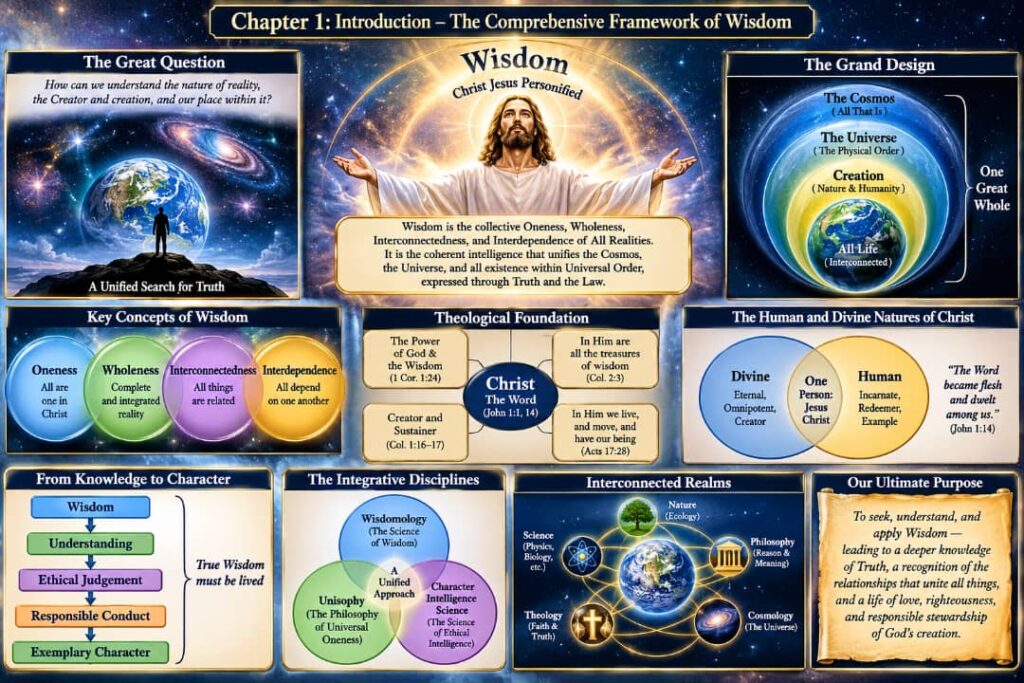
Within Odukaesieme’s philosophical framework, Wisdom is examined in relation to the totality of reality. It is not restricted to the possession of knowledge or the exercise of human intelligence. It concerns the collective Oneness, Wholeness, Interconnectedness, and Interdependence of all realities within Universal Order.
The ontological examination of Wisdom therefore begins with the nature of existence and progresses towards the understanding of reality as an integrated whole.
1.2 THE MEANING AND SCOPE OF ONTOLOGY
Ontology is the philosophical study of being and existence. It investigates what exists, the different kinds of things that exist, and the fundamental relationships through which existence may be understood.
The subject has occupied an important position in the history of philosophy.
Aristotle’s metaphysical inquiry into being, particularly the study of beings insofar as they are beings, represents one of the influential foundations of Western ontological thought.
Ontology raises questions such as:
1. What does it mean to exist?
2. What is the fundamental nature of reality?
3. What distinguishes one form of existence from another?
4. What relationships exist among different entities?
5. What is the relationship between a whole and its constituent parts?
6. Are there fundamental principles through which existence can be understood?
7. How should the relationship between the Creator and creation be understood?
These questions are relevant to the examination of Wisdom because a proper understanding of Wisdom requires an examination of the realities to which it relates.
Ontology provides the philosophical foundation for investigating the nature, structure, and relationships of existence.
1.3 EXISTENCE AS A TOTALITY OF INTERRELATED REALITIES
Existence presents itself through an extraordinary diversity of forms.
There are physical realities, biological realities, human realities, social realities, intellectual realities, and spiritual realities.
The physical world includes matter, energy, space, and the processes investigated by the natural sciences.
The biological world includes living organisms, their structures, functions, development, and relationships with their environments.
Human existence includes consciousness, intelligence, emotions, reasoning, language, relationships, and moral responsibility.
Social existence includes families, communities, institutions, cultures, economies, and political organisations.
Intellectual existence includes knowledge, ideas, theories, philosophical propositions, and scientific explanations.
Spiritual and theological inquiry examines God, creation, faith, revelation, and the ultimate meaning of existence.
These categories are presented to illustrate the diversity of reality. They do not imply that every category is investigated through identical methods or that all forms of existence have the same characteristics.
The important philosophical observation is that reality cannot be adequately understood by considering only one of its dimensions.
The study of a particular part may produce specialised knowledge, but the examination of the totality requires attention to the relationships among different parts and dimensions.
This is one of the central concerns of the present treatise.
1.4 WISDOM AS ONENESS
Oneness is a fundamental dimension of the philosophical framework developed in this work.
It concerns the unity of reality despite the diversity of its constituent forms.
Oneness does not mean that everything is identical. It does not eliminate individuality, distinction, or the unique characteristics of different entities.
A human being is different from a tree. A river is different from a mountain. The Earth is different from the Sun. Each possesses its own characteristics and conditions of existence.
Nevertheless, differences do not necessarily imply absolute separation.
The human body provides a useful illustration. Its organs perform different functions, but their coordinated activities contribute to the life and functioning of one organism.
Similarly, different organisms participate in ecological relationships, while different individuals participate in families, communities, and societies.
These examples demonstrate that unity can exist alongside diversity.
Within Odukaesieme’s framework, Oneness is therefore examined as a principle through which distinct realities may be understood in relation to a greater totality.
The philosophical significance of Oneness lies in recognising unity without denying distinction.
1.5 WISDOM AS WHOLENESS
Wholeness concerns the integrity and completeness of a totality in relation to its constituent dimensions.
A whole may contain different parts, functions, and relationships that contribute to its organisation.
For example, an ecosystem includes living organisms and the physical environment with which they interact. Its examination requires attention to the relationships among organisms, resources, environmental conditions, and ecological processes.
Likewise, the understanding of human health requires consideration of different biological systems and their interactions.
Wholeness does not mean that every part is identical or that every part performs the same function.
It means that the parts must be understood in relation to the organisation and functioning of the whole.
This distinction is important in the examination of Wisdom.
A narrow understanding of reality may produce fragmented knowledge. A broader understanding considers the relationship between individual realities and the totality within which they exist.
Wisdom, in this philosophical framework, requires an appreciation of the whole without neglecting the significance of its individual parts.
1.6 WISDOM AS INTERCONNECTEDNESS
Interconnectedness refers to the relationships through which different entities, systems, and processes are connected.
These relationships may be physical, biological, ecological, social, intellectual, or theological in nature.
In ecology, organisms interact with one another and with their environments. These interactions include competition, predation, cooperation, mutualism, and other ecological relationships.
In human society, individuals are connected through families, education, communication, commerce, governance, and shared institutions.
In the physical sciences, the investigation of natural phenomena reveals relationships among matter, energy, forces, and physical processes.
Interconnectedness therefore encourages the examination of relationships rather than treating every entity as completely isolated.
However, it is important to recognise that not all relationships are direct or equal. Some relationships are immediate, while others are indirect. Some are essential to the functioning of a system, while others have limited influence.
The philosophical importance of interconnectedness lies in recognising that many realities can be properly understood only when their relationships are considered.
Within this treatise, interconnectedness is one of the essential dimensions through which Wisdom is examined.
1.7 WISDOM AS INTERDEPENDENCE
Interdependence refers to the condition in which entities or systems depend upon one another, directly or indirectly, for particular functions, resources, conditions, or outcomes.
In biological existence, organisms depend upon environmental conditions and resources for survival.
Plants require appropriate conditions for growth, while animals depend upon food, water, and suitable habitats.
Human beings also depend upon one another.
The production of food, the provision of healthcare, the development of technology, education, transportation, and the administration of society all involve different forms of cooperation and dependence.
Interdependence does not mean that all entities depend equally upon one another. The degree and nature of dependence vary according to the relationships being examined.
Its philosophical significance is that many forms of existence cannot be adequately understood through the assumption of complete independence.
Within Odukaesieme’s framework, interdependence is a fundamental dimension of the understanding of reality as an integrated totality.
1.8 WISDOM AND UNIVERSAL ORDER
The examination of existence naturally leads to the question of order.
Reality displays different forms of organisation, regularity, structure, and relationship.
The natural sciences investigate many of these patterns through observation, experimentation, mathematical reasoning, and explanatory models.
Physics examines physical laws and interactions.
Biology investigates the organisation and functioning of living systems.
Ecology examines relationships among organisms and their environments.
Cosmology investigates the large-scale structure, history, and development of the universe.
These investigations demonstrate that the natural world can be studied through identifiable patterns and relationships.
In philosophy, the concept of order raises questions about the coherence and intelligibility of reality.
In theology, Universal Order may be understood in relation to the Creator and the order established through creation.
Within this treatise, Universal Order is examined as a foundational principle for understanding the arrangement, relationships, and coherence of existence.
Wisdom is considered in relation to this order because the understanding of reality requires attention not only to what exists but also to the relationships and principles through which existence is understood.
1.9 THE CREATOR AND CREATION: A FUNDAMENTAL DISTINCTION
An important aspect of the ontological examination of existence is the distinction between the Creator and creation.
In Christian theology, God is the Creator of all things, while the universe and everything created belong to creation.
The Creator is not simply another component within the created universe.
This distinction is essential to the theological framework of this treatise.
Creation includes the physical universe, the natural world, living organisms, and humanity. God, as Creator, is understood as distinct from the totality of created things.
The Bible expresses this relationship in Genesis 1:1:
“In the beginning God created the heaven and the earth.”
This passage establishes the biblical foundation for understanding God as Creator and the universe as creation.
The theological examination of Wisdom must therefore recognise both the unity of creation and the distinction between the Creator and what has been created.
The philosophical concept of Universal Oneness should not be interpreted as a denial of this distinction.
Rather, the unity of created realities is examined in relation to the Creator, who remains distinct from creation.
1.10 CHRIST JESUS AND THE THEOLOGICAL FOUNDATION OF WISDOM
The Christian theological examination of Wisdom gives particular attention to Christ Jesus.
First Corinthians 1:24 describes Christ as:
“the power of God, and the wisdom of God.”
This statement establishes an important relationship between Christ and divine Wisdom within Christian theology.
John 1:1 declares:
“In the beginning was the Word, and the Word was with God, and the Word was God.”
John 1:14 further states:
“And the Word was made flesh, and dwelt among us.”
These passages are central to the Christian understanding of Christ’s identity.
Colossians 1:16–17 presents Christ as the one through whom and for whom all things were created, and declares that in Him all things hold together.
These biblical statements provide a theological foundation for examining Christ’s relationship with Wisdom and creation.
Within this treatise, Christ Jesus will be examined as Wisdom personified in the Christian theological understanding.
This examination will distinguish carefully between the theological claims of Scripture, philosophical interpretation, and scientific explanation.
The theological significance of Christ must not be reduced to the status of an ordinary created entity, because Christian doctrine identifies Him with the divine Word and places Him at the centre of the biblical account of creation.
1.11 HUMAN EXISTENCE AND THE MEANING OF ACTS 17:28
Human existence raises fundamental questions about dependence, purpose, responsibility, and the relationship between humanity and the Creator.
Acts 17:28 states:
“For in him we live, and move, and have our being.”
This biblical declaration expresses the dependence of human existence upon God.
It is particularly significant in the theological examination of being because it places human life within a relationship of dependence upon the Creator.
Human beings possess intelligence and the capacity to investigate the world. They can develop scientific knowledge, construct institutions, create technologies, and influence their environments.
Nevertheless, human knowledge and abilities do not make humanity independent of the fundamental conditions of existence.
This recognition should encourage humility and responsibility.
The understanding of human existence must therefore include not only the study of biological and physical conditions but also the moral and theological questions surrounding human purpose and conduct.
1.12 KNOWLEDGE, UNDERSTANDING, AND WISDOM
Knowledge, understanding, and Wisdom are related but distinct concepts.
Knowledge concerns the acquisition and possession of information, facts, principles, and explanations.
Understanding involves interpreting information, recognising relationships, and appreciating the significance of what is known.
Wisdom involves the coherent application of understanding and judgement in relation to Truth, principles, values, and responsible conduct.
A person may possess considerable knowledge without exercising sound judgement.
A scientist may understand the operation of a technology but still require ethical judgement concerning its application.
A political leader may understand the machinery of government but lack the integrity required to govern responsibly.
A medical practitioner may possess technical knowledge but must also exercise sound judgement and respect for human dignity.
These examples illustrate why knowledge alone cannot be regarded as sufficient for Wisdom.
Within this treatise, the relationship may be expressed as follows:
KNOWLEDGE → UNDERSTANDING → ETHICAL JUDGEMENT → RESPONSIBLE CONDUCT → EXEMPLARY CHARACTER
This progression is presented as a conceptual framework rather than a universal empirical law.
It expresses the importance of integrating intellectual ability with ethical responsibility.
Wisdom must therefore be examined not merely as the possession of knowledge but as the proper understanding and responsible application of what is known.
1.13 WISDOM AND THE UNITY OF THE SCIENCES
The different branches of science investigate different dimensions of the natural world.
Physics examines physical phenomena.
Chemistry investigates the composition and transformation of matter.
Biology studies living organisms.
Ecology examines the relationships among organisms and their environments.
Medicine investigates human health and disease.
Geology examines the structure, composition, and history of the Earth.
Astronomy and cosmology investigate celestial objects and the large-scale structure and development of the universe.
These disciplines have distinct methods, specialised questions, and standards of evidence.
Nevertheless, their findings may contribute to a broader understanding of reality.
For example, the study of human health may involve biology, chemistry, physics, environmental science, and medical research.
The examination of climate and environmental change may require contributions from atmospheric science, ecology, geology, chemistry, and mathematics.
Such examples demonstrate the value of interdisciplinary investigation.
The philosophical framework of Wisdom encourages the responsible integration of knowledge while preserving the integrity of individual disciplines.
It does not claim that all scientific questions can be answered through one method or that a philosophical definition can replace empirical investigation.
Rather, it recognises that specialised knowledge may be understood within a wider framework of relationships and significance.
1.14 THE ETHICAL IMPLICATIONS OF ONTOLOGICAL UNDERSTANDING
The examination of existence has important ethical implications.
Human beings do not exist in isolation. Their actions affect other people, institutions, communities, and the natural environment.
The recognition of interconnectedness and interdependence therefore creates a basis for considering responsibility.
Environmental destruction, corruption, dishonesty, negligence, injustice, and abuse of authority can damage the relationships upon which individuals and communities depend.
Conversely, honesty, justice, cooperation, compassion, responsible leadership, and respect for human dignity can strengthen society.
The ethical implications of Wisdom may be considered through four important values:
TRUTH
Truth is essential to the proper understanding of reality. It supports intellectual integrity, sound judgement, and trustworthy relationships.
LOVE
Love expresses concern for the welfare and dignity of others. It provides an important ethical foundation for human relationships.
HUMILITY
Humility recognises the limits of individual knowledge and encourages openness to learning, correction, and responsible reflection.
RESPONSIBILITY
Responsibility requires individuals to consider the consequences of their decisions and actions.
These values connect the philosophical examination of existence with the practical development of human character.
The ultimate importance of understanding reality is not merely intellectual achievement. It must also contribute to responsible human conduct.
1.15 THE PHILOSOPHICAL SIGNIFICANCE OF THE ONTOLOGICAL FOUNDATION
The ontological foundation of Wisdom provides the starting point for examining the nature and relationships of reality.
It establishes the importance of considering existence beyond isolated entities and narrow disciplinary boundaries.
The framework developed in this chapter emphasises five major considerations:
1. EXISTENCE: The recognition that reality includes different forms and dimensions of being.
2. ONENESS: The examination of unity among distinct realities.
3. WHOLENESS: The understanding of parts in relation to the totality.
4. INTERCONNECTEDNESS: The recognition of relationships among different entities and systems.
5. INTERDEPENDENCE: The examination of conditions and relationships through which different realities depend upon one another.
These considerations provide the ontological foundation for the wider examination of Wisdom.
They also prepare the way for the next chapter, which examines Universal Oneness as a central philosophical principle.
The framework does not claim that all realities are identical, that every relationship is direct, or that every aspect of existence has been scientifically explained.
Rather, it proposes that a comprehensive understanding of reality must examine its diversity, relationships, organisation, and wider coherence.
1.16 CONCLUSION
The ontological examination of Wisdom begins with the fundamental question of existence.
It investigates the nature of reality and the relationships among its different dimensions.
The chapter has examined ontology, existence, Oneness, Wholeness, Interconnectedness, Interdependence, Universal Order, the Creator and creation, Christ Jesus, human existence, knowledge, and the ethical implications of understanding reality.
The central argument is that existence should not be examined only through isolated parts. Its relationships, organisation, diversity, and wider coherence must also be considered.
The theological perspective establishes the distinction between the Creator and creation and examines Christ Jesus in relation to divine Wisdom and the creation of all things.
The philosophical perspective considers Oneness, Wholeness, Interconnectedness, and Interdependence as essential dimensions of an integrated understanding of reality.
The scientific illustrations demonstrate the importance of examining relationships and organisation within natural systems, without presenting theological or metaphysical propositions as experimentally established conclusions.
Ultimately, the ontological foundation of Wisdom provides the starting point for understanding the totality of reality within the framework of Universal Order.
The next chapter proceeds from this foundation to examine Wisdom as Universal Oneness.
REFERENCES
The Holy Bible, King James Version.
Aristotle. (1999). Nicomachean Ethics (2nd ed., T. Irwin, Trans.). Hackett Publishing Company.
Aristotle. (1998). Metaphysics (H. Lawson-Tancred, Trans.). Penguin Classics.
Bertalanffy, L. von. (1968). General System Theory: Foundations, Development, Applications. George Braziller.
Kynes, W. (Ed.). (2021). The Oxford Handbook of Wisdom and the Bible. Oxford University Press.
Odum, E. P., & Barrett, G. W. (2005). Fundamentals of Ecology (5th ed.). Thomson Brooks/Cole.
Tansley, A. G. (1935). The use and abuse of vegetational concepts and terms. Ecology, 16(3), 284–307.
Lindeman, R. L. (1942). The trophic-dynamic aspect of ecology. Ecology, 23(4), 399–417.
DEFINITION OF WISDOM
Wisdom is the collective Oneness, Wholeness, Interconnectedness, and Interdependence of All Realities. It is the coherent intelligence that unifies Creation, the Cosmos, the Universe, and all existence within Universal Order, expressed through Truth and the Law established by the Creator.
— ODUKAESIEME
www.odukaesieme.com