

THE NATURE, UNITY, CONSTITUENTS AND GOVERNING ORDER OF WISDOM
Wisdom is the wholeness of existence and Creation, embracing the totality and unity of all realities, truths, knowledge and intelligence, with Oneness as their fundamental principle and Universal Law as the governing order established by the Creator. Wisdom, as presented in this framework, extends beyond the conventional understanding of wisdom as a human capacity for knowledge, intelligence or sound judgment. It is conceived as a comprehensive philosophical framework for understanding existence and Creation in their totality, including their diverse constituents, relationships, truths, knowledge, intelligence and governing order. Its scope encompasses the Cosmos, the Universe, the natural world, living systems and humanity. Wisdom therefore concerns not merely the individual components of reality, but also the relationships, principles and order through which they constitute an interconnected and intelligible whole. Humanity, as an integral part of Creation, is both a subject of Wisdom and a participant in its responsible application.
WISDOM, REALITY, TRUTH, KNOWLEDGE AND INTELLIGENCE
Reality, truth, knowledge and intelligence are essential dimensions of Wisdom. Reality concerns what exists; truth concerns what is genuinely the case about reality; knowledge is understanding acquired through legitimate inquiry, experience and reasoning; and intelligence is the capacity to comprehend, evaluate, reason and apply knowledge. Wisdom brings these dimensions into an integrated relationship. Knowledge detached from truth may lead to error; intelligence without ethical responsibility may be misdirected; and intellectual or technological power without sound judgment may produce harmful consequences. Wisdom therefore concerns not merely the acquisition of knowledge or the exercise of intelligence, but their integration with truth, understanding and responsible judgment.
WHOLENESS, UNITY AND UNIVERSAL ONENESS
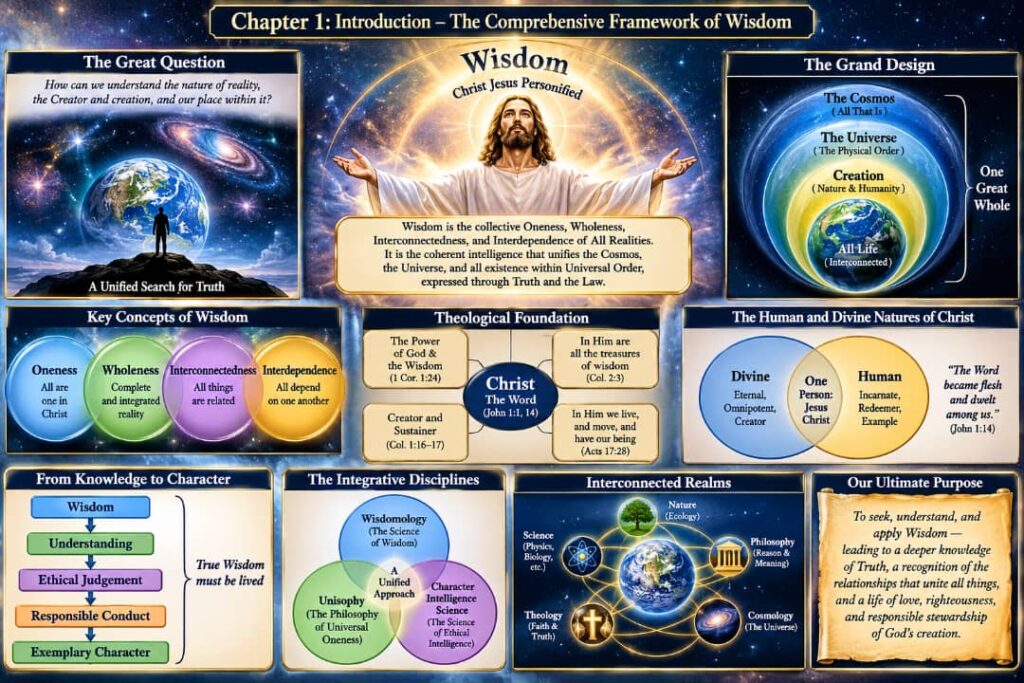
Wholeness expresses the comprehensive nature of Wisdom; unity expresses the relationships connecting its diverse dimensions; and Oneness expresses the fundamental principle underlying their interconnectedness. Universal Oneness does not imply that all things are identical or indistinguishable. Rather, it recognises that distinct realities exist within relationships of interconnectedness and interdependence, forming wider systems and wholes. This principle may be observed in the relationships between organisms and ecosystems, physical structures and natural processes, and individuals and societies. Wisdom therefore requires an understanding of both diversity and unity: the distinct identity of individual realities and the larger whole within which they exist, relate and interact.
WISDOM AND UNIVERSAL LAW
Wisdom is further understood in relation to Universal Law, conceived here as the governing order and fundamental principles established by the Creator through which Creation is ordered. This philosophical conception must be distinguished from particular scientific laws. Scientific laws describe specific patterns and regularities identified through empirical investigation, whereas Universal Law, as used in this framework, refers to the broader governing order of Creation. Wisdom consequently examines not only what exists, but also the relationships, principles and governing order through which existence may be understood as an interconnected whole.
THE CONSTITUENTS OF WISDOM
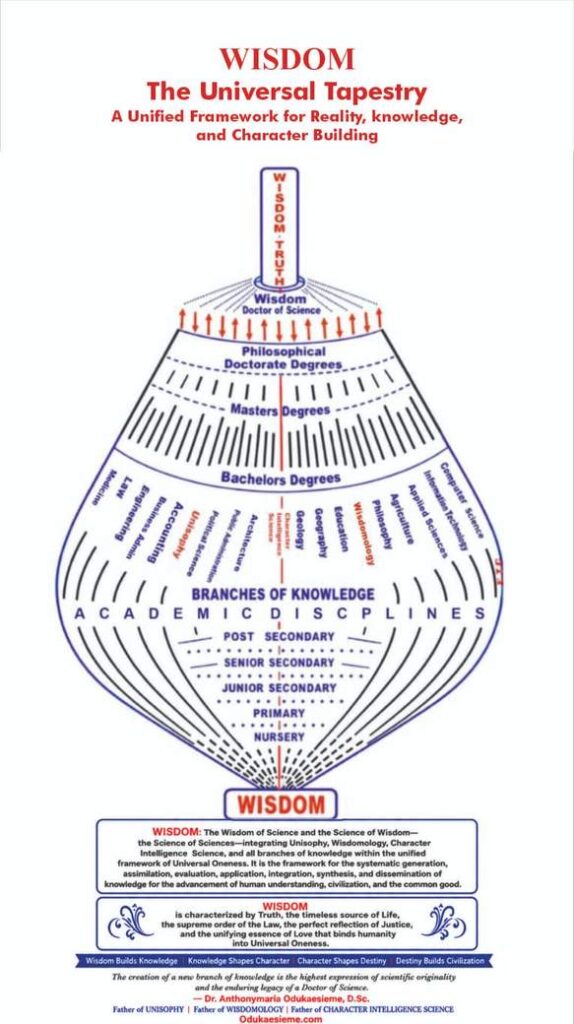
The comprehensive structure of Wisdom may be expressed through eight interconnected dimensions: Reality, Truth, Knowledge, Intelligence, Wholeness, Unity, Oneness and Universal Law. Reality constitutes the field of existence; Truth establishes correspondence with reality; Knowledge provides understanding; Intelligence supplies the capacity to interpret, evaluate and apply that understanding; Wholeness provides the comprehensive perspective; Unity identifies the relationships connecting diverse realities; Oneness expresses their fundamental interconnectedness; and Universal Law represents the governing order of Creation. These dimensions are not isolated elements but mutually related aspects of an integrated framework through which existence and Creation may be examined and understood.
WISDOMOLOGY, UNISOPHY AND CHARACTER INTELLIGENCE SCIENCE
From this comprehensive conception of Wisdom emerge three interconnected intellectual frameworks. Wisdomology is the proposed systematic Science of Wisdom, concerned with the study of the wholeness of existence and Creation, including the relationships among realities, truths, knowledge, intelligence, Oneness and Universal Law. Unisophy is the Philosophy of Universal Oneness, examining the unity, interconnectedness and interdependence of existence and Creation. Character Intelligence Science (CIS) is the Science of Ethical Intelligence and Human Excellence, examining the relationship among character, ethical intelligence, judgment, conduct, leadership and responsible human action. Their conceptual relationship may be expressed as follows: Wisdom is the universal foundation; Wisdomology is the Science of Wisdom; Unisophy is the Philosophy of Universal Oneness; and Character Intelligence Science is the Science of Ethical Intelligence and Human Excellence. Together, these frameworks connect the understanding of existence with the ethical development and responsible advancement of humanity.
HISTORICAL AND INTELLECTUAL CONTEXT
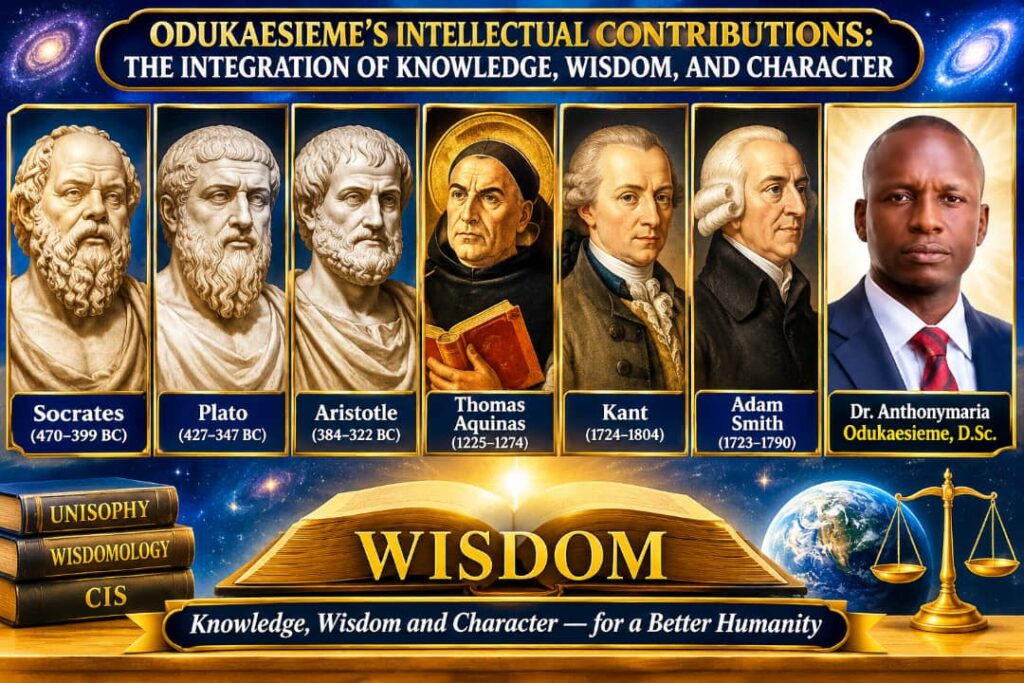
The questions addressed by this framework belong to a long and distinguished tradition of human inquiry. Ancient philosophy examined wisdom, truth, virtue, knowledge and reality; medieval philosophy and theology explored God, Creation, faith and reason; modern philosophy investigated reason, experience and the foundations of knowledge; while modern science progressively revealed the complexity, structure and interrelationships of the natural world. The present framework seeks to bring these related fields of inquiry into a coordinated conceptual structure centred on Wisdom, Universal Oneness, Universal Law and ethical intelligence. Its intellectual contribution should be evaluated through the originality and precision of its definitions, the coherence of its arguments, its engagement with existing scholarship and the evidence supporting its historical and intellectual claims.
INTERDISCIPLINARY AND CIVILIZATIONAL SIGNIFICANCE
Wisdom has far-reaching implications for education, science, technology, philosophy, theology, governance, economics, environmental responsibility and civilisation. It provides a framework for connecting knowledge with judgment, intelligence with responsibility, scientific advancement with ethical consideration, leadership with character, and human development with the wider order of Creation. It further proposes that civilisation should not be measured solely by material prosperity, scientific achievement or technological power, but also by the quality of its knowledge, institutions, human relationships, ethical character and responsible application of intelligence. The ultimate concern is not merely what humanity can discover, create or accomplish, but how such achievements can be directed towards truth, human dignity, the common good and the responsible advancement of civilisation.
SCHOLARLY DEVELOPMENT AND FUTURE INQUIRY
The systematic development of Wisdomology, Unisophy and Character Intelligence Science requires conceptual precision, logical consistency, methodological clarity, engagement with established scholarship, appropriate evidence and openness to critical examination. Wisdomology must clarify the scope, principles and methods that distinguish a systematic Science of Wisdom from general philosophical reflection on wisdom. Unisophy must rigorously examine the meaning, foundations and implications of Universal Oneness. Character Intelligence Science must define and systematically investigate character, ethical intelligence and human excellence, including their relationship with individual conduct and societal development. Further inquiry should also examine the philosophical foundations of Wisdom and Oneness, the relationship between Universal Law and Creation, the distinction between the universal conception of Wisdom and human wisdom, and the practical application of these frameworks to education, leadership, governance and civilisation.
CONCLUSION
Wisdom is presented in this framework as the universal wholeness of existence and Creation, embracing the totality and unity of realities, truths, knowledge and intelligence, with Oneness as their fundamental principle and Universal Law as the governing order established by the Creator. Its central significance lies in integrating dimensions of existence and human understanding that are often examined separately: reality and truth, knowledge and intelligence, diversity and unity, intellectual advancement and ethical responsibility, and human development and the wider order of Creation. Wisdomology provides the proposed Science of Wisdom; Unisophy provides the Philosophy of Universal Oneness; and Character Intelligence Science provides the Science of Ethical Intelligence and Human Excellence. Together, they constitute an integrated intellectual vision directed towards comprehensive understanding, responsible knowledge, ethical character and the advancement of humanity and civilisation.
Wisdom, therefore, is not presented merely as a human possession or intellectual accomplishment, but as the comprehensive framework through which existence, Creation, truth, knowledge, intelligence, responsibility and the fundamental unity of reality may be understood in their totality.
BIBLICAL AND CHRISTOLOGICAL RECONCILIATION
This understanding of the universal wholeness, interconnectedness and governing order of Creation finds a profound biblical expression in Acts 17:28: “For in him we live, and move, and have our being; as certain also of your own poets have said, For we are also his offspring.” (KJV).
In the Christian understanding, this truth finds its fullest Christological expression in Christ Jesus, through whom all things were created and in whom all things hold together (Colossians 1:16–17). Christ Jesus therefore occupies a central place in understanding the relationship between the Creator, Creation and the universal order. The biblical affirmation that all existence derives its being and sustenance from God provides a theological foundation for understanding the unity, interdependence and wholeness of Creation. Thus, the philosophical conception of Wisdom presented here finds a profound point of reconciliation with the Christian revelation of God through Christ Jesus.
— Odukaesieme
www.odukaesieme.com