

Wisdom reaches beyond the individual human mind into the larger order of existence. To understand Wisdom fully is to recognise that creation is not merely a collection of unrelated things, but a reality in which relationships, principles, patterns, causes, consequences, and interdependencies exist.
The order of creation refers to the arrangement, relationship, continuity, and governing principles through which existence operates. It is the intelligible structure within which life unfolds and through which the different dimensions of creation relate to one another.
Wisdom seeks to understand this order.
Human intelligence observes the world, investigates its processes, discovers its patterns, and develops knowledge about its operation. Science is one of the great expressions of this human capacity. Yet Wisdom asks a deeper question: What does the order we discover reveal about existence itself, and how should humanity live within that order?
The discovery of order is therefore not merely an intellectual exercise. It carries responsibility.
When human beings understand the laws and processes of nature, they acquire greater capacity to intervene in the world. That capacity can be used constructively or destructively. Wisdom therefore requires that knowledge of creation be accompanied by respect for the order within which creation exists.
Creation demonstrates relationship.
The earth depends upon the sun.
Life depends upon ecological relationships.
Human beings depend upon one another.
Societies depend upon cooperation.
Civilizations depend upon systems of knowledge, justice, responsibility, and order.
Nothing exists entirely in isolation.
This recognition is central to Wisdom.
The human tendency to see existence in isolated fragments can produce fragmented thinking. Wisdom seeks integration. It asks how each part relates to the whole and how changes in one part may influence other parts.
Thus, Wisdom is the intelligence of relationship.
The order of creation also reveals the importance of balance. Natural systems often depend upon dynamic relationships among different elements. Excess in one direction can disturb the stability of the whole.
Human life likewise requires balance.
Knowledge requires wisdom.
Freedom requires responsibility.
Power requires restraint.
Justice requires compassion.
Individuality requires relationship.
Progress requires sustainability.
Wisdom recognises that genuine order is not necessarily rigid uniformity. Order can contain diversity, movement, growth, adaptation, and change while still maintaining coherence.
This is an important principle for understanding creation.
The existence of diversity does not necessarily mean the absence of unity. Different forms of life, different systems, different functions, and different expressions may participate within a larger order.
Wisdom therefore seeks unity without destroying legitimate diversity.
This understanding becomes increasingly important in human civilization. Humanity consists of individuals, families, communities, cultures, institutions, and nations. These differences can produce richness and creativity, but without an understanding of relationship they can also produce division and conflict.
Wisdom asks humanity to recognise both distinction and connection.
The individual is not the whole.
The community is not the whole.
The nation is not the whole.
Humanity itself exists within a larger order of creation.
This does not diminish the value of the individual or any particular community. Instead, it places each within a wider context of responsibility and relationship.
Wisdom therefore teaches that human freedom must operate within reality rather than against it.
Human beings have the capacity to transform their environment, develop technologies, create institutions, and alter the conditions of life. But human power does not eliminate the consequences of violating fundamental relationships and realities.
Nature responds to misuse.
Societies respond to injustice.
Individuals respond to oppression.
Institutions respond to corruption.
Civilizations respond to disorder.
Wisdom therefore requires an understanding of consequences.
The order of creation is not merely something to observe. It is something within which humanity participates.
Human beings are both observers and participants in creation.
They study nature while being part of nature.
They investigate life while being living beings.
They develop knowledge while being subject to the realities they seek to understand.
This creates a profound responsibility.
The more humanity understands, the more responsibly that understanding must be used.
Wisdom therefore transforms the study of creation into a philosophy of responsible participation.
The wise person does not seek merely to control everything that can be controlled. The wise person seeks to understand when intervention is appropriate, when cooperation is necessary, when restraint is required, and when humility is wiser than domination.
This principle is particularly relevant to scientific and technological civilization.
Technology gives humanity extraordinary power to modify its environment. Yet the possession of power does not automatically confer Wisdom about how that power should be used.
Wisdom must therefore accompany scientific progress.
Scientific knowledge can reveal what is possible.
Wisdom asks what is appropriate.
Technology can reveal what can be achieved.
Wisdom asks what should be achieved.
Human intelligence can expand power.
Wisdom determines how that power should serve life and the whole.
The order of creation therefore becomes a teacher of Wisdom.
It teaches relationship.
It teaches interdependence.
It teaches balance.
It teaches consequence.
It teaches continuity.
It teaches humility.
It teaches that existence is greater than any single part within it.
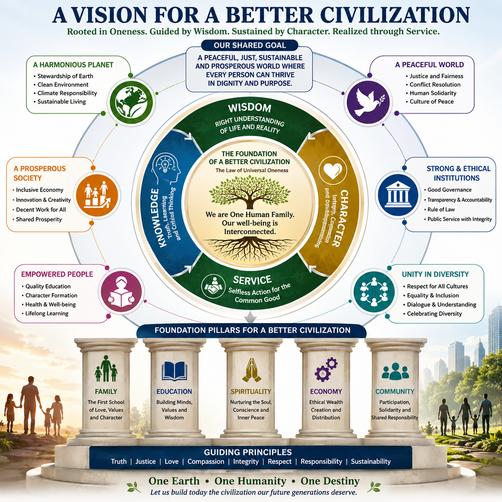
The deeper humanity understands this order, the more clearly it can recognise the principle of Universal Oneness.
Universal Oneness does not mean that everything is identical. It means that existence is fundamentally interconnected within a greater unity of relationship.
Wisdom therefore moves from understanding the order of individual things toward understanding the unity of the whole.
The order of creation is consequently not separate from Wisdom. It is one of the realities through which Wisdom becomes visible.
Wisdom is the capacity to understand the order, recognise one’s place within it, respect its principles, and act in harmony with the whole.
This understanding prepares the foundation for the next chapter:
Wisdom And Universal Oneness.
-Dr. Anthonymaria Odukaesieme, D.Sc.
Founder of Unisophy
Founder of Wisdomology
Founder of Character Intelligence Science