

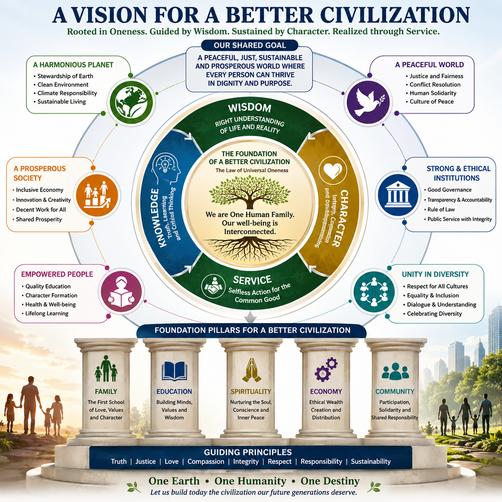
The recognition of Universal Oneness naturally leads to the recognition that interconnected existence is not without order. Where there is relationship, there are principles governing those relationships. Where there is harmony, there is an order through which harmony is sustained. Where there is unity within diversity, there are principles through which that unity remains coherent.
The Law that governs Oneness is therefore the principle of order within the interconnectedness of existence.
Universal Oneness is not merely the statement that everything is connected. It is the recognition that the relationships within existence operate according to an intelligible order.
Wisdom seeks to perceive this order.
The Law does not create the reality of Oneness. Rather, it expresses the governing principle through which Oneness operates.
This distinction is fundamental.
Wisdom recognises the order.
The Law expresses the principle of the order.
Oneness reveals the unity within which the order operates.
Thus, Wisdom, Oneness, and Law are not isolated concepts. They form an integrated philosophical relationship.
Wisdom perceives.
Oneness connects.
Law governs.
The existence of order can be observed throughout creation. The movements of celestial bodies follow patterns. Natural processes operate according to consistent principles. Life depends upon relationships and conditions. Human societies develop systems of order through laws, customs, responsibilities, and institutions.
These different expressions of order point toward a deeper principle: existence is not arbitrary.
Human beings may discover, interpret, and formulate laws, but humanly formulated laws are not identical to the fundamental order of existence. Human law seeks to regulate human conduct; the Universal Law concerns the deeper principles governing relationships within existence.
This distinction is essential.
Human laws can be changed.
Human laws can be mistaken.
Human laws can be unjust.
Human laws can be improved.
But the deeper order of existence is not created by human legislation.
Wisdom therefore seeks to discover the principles of order rather than merely impose human preferences upon reality.
The Law that governs Oneness can consequently be understood through relationship, consequence, balance, reciprocity, responsibility, and harmony.
Every action occurs within a network of relationships.
Every relationship produces consequences.
Every consequence becomes part of the continuing order of existence.
Therefore, no action is entirely isolated.
This is why Wisdom recognises responsibility as a natural consequence of Oneness.
If all existence is interconnected, then actions affect relationships, and relationships affect the whole.
To harm another is not merely to affect another.
To corrupt an institution is not merely to affect an institution.
To damage the natural environment is not merely to affect nature.
Each action enters the wider network of existence and produces consequences beyond the immediate moment.
Wisdom therefore teaches that freedom cannot be separated from responsibility.
The greater the capacity to act, the greater the responsibility to understand the consequences of action.
This principle applies to individuals, institutions, nations, and humanity as a whole.
The Law governing Oneness therefore reveals that existence is relational.
Nothing exists entirely by itself.
Everything participates in relationships.
Everything is affected by relationships.
Everything contributes, directly or indirectly, to the continuing condition of the whole.
This does not mean that every event is caused by every other event. Rather, it means that existence is structured through relationships and that actions within those relationships can produce consequences beyond their immediate point of origin.
Wisdom enables humanity to recognise these relationships.
Discernment enables humanity to distinguish them.
Judgment enables humanity to respond appropriately.
Character enables humanity to act responsibly.
The Law provides the order within which these actions occur.
Harmony is therefore not merely the absence of conflict. Harmony is the condition in which relationships operate in appropriate order.
Justice contributes to harmony.
Truth contributes to harmony.
Love contributes to harmony.
Responsibility contributes to harmony.
Respect contributes to harmony.
When these principles are violated, disorder emerges.
Thus, the Law governing Oneness may be understood as a Law of ordered relationship.
It does not eliminate diversity.
It coordinates diversity.
It does not abolish individuality.
It places individuality within relationship.
It does not prevent change.
It provides continuity and coherence through change.
This understanding gives Universal Oneness practical significance.
Oneness is not simply a philosophical statement about the unity of existence. It becomes a principle of life.
To recognise Oneness is to recognise responsibility.
To recognise responsibility is to recognise consequence.
To recognise consequence is to recognise order.
To recognise order is to seek the Law through which that order operates.
Wisdom therefore leads the human mind from observation to understanding, from understanding to recognition, and from recognition to responsible participation.
This is where the philosophy of Unisophy becomes deeply connected with Wisdomology.
Unisophy seeks to understand Universal Oneness.
Wisdomology seeks to understand Wisdom.
The Law that governs Oneness provides a bridge between them.
Wisdom reveals the principle.
Unisophy recognises the unity.
The Law explains the order.
Together, they form an integrated philosophical vision in which Wisdom is not merely an intellectual achievement but a way of understanding and participating responsibly in the Universal Order.
The ultimate purpose of understanding the Law is therefore not domination over creation.
It is harmony with creation.
Humanity does not become wise by attempting to control everything. Humanity becomes wise by understanding the order within which it exists and learning how to act responsibly within that order.
The Law governing Oneness therefore calls humanity toward truth, responsibility, justice, compassion, balance, and harmony.
It reveals that the wellbeing of the whole cannot be permanently separated from the responsible wellbeing of its parts.
The individual matters.
The community matters.
Humanity matters.
Creation matters.
And their relationships matter.
Wisdom is the capacity to understand these relationships and to act accordingly.
The Law is the principle through which those relationships remain ordered.
Universal Oneness is the reality within which those relationships exist.
Thus:
Wisdom perceives the Law.
The Law governs Oneness.
Oneness reveals the interconnectedness of existence.
And humanity, through Wisdom, learns to participate consciously and responsibly within the whole.
The understanding of this relationship prepares the way for the next dimension of Wisdom:
Wisdom, Love, And Harmony.
-Dr. Anthonymaria Odukaesieme, D.Sc.
Founder of Unisophy
Founder of Wisdomology
Founder of Character Intelligence Science