

If Universal Oneness reveals the interconnectedness of existence, and the Law reveals the order governing that interconnectedness, then Love expresses the relational force through which the parts of the whole can coexist, cooperate, and contribute to harmony.
Love, in its highest expression, is not merely an emotion. It is a principle of relationship, recognition, responsibility, and goodwill. It is the willingness to recognise the value of another and to act in ways that preserve, protect, nurture, and advance the wellbeing of the whole.
Wisdom gives Love understanding.
Love gives Wisdom human expression.
Without Wisdom, love may become blind affection, attachment, partiality, or sentiment without discernment. Without Love, Wisdom may become cold intellectualism, detached from compassion and the wellbeing of others.
Wisdom and Love therefore complement one another.
Wisdom asks what is true and what is right.
Love asks how truth and right action can serve life and relationship.
Wisdom provides direction.
Love provides compassion.
Wisdom provides discernment.
Love provides care.
Wisdom provides judgment.
Love provides mercy.
Together, they create the conditions for harmony.
Harmony is not the elimination of difference. It is the proper relationship of differences within a greater unity.
A musical harmony does not require every note to be identical. The beauty comes from the relationship among different notes. In the same way, human harmony does not require every person, culture, community, or nation to become identical. It requires differences to exist within an order of mutual respect, justice, responsibility, and cooperation.
Wisdom understands this principle.
Love enables it to be lived.
Universal Oneness provides its wider context.
The Law provides its order.
Harmony is therefore not accidental. It emerges when relationships are governed by principles that respect both individuality and the whole.
Human relationships demonstrate this continuously.
Families require love, but they also require wisdom.
Communities require cooperation, but they also require justice.
Nations require sovereignty, but they also require responsibility toward humanity.
Humanity requires diversity, but it also requires recognition of common existence.
Wisdom therefore prevents Love from becoming partial or destructive.
Love without Wisdom may protect wrongdoing in the name of affection. Wisdom without Love may recognise wrongdoing without sufficient compassion for the person involved.
The wise expression of Love therefore combines truth with compassion.
It does not confuse forgiveness with the approval of wrongdoing.
It does not confuse compassion with weakness.
It does not confuse justice with revenge.
It does not confuse peace with the absence of truth.
True harmony requires balance.
Justice without compassion can become harshness.
Compassion without justice can become permissiveness.
Truth without Love can become cruelty.
Love without truth can become deception.
Wisdom brings these principles into proper relationship.
This is why Wisdom is essential to harmony.
Harmony is not merely a pleasant condition. It is an ordered state of relationship in which the different parts of a system can function without destroying one another.
Within the individual, harmony exists when thought, character, emotion, values, and action are brought into responsible alignment.
Within the family, harmony exists when love, respect, responsibility, and communication are cultivated.
Within society, harmony requires justice, truth, cooperation, accountability, and respect for human dignity.
Within civilization, harmony requires institutions and systems that serve the wellbeing of humanity rather than merely the interests of the powerful.
Within creation, harmony requires humanity to recognise that it exists within, rather than outside, the natural order.
Wisdom therefore expands the meaning of Love from personal affection to universal responsibility.
To love the whole is to recognise that the wellbeing of others matters.
To love humanity is to recognise that every human life possesses dignity.
To love creation is to recognise that the conditions sustaining life deserve responsible stewardship.
To love truth is to refuse deliberate falsehood.
To love justice is to oppose exploitation and oppression.
To love Wisdom is to remain committed to learning, understanding, and responsible action.
Love therefore becomes an active principle.
It is not merely what one feels.
It is what one is willing to protect, nurture, serve, and uphold.
This is where Love meets Character.
A person may claim to love humanity, but character reveals whether that love is expressed through honesty, compassion, service, responsibility, patience, humility, and justice.
Wisdom transforms Love from sentiment into disciplined conduct.
The highest form of Love is therefore not simply emotional attachment but a conscious commitment to the good.
This commitment extends beyond personal preference.
It recognises that genuine wellbeing cannot be built permanently upon the suffering, exploitation, or destruction of others.
Thus, Love and Universal Oneness are deeply connected.
If existence is interconnected, then Love becomes an appropriate response to that interconnectedness because it recognises relationship rather than isolation.
Love says:
You matter.
I matter.
We are related.
Our actions have consequences.
Therefore, our relationship carries responsibility.
This recognition is one of the foundations of peaceful civilization.
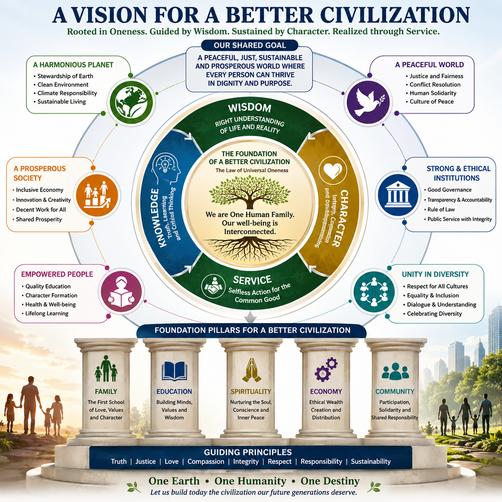
A civilization without Love may become efficient but inhumane.
A civilization without Wisdom may become powerful but destructive.
A civilization without harmony may become divided and unstable.
But when Wisdom, Love, and harmony are integrated, knowledge can become service, power can become responsibility, and civilization can become an instrument for human flourishing.
Wisdom therefore teaches that the highest expression of intelligence is not domination but harmonious participation.
The wise person seeks not merely to succeed within the world but to contribute to the wellbeing of the world.
This is the movement from individual Wisdom toward civilizational Wisdom.
As humanity develops greater knowledge, technology, and power, the need for this integration becomes increasingly important. The future of civilization will depend not only on what humanity can invent, but on whether humanity possesses sufficient Wisdom and Love to govern what it invents.
The purpose of Wisdom is therefore not merely to understand the Universal Order.
It is to live within that order with truth, character, responsibility, Love, and harmony.
Wisdom recognises Oneness.
The Law orders Oneness.
Love humanises relationship.
Harmony expresses the proper relationship of the whole.
Together, they form a foundation for a civilization capable of advancing without losing its humanity.
-Dr. Anthonymaria Odukaesieme, D.Sc.
Founder of Unisophy
Founder of Wisdomology
Founder of Character Intelligence Science