

Introduction: An Intellectual Framework For Integration
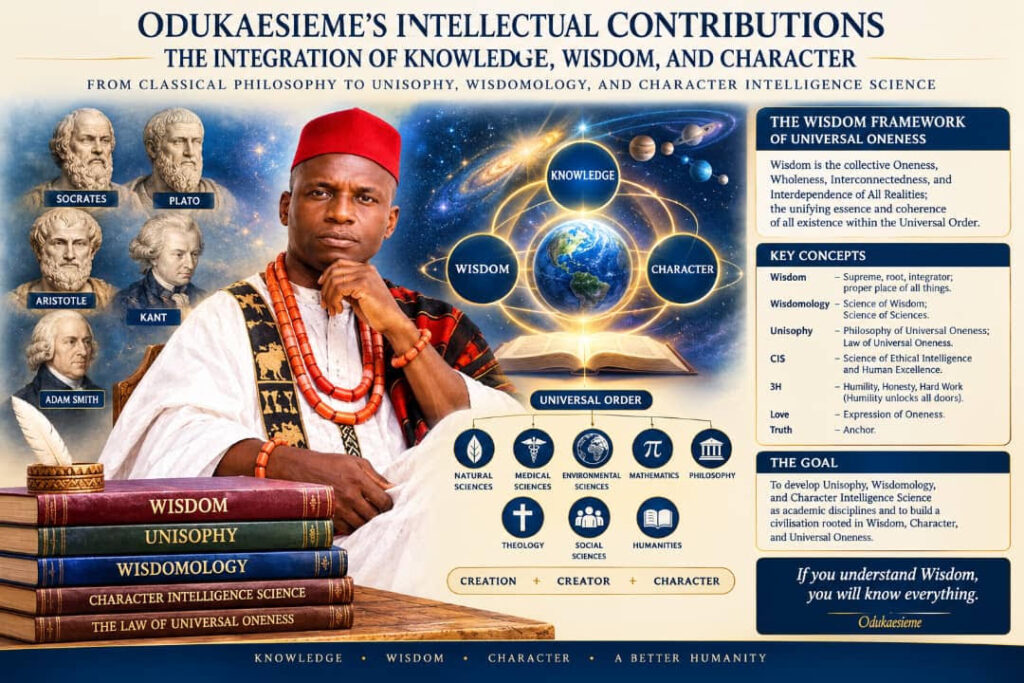
The history of human thought is marked by exceptional thinkers whose contributions have transformed humanity’s understanding of truth, knowledge, wisdom, ethics, nature, and civilization. From Socrates, Plato, and Aristotle in ancient Greece to Immanuel Kant and Adam Smith in modern philosophy, successive generations of thinkers have expanded the intellectual foundations upon which contemporary knowledge and civilization rest.
Dr. Anthonymaria Odukaesieme’s intellectual work enters this historical tradition with an integrative objective: to establish a framework connecting the interconnectedness of existence, the science of wisdom, and the intelligence of ethical character. His work is organized around three interconnected disciplines: Unisophy, the Philosophy of Universal Oneness; Wisdomology, the Science of Wisdom; and Character Intelligence Science (CIS).
The distinctive ambition of this framework is to bring philosophical understanding, scientific knowledge, wisdom, and ethical character into a unified system for examining human development and civilization. Rather than treating these concerns as isolated subjects, Odukaesieme seeks to establish their relationship as a foundation for responsible human action, institutional effectiveness, and the advancement of civilization.
His intellectual significance must therefore be examined through two complementary perspectives: his relationship with the established traditions of philosophy and the originality of the conceptual framework through which he seeks to integrate their enduring questions.
-
Socrates: The Pursuit Of Wisdom And Virtue
Socrates occupies a foundational position in Western philosophy through his commitment to critical questioning, self-examination, and the pursuit of wisdom. His philosophical method challenged assumptions and encouraged the examination of human beliefs, moral conduct, and the meaning of a good life. His intellectual legacy established a lasting relationship between the pursuit of knowledge and the examination of virtue.
Odukaesieme shares this fundamental concern with wisdom and ethical conduct. However, his approach seeks to extend the inquiry through the formal development of Wisdomology as a distinct discipline and Character Intelligence Science as a framework for examining the relationship between character, intelligence, and human performance.
Where Socrates is especially associated with philosophical dialogue and the examination of virtue, Odukaesieme seeks to organize wisdom and character into interconnected disciplines intended to guide practical human development.
The distinction lies not in claiming that Socrates lacked a concern for practical wisdom, but in Odukaesieme’s attempt to formalize these concerns within a broader, integrated intellectual system.
-
Plato: Truth, Knowledge, And The Good
Plato made enduring contributions to metaphysics, epistemology, ethics, and political philosophy. His examination of truth, knowledge, justice, and the Good profoundly influenced the development of Western thought. His political philosophy also emphasized the importance of wisdom in leadership and the governance of society.
Odukaesieme’s intellectual framework similarly places Truth and Wisdom at the centre of human development. His approach, however, seeks to connect these principles with Universal Oneness, Natural Law, and the practical role of character in determining how knowledge and intelligence are exercised.
Through Unisophy, he proposes a unifying philosophical framework for understanding the interconnectedness of existence and knowledge. Through Wisdomology and Character Intelligence Science, he seeks to connect this philosophical foundation with the responsible application of knowledge and the development of ethical human capabilities.
Where Plato developed influential philosophical accounts of truth, knowledge, and the Good, Odukaesieme’s distinctive ambition is to integrate related concerns through three interconnected disciplines with an explicit orientation towards human development and civilization.
-
Aristotle: Systematic Knowledge, Virtue, And Practical Wisdom
Aristotle stands among history’s most influential systematic thinkers. His contributions encompass logic, metaphysics, biology, ethics, politics, and other fields. His concept of practical wisdom, or phronesis, addresses the ability to deliberate well and make sound judgments in particular circumstances. His virtue ethics also examines the development of good character through habituation and responsible conduct.
Aristotle’s work is especially relevant to Odukaesieme’s intellectual project because both recognize the importance of connecting knowledge with sound judgment and ethical action.
Nevertheless, their approaches have different organizing emphases. Aristotle developed an extensive philosophical system examining numerous branches of knowledge and dimensions of human existence. Odukaesieme seeks to organize the relationship between universal interconnectedness, wisdom, and character intelligence through three formally distinguished disciplines.
Unisophy provides the proposed philosophical foundation of Universal Oneness; Wisdomology addresses the systematic understanding and application of wisdom; and Character Intelligence Science examines the relationship between character, intelligence, and human performance.
The intended distinction is therefore structural and integrative. It lies in the proposed organization of these concerns into a connected framework rather than in the assertion that earlier philosophers failed to recognize their importance.
-
Immanuel Kant: Reason, Moral Duty, And Human Dignity
Immanuel Kant profoundly influenced modern philosophy through his investigations of human reason, the conditions of knowledge, moral duty, and human autonomy. His ethical philosophy emphasizes the importance of moral principles and insists that humanity must be treated as an end in itself rather than merely as a means.
Kant’s work provides an important point of comparison with Odukaesieme’s emphasis on the ethical direction of intelligence and the responsible exercise of human capabilities.
Odukaesieme’s framework seeks to connect ethical responsibility with a wider philosophical structure encompassing Wisdomology, Character Intelligence Science, Natural Law, and Universal Order.
This integration has potential relevance to contemporary questions about leadership, scientific advancement, economic efficiency, and technological development. It emphasizes that the value of knowledge and capability must be considered alongside the principles governing their application and the consequences of their use.
The distinction is the proposed integration of wisdom, character, and universal interconnectedness within a framework intended to address both individual conduct and broader civilizational challenges.
-
Adam Smith: Moral Philosophy And Economic Efficiency
Adam Smith’s contributions to moral philosophy and political economy provide another important historical point of comparison. Through The Theory of Moral Sentiments, he examined sympathy, moral judgment, and human social behaviour. Through The Wealth of Nations, he developed influential analyses of economic activity, markets, productivity, and the organization of economic life.
His work demonstrates the importance of examining economic activity in relation to human behaviour and social institutions.
Odukaesieme’s proposed Law of Economic Efficiency, situated within Character Intelligence Science, places particular emphasis on the relationship between character and economic performance. It raises the question of how honesty, integrity, responsibility, and other dimensions of character influence the use of resources, the exercise of economic authority, and the achievement of sustainable outcomes.
The distinctive proposition is that economic efficiency should be examined not only through productivity, resource allocation, technology, and institutional capacity but also through the character of those who make decisions and direct economic activity.
This perspective provides a basis for examining character as a potentially important determinant of economic conduct and institutional performance. Its scientific strength will depend on clearly defined principles, measurable variables, and evidence establishing the relationships it proposes.
-
UNISOPHY: The Philosophy Of Universal Oneness
Unisophy is founded on the principle of Universal Oneness. It approaches existence through the interconnectedness and interdependence of realities, knowledge, and human actions.
The idea that existence is interconnected has precedents in several philosophical and intellectual traditions. Odukaesieme’s contribution must therefore be understood in terms of his particular formulation of Universal Oneness, the principles he derives from it, and the systematic role he assigns to it within his wider intellectual framework.
Unisophy seeks to provide a unifying philosophical foundation for understanding the relationships among different branches of knowledge and dimensions of existence. It encourages an integrated examination of the sciences, human relationships, ethical conduct, and the wider order within which human life unfolds.
Its proposed distinction lies in its formalization as a named philosophical discipline and its intended function as the foundational principle connecting Wisdomology and Character Intelligence Science.
Within this framework, Universal Oneness is not merely an abstract proposition about existence. It serves as a guiding principle for considering the relationships among knowledge, human responsibility, and civilization.
-
WISDOMOLOGY: The Science Of Wisdom
Wisdom has occupied a central place in philosophy since antiquity. Socrates examined the relationship between wisdom and virtue; Plato explored knowledge and the Good; Aristotle investigated practical wisdom and sound judgment; and numerous subsequent thinkers examined wisdom through ethics, religion, psychology, and theories of human development.
Odukaesieme’s Wisdomology seeks to establish wisdom as a distinct and systematic field of inquiry.
Within this framework, wisdom is not merely the accumulation of information, the possession of intellectual ability, or the product of experience. It concerns the proper understanding, evaluation, organization, and application of knowledge in pursuit of truth, sound judgment, ethical responsibility, and human advancement.
Wisdomology therefore seeks to address a fundamental question: how can knowledge be directed towards appropriate and beneficial ends?
Its proposed distinction lies in the formalization of the Science of Wisdom as an identifiable discipline and its integration with the philosophy of Universal Oneness and the study of Character Intelligence Science.
To establish its scientific standing, Wisdomology requires clearly articulated foundational concepts, systematic methods of inquiry, and criteria through which its propositions and practical applications can be evaluated.
Its intellectual importance rests on the proposition that the advancement of knowledge should be accompanied by the advancement of wisdom in its application.
-
Character Intelligence Science: The Intelligence Of Ethical Character
Character has long been examined through moral philosophy, ethics, psychology, education, and theories of human development. Odukaesieme’s Character Intelligence Science seeks to extend this inquiry by treating character as a functional dimension of intelligence and human performance.
Its central proposition is that intellectual ability, technical competence, and analytical capacity do not, by themselves, guarantee responsible decisions or beneficial outcomes.
The manner in which intelligence is exercised is influenced by the principles, dispositions, and ethical qualities governing human conduct. Honesty, integrity, humility, responsibility, and disciplined judgment can influence how individuals use knowledge, exercise authority, manage resources, and fulfil institutional responsibilities.
Character Intelligence Science therefore seeks to examine the relationship between character and the effective, responsible application of intelligence across different areas of human endeavour.
Its proposed applications include education, leadership, governance, economics, healthcare, and scientific and technological development.
The distinctive ambition of CIS is to establish character as an explicit subject of systematic inquiry in relation to intelligence, decision-making, and human performance. Its scientific development requires operational definitions of character intelligence, reliable methods of assessment, and empirical evidence connecting its proposed dimensions with relevant outcomes.
The importance of this approach is that it directs attention beyond what individuals and institutions are capable of doing towards the principles governing what they actually do and the consequences of their actions.
-
The Integration: Odukaesieme’s Distinctive Intellectual Framework
The central distinction of Odukaesieme’s intellectual project lies in the proposed integration of three disciplines into a coherent framework for human development and civilization.
UNISOPHY establishes the philosophical principle of Universal Oneness and the interconnectedness of existence.
WISDOMOLOGY addresses the systematic understanding and application of wisdom as a guiding intelligence for organizing knowledge and directing action.
CHARACTER INTELLIGENCE SCIENCE examines the relationship between character, intelligence, ethical decision-making, and human performance.
These disciplines are intended to function in relationship with one another rather than as independent intellectual compartments. Unisophy provides the proposed philosophical foundation; Wisdomology addresses the intelligent application of knowledge; and Character Intelligence Science examines the character-related principles governing the exercise of intelligence.
Together, they seek to connect the nature of existence, the purpose of knowledge, and the ethical consequences of human action.
This integrated structure constitutes the central organizing proposition of Odukaesieme’s intellectual framework.
Its originality should be established through the historical documentation of its development, the precise definitions of its concepts, its published formulations, and a careful comparison with existing philosophical and scientific systems. Such examination would distinguish the elements inherited from established traditions from the particular concepts, relationships, and methods developed within Odukaesieme’s work.
-
Odukaesieme, Artificial Intelligence, And Superintelligence
The advancement of artificial intelligence has intensified longstanding questions about the relationship between intelligence, wisdom, ethics, responsibility, and human welfare.
Artificial General Intelligence and superintelligence raise particularly important questions about the direction and consequences of increasingly powerful computational systems.
Odukaesieme’s framework offers a philosophical basis for examining these developments through the relationship between Wisdomology, Character Intelligence Science, Natural Law, and Universal Order.
Computational capacity, processing speed, and analytical performance are important dimensions of artificial intelligence. However, capability alone does not establish the ethical acceptability of a system’s objectives, decisions, or consequences.
The central question is not simply how powerful an intelligent system can become, but how its capabilities can be directed, governed, and evaluated in relation to human welfare and ethical responsibility.
Wisdomology provides a proposed framework for examining the appropriate application of intelligence. Unisophy emphasizes the interconnected consequences of technological actions. Character Intelligence Science raises questions about the character, responsibilities, and decision-making principles of the people and institutions that develop and deploy advanced systems.
This approach does not require attributing human conscience or moral character to machines. Rather, it emphasizes the importance of evaluating artificial intelligence through the ethical principles governing its design, objectives, oversight, and use.
The broader proposition is that technological advancement should not be measured exclusively by computational power or efficiency. It must also be assessed in relation to its consequences for humanity, the environment, social institutions, and the wider order of existence.
-
Originality, Historical Development, And Intellectual Contribution
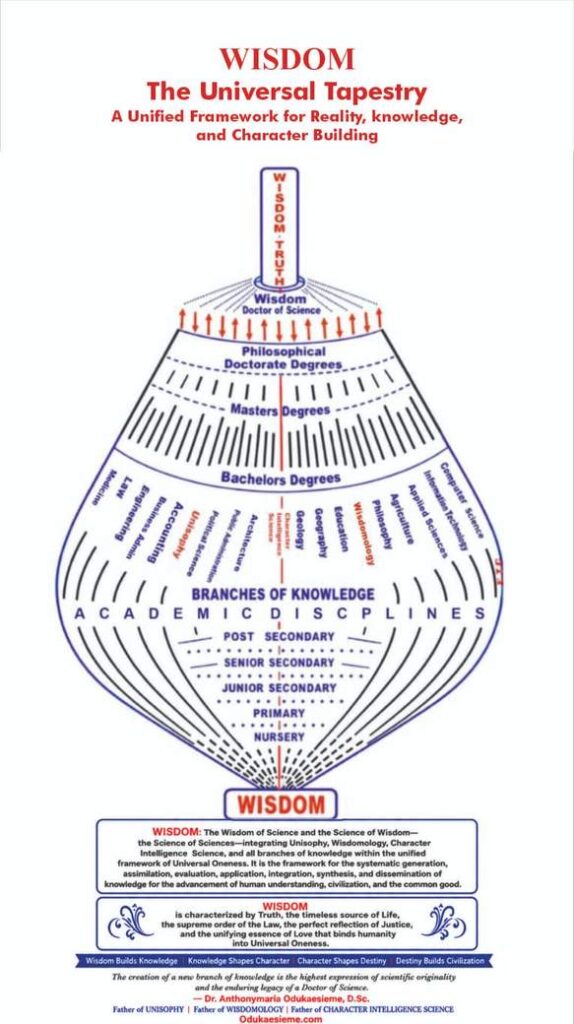
The originality of an intellectual contribution is best established through the identification of its concepts, the documentation of their development, and a rigorous comparison with relevant earlier work.
In Odukaesieme’s case, his published writings provide an important basis for investigating the historical development of his ideas. His work, WISDOM: A Discovery in a Nation with a Broken Heart, first published in 2000, is a significant starting point for documenting the development of his thinking about wisdom and its relationship to human affairs.
A systematic examination of this and his subsequent publications could establish the chronology of his formulations, the evolution of his terminology, and the relationships among Unisophy, Wisdomology, and Character Intelligence Science.
This historical record is particularly important because the originality of a framework does not depend merely on the novelty of its name. It depends on the substance of its concepts, the relationships it establishes, the problems it addresses, and the contribution it makes beyond what is already known.
Accordingly, Odukaesieme’s intellectual contributions should be assessed through the documented development of his work, the coherence of his proposed system, the rigour of its methods, and its capacity to generate meaningful explanations and practical applications.
Such an approach provides a credible foundation for evaluating his contribution to the continuing development of philosophy, science, and civilization.
Conclusion: The Pursuit Of Wisdom As A Foundation For Civilization
Socrates, Plato, Aristotle, Immanuel Kant, Adam Smith, and other influential thinkers have contributed enduring insights into wisdom, truth, knowledge, virtue, moral responsibility, governance, and economic life.
Odukaesieme’s intellectual project enters this historical conversation with an integrative objective: to establish a connected framework through which Universal Oneness, Wisdom, and Character Intelligence can be examined as interrelated foundations of human development.
Unisophy addresses the interconnectedness of existence. Wisdomology seeks to systematize the understanding and application of wisdom. Character Intelligence Science examines the relationship between character, intelligence, and human performance.
Their unifying purpose is to connect knowledge with wisdom, intelligence with ethical responsibility, and human development with the principles of Universal Order.
The significance of this undertaking will ultimately depend on the originality and clarity of its formulations, the documentation of its intellectual history, the rigour of its methods, and its demonstrated contribution to solving real-world problems.
If developed and evaluated with sustained scholarly rigour, this integrated framework offers a basis for further inquiry into the relationship between knowledge, wisdom, character, and civilization.
The enduring question at the heart of Odukaesieme’s intellectual work is therefore not simply how humanity can acquire more knowledge or develop greater intelligence, but how knowledge and intelligence can be directed towards truth, ethical responsibility, and the advancement of human civilization.