

Introduction
Economic efficiency is commonly examined in relation to resource allocation, productivity, technological advancement, institutional capacity, and the effectiveness of economic policies. Although these factors are indispensable to economic development, their outcomes are also influenced by the ethical character of the individuals and institutions responsible for making decisions, exercising authority, managing resources, and determining collective priorities. Corruption, dishonesty, negligence, and the abuse of entrusted responsibilities can impose substantial economic costs, while integrity, accountability, and responsible conduct can contribute to the effective utilization of resources and the achievement of developmental objectives.
It is within this context that Odukaesieme proposes the Law of Character-Based Economic Efficiency as a conceptual principle within his broader intellectual framework of Character Intelligence Science (CIS). The proposed law examines the relationship between ethical character and economic performance, particularly the avoidable costs arising from misconduct and the potential benefits of responsible human conduct. Its central proposition is that the ethical quality of decision-making deserves systematic consideration in understanding how societies preserve wealth, maintain institutional effectiveness, allocate resources, and pursue sustainable development.
The intellectual significance of this proposition lies in its integration of character with the application of intelligence. Intelligence enables individuals and institutions to reason, innovate, organize, produce, and solve problems; character influences how these capabilities are exercised, the purposes they serve, and the consequences they generate. Intelligence without adequate ethical responsibility can facilitate corruption, exploitation, manipulation, and the diversion of resources from their intended purposes. Conversely, intelligence guided by honesty, integrity, accountability, and responsibility can support sound decision-making, strengthen institutional trust, and improve the responsible management of collective resources.
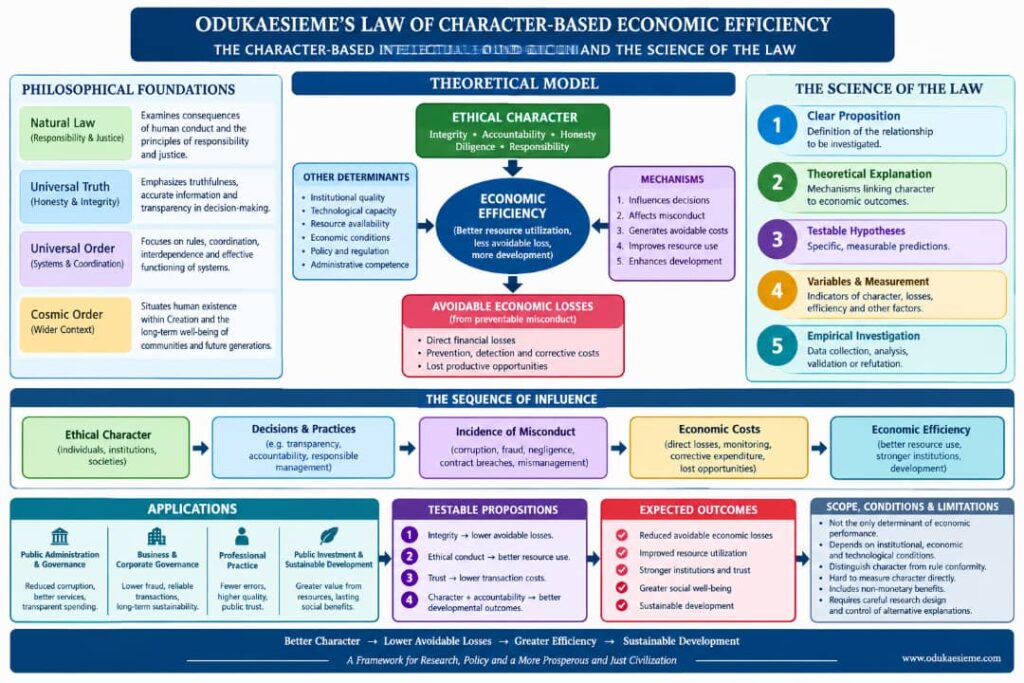
Within Odukaesieme’s philosophical framework, this relationship is examined in connection with Natural Law, Universal Truth, Universal Order, and Cosmic Order. Natural Law provides a philosophical basis for examining the consequences of human conduct and the principles of responsibility and justice. Universal Truth concerns the pursuit and recognition of truth in human understanding and decision-making. Universal Order directs attention to the relationships, principles, and coordination necessary for the effective functioning of systems, while Cosmic Order situates human existence within the wider order of Creation. These concepts establish the philosophical orientation of the proposed law; their inclusion does not, in itself, establish its specific economic predictions. Those predictions require appropriate theoretical analysis and empirical investigation.
The proposed law consequently seeks to extend the examination of economic efficiency beyond the measurement of financial expenditure and productive output. It directs attention to the resources societies expend on preventing, detecting, correcting, and compensating for misconduct, as well as the developmental opportunities lost through corruption, negligence, and institutional failure. It also raises a fundamental research question: to what extent can improvements in ethical conduct reduce avoidable economic losses and improve the application of resources to collective needs?
For scholarly precision, the Law of Character-Based Economic Efficiency is presented here as a proposed conceptual law rather than an empirically established universal economic law. Its intellectual merit rests on the clarity of its proposition, the coherence of its theoretical foundations, its capacity to generate testable hypotheses, and the extent to which subsequent research supports or challenges its predictions. Its scientific development therefore requires a clearly defined theoretical structure, identifiable causal mechanisms, measurable variables, and empirical evidence capable of supporting, refining, or rejecting its central proposition.
-
The Science Of The Law: Theoretical Structure, Mechanisms, And Validation
The Science of the Law of Character-Based Economic Efficiency concerns the systematic examination of the principles, relationships, mechanisms, and measurable consequences underlying the proposed law. Within Odukaesieme’s broader intellectual framework of Character Intelligence Science (CIS), it establishes a proposed framework for investigating how ethical character may influence economic behaviour, institutional performance, the preservation of resources, and the achievement of developmental objectives.
The distinction between the law and the science of the law is fundamental. The proposed law states the relationship to be investigated: the potential contribution of ethical character to economic efficiency through the reduction of avoidable losses and the improvement of resource utilization. The science of the law concerns the theoretical explanation, analytical formulation, measurement, investigation, and potential validation of that relationship.
The scientific structure rests on five interconnected elements: a clearly defined proposition, an explanation of the mechanisms through which character may influence economic outcomes, the formulation of testable hypotheses, the identification and measurement of relevant variables, and the systematic evaluation of empirical evidence.
The proposed relationship can be examined through a sequence of economic mechanisms. Ethical character may influence individual decisions and institutional practices; these decisions may affect the incidence of fraud, corruption, negligence, contractual breaches, and resource mismanagement; such conduct may generate direct losses, additional monitoring costs, corrective expenditure, and lost productive opportunities; and these consequences may ultimately affect economic efficiency and developmental outcomes.
This sequence provides a theoretical pathway for empirical investigation rather than proof that every link necessarily operates in the same way under all conditions. Institutional safeguards, enforcement mechanisms, incentives, administrative competence, and economic circumstances may strengthen, weaken, or alter the relationship.
The scientific question is therefore not simply whether ethical character is desirable, but whether identifiable improvements in ethical conduct produce measurable economic benefits, through which mechanisms those benefits arise, and under what conditions the relationship holds.
Scientific investigation must distinguish correlation from causation. An observed association between institutional integrity and economic performance does not, by itself, establish that integrity caused the observed outcome. Researchers must consider alternative explanations, including differences in institutional quality, regulatory enforcement, economic resources, administrative competence, technological capacity, and prevailing incentives.
The Science of the Law consequently requires conceptual clarity, operational definitions, testable predictions, appropriate research methods, independent scrutiny, and reproducible findings. Philosophical reasoning establishes the conceptual orientation of the inquiry, theoretical analysis explains the proposed mechanisms, and empirical investigation determines the extent to which the economic propositions are supported by evidence.
At its present stage, the Science of the Law of Character-Based Economic Efficiency is best understood as a proposed scientific research framework. Its further development will depend on the precision of its theoretical structure, the quality of its methods, and the strength of the evidence obtained through systematic investigation.

-
The Proposed Law: Character, Order, And Economic Consequences
Odukaesieme proposes the Law of Character-Based Economic Efficiency as a principle for investigating how the ethical character of individuals, institutions, and societies may influence economic efficiency and the avoidable costs associated with misconduct.
The proposed law rests on the proposition that human conduct affects the acquisition, preservation, allocation, management, and utilization of collective resources. Where dishonesty, corruption, and irresponsibility become prevalent, additional resources may be required to detect misconduct, enforce laws, investigate wrongdoing, recover diverted funds, repair institutional damage, and compensate for preventable losses. Such expenditure may reduce the resources available for productive investment, essential public services, and other developmental priorities.
Conversely, where integrity, accountability, honesty, diligence, and responsible conduct are consistently practised, individuals and institutions may be better positioned to prevent misconduct, protect resources, strengthen cooperation, and achieve their objectives more effectively. Potential economic benefits include reduced losses arising from preventable wrongdoing, greater reliability in institutional transactions, improved stewardship of public funds, and more effective delivery of essential services.
The proposed law does not claim that ethical character independently determines economic performance. Rather, it identifies character as a potentially significant influence operating alongside institutional design, regulatory effectiveness, administrative competence, technological capacity, economic conditions, and other relevant factors.
Its central concern is whether stronger ethical conduct, supported by appropriate institutions, contributes to the reduction of avoidable economic losses and the more effective utilization of available resources.
-
The Philosophical Foundations Of The Proposed Law
3.1 Natural Law and the Consequences of Human Conduct
The proposed law draws on Natural Law as a philosophical framework for examining the relationship between human conduct, responsibility, justice, and the consequences of action. Its foundational proposition is that decisions affecting other people and collective resources should be evaluated not only in terms of the intentions of those who make them, but also in terms of their consequences.
In economic life, this perspective directs attention to the effects of corruption, dishonesty, exploitation, and irresponsible management on individuals, institutions, and society. It also highlights the importance of fairness, accountability, respect for legitimate rights, and responsible stewardship in the management of resources.
The Natural Law foundation therefore provides a philosophical basis for investigating why ethical character matters in economic relationships. It establishes a normative framework for evaluating human conduct but does not substitute for empirical evidence concerning the magnitude or direction of particular economic effects.
3.2 Universal Truth and the Integrity of Economic Decision-Making
Within Odukaesieme’s philosophical framework, Universal Truth provides a basis for emphasizing honesty, truthful communication, reliable information, and intellectual integrity in human affairs.
Economic decisions depend substantially on the accuracy of information, the reliability of financial reporting, the transparency of transactions, and the credibility of commitments. False reporting, deliberate concealment, fraud, and the manipulation of information can distort decisions, misdirect resources, and undermine confidence in institutions and markets.
The proposed law therefore identifies truthfulness as a relevant ethical consideration in economic efficiency. However, the extent to which truthful conduct improves particular economic outcomes must be examined in relation to institutional safeguards, incentives, and the circumstances in which decisions are made.
3.3 Universal Order and the Organization of Resources
The connection with Universal Order concerns the relationships, rules, coordination, and interdependence that contribute to the effective functioning of systems. Institutions depend on the responsible performance of duties, reliable information, the fulfilment of obligations, and the consistent application of legitimate rules.
Where these conditions are undermined by dishonesty and irresponsible conduct, institutional operations can become less effective and more costly. Where they are supported by integrity, accountability, and sound administration, coordination and resource management may improve.
The proposed law applies this systems-oriented perspective to economic life by examining whether ethical character contributes to the orderly functioning of institutions and the efficient utilization of resources.
3.4 Cosmic Order and the Wider Context of Existence
The relationship with Cosmic Order situates human society within the wider order of Creation. In Odukaesieme’s philosophical framework, human conduct is understood in relation to the broader consequences of action and the interdependence of existence.
Applied to economic questions, this perspective encourages consideration of the wider consequences of decisions for communities, the environment, future generations, and the long-term sustainability of human development.
Nevertheless, philosophical alignment with Cosmic Order should not be confused with scientific proof of a particular economic relationship. The measurable effects of ethical character on economic efficiency remain questions for systematic investigation.
-
Formulation And Analytical Model Of The Proposed Law
The Law of Character-Based Economic Efficiency may be formulated as follows:
The Stronger A Society’s Ethical Character, All Other Relevant Conditions Being Comparable, The Greater Its Potential To Reduce Avoidable Economic Losses Arising From Misconduct And To Utilize Its Resources More Efficiently For Collective Development.
This formulation identifies a proposed relationship between ethical character and economic efficiency. The qualification concerning comparable conditions is essential because societies differ in their institutional structures, economic resources, regulatory systems, technological capabilities, administrative competence, and developmental circumstances.
The formulation also distinguishes potential influence from guaranteed outcomes. A society with strong ethical standards may still experience economic difficulties arising from external shocks, inadequate infrastructure, ineffective policies, or limited resources. Likewise, economic growth does not, by itself, demonstrate that a society possesses strong ethical character.
To make the proposition more analytically precise, the relationship can be represented through the following conceptual model:
Economic Efficiency = F (Ethical Character, Institutional Quality, Technological Capacity, Resource Availability, Economic Conditions, And Other Relevant Factors).
Within this model, ethical character is a proposed explanatory factor rather than the sole determinant of economic efficiency.
A second relationship can express the central mechanism:
Avoidable Economic Losses = F (Misconduct, Prevention Costs, Detection Costs, Corrective Costs, And Lost Productive Opportunities).
The purpose of this second expression is to organize the categories of loss for investigation. In empirical applications, researchers must distinguish actual financial losses from the costs of preventing and detecting misconduct, since effective prevention and detection can reduce total losses even when they require additional expenditure.
The two relationships together suggest a testable proposition: where improvements in ethical conduct reduce the incidence or severity of preventable misconduct, and where institutional safeguards remain effective, avoidable economic losses may decline and more resources may become available for productive and developmental purposes.
These expressions are conceptual models, not established mathematical laws. They identify the relationships to be investigated without claiming that a numerical relationship, universal coefficient, or predetermined magnitude of effect has already been demonstrated.
The scientific development of the proposed law requires operational definitions of ethical character, avoidable economic loss, and economic efficiency. Researchers must determine how each variable will be measured, which indicators are suitable for different institutional settings, and how competing influences will be controlled.
The law’s analytical strength will depend on whether these definitions support consistent measurement, meaningful comparison, and reliable predictions.
-
The Distinction Between Necessary And Avoidable Economic Costs
A central analytical distinction within the proposed law is the difference between the necessary costs of maintaining justice and public order and the avoidable costs generated by preventable misconduct.
Every functioning society requires courts, policing, regulatory oversight, auditing, inspection, and public accountability. These institutions consume resources, but their existence is not evidence of deficient character. Properly designed and effectively administered, they protect rights, enforce legitimate standards, deter wrongdoing, and contribute to institutional stability.
The avoidable costs considered by the proposed law arise when resources must be expended because of corruption, fraud, negligence, abuse of authority, or other preventable failures. Such costs may include direct financial losses, investigations, litigation, recovery operations, corrective expenditure, abandoned projects, damaged assets, and the loss of productive opportunities.
The distinction matters because a reduction in enforcement expenditure does not automatically indicate an improvement in ethical conduct. Lower expenditure may reflect reduced misconduct, but it may also result from inadequate oversight, underreporting, or ineffective enforcement. Conversely, stronger auditing and investigation may initially increase expenditure while exposing previously concealed wrongdoing and preventing larger future losses.
Consequently, an assessment of character-based economic efficiency must consider both the costs incurred and the effectiveness of the institutions responsible for maintaining accountability.
The objective is not to eliminate the institutions of justice and oversight, but to investigate whether improved ethical conduct can reduce preventable wrongdoing while preserving effective safeguards.
-
Character Intelligence And Economic Performance
Within Character Intelligence Science, the proposed law places ethical character within the broader examination of how human intelligence is applied. It recognizes that technical knowledge, intellectual ability, and managerial competence do not automatically guarantee responsible conduct.
An individual may possess considerable intelligence and professional expertise while using those capabilities to manipulate information, exploit institutional weaknesses, or obtain illegitimate advantages. In such circumstances, intelligence may increase the capacity to cause economic harm rather than contribute to collective development.
Character Intelligence emphasizes the importance of directing intellectual capabilities towards responsible and constructive purposes. In economic settings, this involves the responsible exercise of authority, truthful reporting, transparent transactions, prudent resource management, fulfilment of obligations, and accountability for decisions.
The proposed law consequently treats ethical character as a potential contributor to the effective application of intelligence in economic and institutional life. It does not replace technical competence, sound economic policy, or effective institutional design; rather, it examines how the ethical quality of human conduct may influence their practical effectiveness.
Within this framework, the relationship between intelligence and character becomes particularly important because economic decisions frequently involve competing interests, limited resources, uncertainty, and consequences extending beyond the immediate decision-maker. Responsible intelligence requires not only the capacity to identify effective means but also the ethical judgment to evaluate the purposes and consequences of their use.
-
Economic Applications Of The Proposed Law
7.1 Public Administration and Governance
In public administration, corruption and the abuse of authority can divert public funds from essential services, increase procurement costs, undermine project delivery, and weaken public confidence. Ethical leadership, transparent procedures, independent auditing, and effective accountability may help prevent such losses and improve the responsible management of public resources.
The proposed law provides a framework for investigating whether stronger ethical practices are associated with improved expenditure management, more reliable public services, and reduced losses arising from misconduct.
Such investigations should distinguish the influence of personal character from the effects of institutional arrangements, enforcement mechanisms, administrative competence, and political incentives.
7.2 Business and Corporate Governance
In business, dishonesty, fraud, contractual breaches, and irresponsible management can generate financial losses, legal disputes, reputational damage, and additional monitoring costs. Integrity and accountability may support reliable commercial relationships, protect organizational assets, and strengthen confidence among employees, customers, investors, and business partners.
The proposed law invites investigation into whether differences in ethical organizational culture are associated with measurable differences in operating costs, compliance burdens, contractual performance, and long-term business sustainability.
Relevant indicators may include verified fraud losses, contractual disputes, compliance failures, employee misconduct, financial reporting irregularities, and the costs associated with correcting preventable organizational failures.
7.3 Professional Practice
Professional institutions depend on the responsible application of specialized knowledge and the fulfilment of duties to clients, patients, institutions, and the public. Misconduct can result in financial losses, avoidable errors, regulatory sanctions, and diminished public trust.
The proposed law highlights the relevance of professional integrity and responsible decision-making to the effective use of human expertise and institutional resources.
Its application to professional practice also raises the question of whether ethical training, accountability systems, and character-oriented professional education can reduce preventable errors and improve the quality and reliability of professional services.
7.4 Public Investment and Sustainable Development
Development depends not only on the availability of financial resources but also on the quality of decisions governing their application. Corruption, negligence, and inadequate accountability can reduce the developmental value of investments in healthcare, education, infrastructure, scientific research, environmental protection, and technology.
Where ethical conduct is supported by competent institutions and effective policies, resources may be more effectively directed towards these priorities. The proposed law therefore encourages the investigation of character-related factors in the conversion of economic resources into sustainable social benefits.
The broader developmental question is whether improvements in ethical conduct, combined with sound policies and institutional competence, can increase the proportion of available resources that produces measurable and lasting public value.
-
Testable Propositions And Empirical Investigation
A principal requirement for advancing the proposed law towards scientific validation is the translation of its central proposition into clearly defined and testable hypotheses.
The following hypotheses could guide empirical investigation.
8.1 Hypothesis One: Institutional Integrity and Avoidable Losses
Institutions demonstrating stronger, independently measured indicators of integrity and accountability will, under comparable conditions, tend to experience lower losses attributable to corruption, fraud, and other preventable misconduct.
8.2 Hypothesis Two: Ethical Conduct and Resource Utilization
Stronger ethical compliance, when supported by effective institutional systems, will be associated with improved resource utilization and fewer preventable failures in project implementation and public-service delivery.
8.3 Hypothesis Three: Character, Trust, and Transaction Costs
Higher levels of institutional trust and demonstrated ethical reliability will be associated with lower costs arising from preventable disputes, excessive monitoring, contractual non-compliance, and other forms of institutional friction.
8.4 Hypothesis Four: Character and Developmental Outcomes
Institutions combining ethical leadership, effective accountability, and administrative competence will tend to achieve better developmental outcomes than otherwise comparable institutions lacking these conditions.
These hypotheses are propositions for investigation, not established scientific findings. Their validity must be determined through systematic evidence capable of supporting, refining, or rejecting them.
Empirical research could employ indicators such as independently verified financial losses, procurement performance, project completion rates, audit findings, compliance costs, service-delivery outcomes, and measures of institutional trust. Researchers would need to define these variables consistently, select appropriate comparison groups, and account for differences in institutional design, economic conditions, enforcement capacity, and available resources.
Longitudinal studies could examine whether changes in ethical practices precede changes in economic outcomes. Comparative studies could investigate whether institutions with similar responsibilities and resources perform differently under varying conditions of integrity and accountability. Where feasible, quasi-experimental methods could help distinguish the effects of particular reforms from broader economic or institutional changes.
Careful measurement is particularly important because corruption is often concealed, reported cases depend partly on enforcement capacity, and public perceptions do not always correspond directly to actual conduct. No single indicator should therefore be treated as a complete measure of ethical character or economic efficiency.
Researchers must also consider reverse causation. Although ethical conduct may contribute to improved economic performance, economic security and effective institutions may themselves support ethical behaviour by reducing incentives for misconduct and strengthening accountability. Establishing the direction and magnitude of any relationship therefore requires appropriate research designs.
The scientific strength of the proposed law will ultimately depend on the consistency, explanatory power, predictive value, and reproducibility of the evidence obtained through such investigations.
-
Scientific Scope, Conditions, And Limitations
The proposed law concerns the potential influence of ethical character on avoidable economic losses and resource utilization. It does not assert that ethical character is the only, or necessarily the strongest, determinant of economic performance in every setting.
Economic efficiency is also influenced by infrastructure, technological development, workforce capabilities, market conditions, regulatory quality, political stability, institutional design, and the availability of resources. These factors may interact with ethical character in complex ways.
Furthermore, individual integrity cannot compensate indefinitely for defective institutional arrangements. Even well-intentioned individuals may operate within systems that reward misconduct, discourage transparency, or fail to enforce legitimate rules. Effective implementation therefore requires attention to both personal character and the institutional conditions that shape behaviour.
The proposed law should also distinguish ethical character from mere conformity to existing rules. Rules and institutions may themselves be poorly designed or unjust. Responsible character must therefore include critical judgment, respect for legitimate rights, and a commitment to accountability rather than unquestioning compliance.
Another important consideration is the difficulty of measuring character directly. Researchers may examine observable behaviours, verified misconduct, ethical decision-making, institutional practices, and independently assessed indicators of integrity. However, these measures should not automatically be treated as complete representations of an individual’s or society’s ethical character.
The law must also accommodate situations in which ethical improvements produce benefits that are difficult to quantify financially, such as increased public confidence, improved fairness, reduced harm, and greater institutional legitimacy. Such outcomes may be economically and socially significant even when their monetary value cannot be established with precision.
These qualifications strengthen the proposed law by clarifying its scope, identifying potential sources of bias, and specifying conditions under which its propositions should be examined. They also provide a more rigorous foundation for future theoretical development and empirical research.
-
Scientific And Intellectual Significance
The intellectual significance of Odukaesieme’s proposed Law of Character-Based Economic Efficiency lies in its effort to integrate ethical character into the analysis of economic performance within the framework of Character Intelligence Science.
Its central conceptual contribution is to direct attention to the relationship between the ethical quality of human decisions and the costs, benefits, and developmental consequences of economic activity. It encourages researchers and policymakers to consider whether conventional assessments of efficiency adequately account for losses arising from misconduct and for the potential economic value of integrity, accountability, and responsible resource management.
Its philosophical foundations provide a framework for examining the relationship between human conduct, responsibility, and the wider order of existence. Its theoretical model identifies possible mechanisms linking ethical character to economic outcomes, while its empirical propositions provide a basis for investigating measurable relationships among ethical practices, institutional performance, economic losses, and developmental outcomes.
The proposed law should not be regarded as scientifically established merely because its philosophical premises appear coherent or its practical implications seem plausible. Its scientific standing will depend on precise definitions, transparent methods, independent scrutiny, and evidence capable of supporting or challenging its predictions.
Its development also requires a clear distinction between a conceptual law, a normative principle, and an empirically validated scientific law. A conceptual law organizes a proposed relationship for systematic examination. A normative principle expresses a position concerning how people or institutions ought to behave. An empirically supported scientific law requires evidence demonstrating a sufficiently consistent relationship within a clearly defined scope, together with careful consideration of alternative explanations and the conditions under which the relationship may not hold.
The Law of Character-Based Economic Efficiency currently occupies the position of a proposed conceptual law whose hypotheses are open to empirical investigation. This classification does not diminish its intellectual purpose; it establishes an appropriate standard for evaluating its future development.
The openness to critical examination is essential to the development of a credible scientific framework. A proposition becomes more scientifically useful when its scope is clear, its implications are testable, alternative explanations are considered, and the conditions under which it may fail are explicitly acknowledged.
The scientific and intellectual significance of the proposed law therefore rests not on an assumption of prior validation, but on its capacity to organize a meaningful research programme around the relationship between ethical character and economic efficiency.
-
Conclusion: Character As A Factor In Economic And Civilizational Development
Odukaesieme’s proposed Law of Character-Based Economic Efficiency advances the proposition that ethical character deserves systematic consideration in the examination of economic efficiency, institutional integrity, and sustainable development. Within Character Intelligence Science, it emphasizes that the value of intelligence depends not only on the capacity to generate knowledge, wealth, and technological progress, but also on the character with which these capabilities are exercised.
The proposed law directs attention to the avoidable economic burdens associated with corruption, dishonesty, negligence, and irresponsible conduct. It also identifies an important field of inquiry concerning whether integrity, accountability, and responsible decision-making can contribute to the more effective preservation and utilization of collective resources.
Its alignment with Natural Law, Universal Truth, Universal Order, and Cosmic Order establishes its philosophical orientation. Its theoretical model identifies possible pathways through which character may influence economic outcomes, while its testable hypotheses establish a basis for systematic empirical investigation. Its economic propositions, however, require independent examination to determine their explanatory power, predictive value, scope, and limitations.
Ultimately, the proposed law offers a conceptual framework for investigating character as a factor in economic efficiency and civilizational development. It calls for an integrated understanding of prosperity that considers not only the wealth societies generate, but also the ethical quality of the decisions through which that wealth is acquired, managed, protected, and applied for human well-being.
Within Odukaesieme’s broader intellectual framework, the cultivation of ethical character is therefore an important subject for philosophical inquiry, scientific investigation, responsible governance, and sustainable development. By bringing character into a systematic examination of economic performance, the proposed law invites further research into how ethical responsibility, sound institutional arrangements, and the intelligent management of resources may work together to advance human welfare.
The ultimate scientific test of the law will be whether clearly defined, independently examined evidence supports its central proposition and establishes the conditions under which character-based improvements contribute to measurable economic efficiency.