

The human assessment of Wisdom begins with the fundamental human capacity to perceive, recognize, understand, and respond to reality. Before Wisdom can be expressed through knowledge, judgment, character, or action, there must first be an intelligence capable of recognizing that existence possesses order, relationship, consequence, and meaning.
Wisdom does not originate from the mere accumulation of information. Information becomes knowledge when it is understood; knowledge becomes meaningful when intelligence recognizes relationships, distinguishes what is essential from what is incidental, evaluates consequences, and learns from experience. Through this progressive development, the human mind advances from perception toward comprehension, and from comprehension toward Wisdom.
The earliest assessment of Wisdom therefore arises from humanity’s encounter with reality itself. Human beings observe nature, experience life, encounter uncertainty, recognize consequences, learn from error, and progressively discover patterns and principles that guide thought and conduct. In this process, experience becomes reflection, reflection deepens into understanding, and understanding provides the foundation upon which Wisdom is recognized and expressed.
Yet the assessment of Wisdom cannot be reduced to individual experience alone. Human beings exist within a larger reality of which they are an inseparable part. The relationships among people, nature, society, and the wider order of creation continually provide the conditions through which Wisdom is discovered, tested, refined, and expressed.
From this perspective, Wisdom is not arbitrarily invented by humanity. It is progressively recognized through the human capacity to perceive and understand the order already present in existence. Human intelligence discovers principles that transcend mere personal preference because they are revealed through consistent relationships, consequences, patterns, and realities that govern life.
The foundations of Wisdom therefore lie at the meeting point between intelligence and reality: reality provides what is to be understood, while intelligence provides the capacity to perceive, interpret, evaluate, integrate, and learn from it.
As intelligence develops, the human mind begins to recognize that actions have consequences, relationships matter, each part is related to the whole, and existence cannot be adequately understood through isolated appearances. This recognition marks a decisive transition from mere knowing to understanding, and from understanding toward Wisdom.
Thus, the foundations of Wisdom are found neither solely within the individual nor independently outside humanity. They arise through the dynamic relationship between the intelligence that seeks understanding and the reality that continually presents itself for understanding.
In its deepest sense, Wisdom is founded upon the recognition of order, relationship, consequence, interconnectedness, and the unity of existence. Its development is the progressive awakening of intelligence to the deeper realities and universal patterns that govern life, relationships, and the whole of creation.
These foundations provide the basis for understanding the essence of Wisdom.
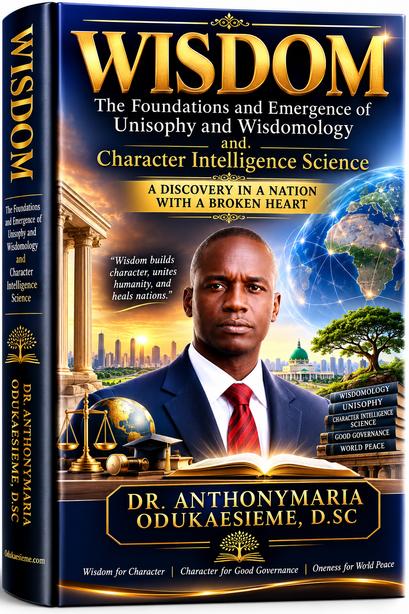
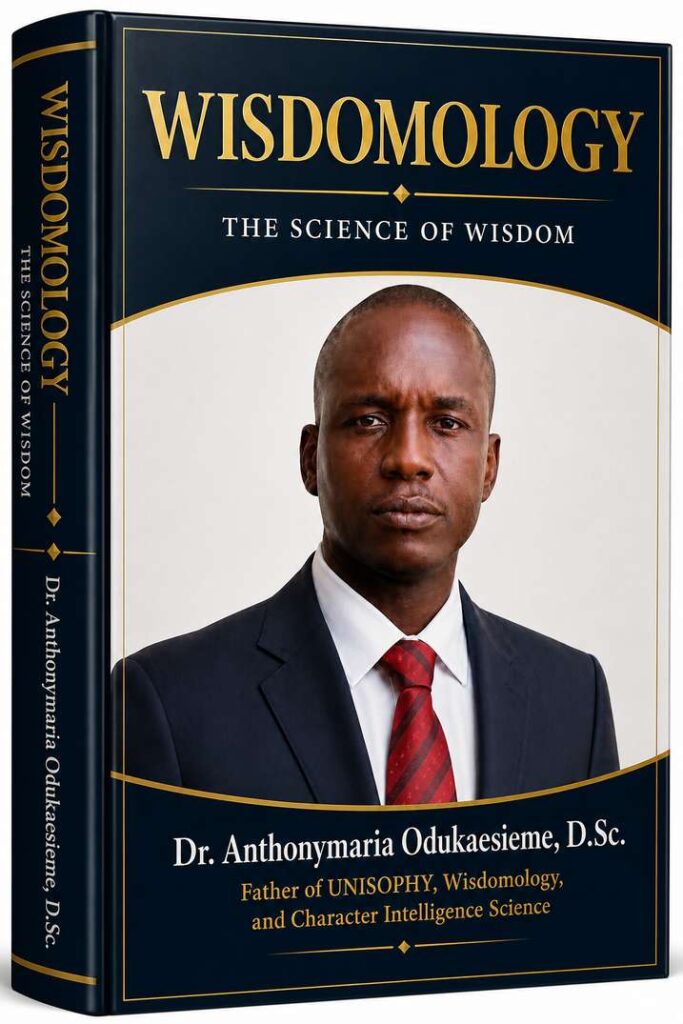
Dr. Anthonymaria Odukaesieme, D.Sc.
Founder of Unisophy, Wisdomology, and Character Intelligence Science
Odukaesieme.com