

5.1 Introduction
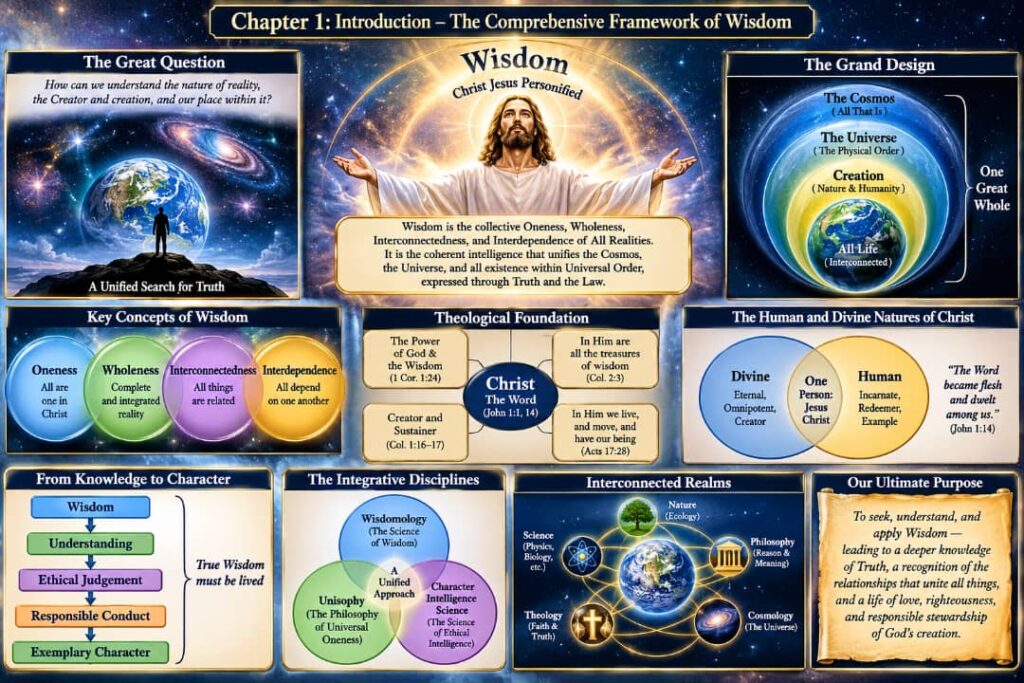
The examination of Christ Jesus as the Embodiment of Wisdom leads to an important theological question: Who is Christ, and what is the relationship between His divine nature and His human nature?
Christian theology teaches that Jesus Christ is truly God and truly human. This understanding is central to the doctrine of the Incarnation and provides the foundation for examining His identity, earthly life, teachings, character, and relationship with humanity.
Christ did not merely appear to be human. He entered human existence, experienced the realities of human life, and lived among people in a recognisably human form.
At the same time, Christian Scripture presents Him as the eternal Word, the Son of God, and the one through whom all things were created.
This chapter examines the divine and human natures of Christ, the theological significance of the Incarnation, His human development, His exemplary character, and the manifestation of divine Wisdom through His earthly life.
The central argument is that Christ’s earthly existence provides the supreme Christian revelation of divine Wisdom expressed through authentic human life.
5.2 THE DIVINITY OF CHRIST
The divinity of Christ is a foundational teaching of Christianity.
John 1:1 declares:
“In the beginning was the Word, and the Word was with God, and the Word was God.”
This passage establishes the eternal existence and divine identity of the Word, whom Christian theology identifies as Jesus Christ.
John 1:14 further states:
“And the Word was made flesh, and dwelt among us…”
The passage connects the eternal Word with the historical person of Jesus Christ.
Christ’s divinity is also expressed in Colossians 2:9:
“For in him dwelleth all the fulness of the Godhead bodily.”
This declaration is central to Christian understanding of Christ’s divine nature.
It teaches that the fullness of deity dwells in Christ bodily.
The significance of this teaching is that Christ is not regarded as merely a prophet, philosopher, moral teacher, or exceptionally intelligent human being.
He is understood within Christian theology as the divine Son who assumed human nature.
His identity therefore goes beyond the limits of ordinary human existence.
5.3 THE HUMANITY OF CHRIST
The Christian doctrine of the Incarnation also affirms the genuine humanity of Jesus Christ.
He was born into human history, lived among human beings, experienced physical needs, interacted with society, and participated in the ordinary circumstances of human existence.
Luke 2:7 records His birth.
Luke 2:52 states:
“And Jesus increased in wisdom and stature, and in favour with God and man.”
This verse is particularly significant to the present treatise.
It demonstrates that Christ experienced genuine human development.
He grew physically and manifested human development in wisdom and understanding.
John 4:6 describes Jesus as being weary from His journey.
Matthew 4:2 records that He experienced hunger.
John 11:35 records His weeping at the death of Lazarus.
These passages illustrate the reality of His human experience.
His humanity was not an illusion or an appearance.
Christian theology therefore maintains that Christ assumed a complete human nature while remaining divine.
5.4 THE INCARNATION: THE WORD MADE FLESH
The Incarnation is the Christian doctrine that the eternal Son of God became human in Jesus Christ.
John 1:14 provides its central biblical expression:
“And the Word was made flesh, and dwelt among us…”
The Incarnation represents a profound theological event.
The eternal Word entered human history and lived among humanity.
This has significant implications for the examination of Wisdom.
If Christ is identified as the Wisdom of God, and the Word became flesh, then Christian theology presents the earthly life of Christ as the manifestation of divine Wisdom within human existence.
This does not mean that divine Wisdom is limited to the physical dimensions of Christ’s human body.
Rather, it means that the eternal Son truly assumed human nature and lived a genuinely human life.
The Incarnation therefore establishes the relationship between divine identity and human existence without confusing the two.
5.5 CHRIST’S DIVINE AND HUMAN NATURES
The historic Christian understanding of Christ’s two natures was expressed with particular clarity in the Definition of Faith of the Council of Chalcedon in AD 451.
The Chalcedonian formulation teaches that Christ is acknowledged in two natures, divine and human, without confusion, change, division, or separation.
This teaching protects two essential Christian convictions:
1. Christ is truly divine.
2. Christ is truly human.
The divine nature was not transformed into a human nature, and the human nature did not replace the divine nature.
Rather, the two natures are united in the one person of Jesus Christ.
This theological distinction is important because it prevents the mistaken conclusion that Christ was partly divine and partly human.
Christian orthodoxy affirms His complete divinity and complete humanity.
Consequently, His human life must be taken seriously when examining His example of wisdom, character, and excellence.
5.6 CHRIST AND THE EXCELLENCE OF HUMAN LIFE
One of the remarkable dimensions of Christ’s earthly life is the excellence demonstrated through His conduct.
The Gospels present Him as a model of compassion, humility, righteousness, forgiveness, courage, truthfulness, and obedience to God.
His excellence was not merely intellectual.
It was expressed through the totality of His conduct.
He demonstrated compassion towards the suffering, mercy towards those who sought forgiveness, courage in confronting injustice, and humility in serving others.
Matthew 20:28 records His teaching:
“Even as the Son of man came not to be ministered unto, but to minister, and to give his life a ransom for many.”
This passage presents service as an important dimension of His earthly mission.
Christ’s greatness was not expressed through domination or the pursuit of personal status.
It was demonstrated through service, sacrifice, and commitment to His mission.
His life therefore provides a profound Christian example of excellence expressed through character.
5.7 CHRIST AS THE EMBODIMENT OF WISDOM IN HUMAN FORM
The central concern of this treatise is the nature and meaning of Wisdom.
First Corinthians 1:24 identifies Christ as the Wisdom of God.
Colossians 2:3 declares that in Him are hidden all the treasures of wisdom and knowledge.
These passages provide the theological foundation for describing Christ as the Embodiment of Wisdom.
The significance of this expression is that Christ did not merely communicate information about Wisdom.
He lived among humanity and demonstrated divine Wisdom through His teachings, decisions, actions, relationships, and obedience to the Father.
His earthly life provides a practical manifestation of the virtues associated with Wisdom.
He taught Truth, demonstrated Love, practised humility, exercised compassion, and upheld righteousness.
In this sense, the life of Christ provides the supreme Christian example of Wisdom manifested through human existence.
It is important, however, to distinguish between Christ’s unique divine identity and the human responsibility to imitate His virtues.
Human beings are called to follow His example, but they do not thereby become divine in the same sense as Christ.
5.8 CHRIST AND THE PERFECTION OF CHARACTER
Character is an essential dimension of human excellence.
A person may possess extensive knowledge, intellectual ability, professional qualifications, and material resources without necessarily demonstrating good character.
Christ’s earthly life provides a Christian standard by which human character may be examined.
His teachings condemn hypocrisy, pride, greed, injustice, and the abuse of authority.
He emphasises sincerity, mercy, forgiveness, humility, and righteousness.
Matthew 5:48 records His teaching:
“Be ye therefore perfect, even as your Father which is in heaven is perfect.”
This verse belongs to the wider teaching of the Sermon on the Mount, particularly its call to comprehensive love and moral integrity.
The pursuit of excellent character therefore requires more than outward religious appearance.
It involves the transformation of motives, attitudes, relationships, and conduct.
Within Odukaesieme’s Character Intelligence Science framework, ethical intelligence and exemplary character are central to human excellence.
This proposed framework may be examined in dialogue with the moral teachings of Christ, while maintaining the distinction between a contemporary philosophical formulation and established Christian doctrine.
5.9 CHRIST, HUMILITY, AND THE EXAMPLE OF SERVICE
Humility is one of the important virtues demonstrated by Christ.
Philippians 2:5–8 presents Christ as the example of humility and obedience.
The passage describes His willingness to humble Himself and become obedient unto death, even the death of the cross.
John 13:3–15 records the account of Christ washing the feet of His disciples.
This act provides a remarkable example of service.
The teacher and Lord performed a task associated with humble service and instructed His disciples to learn from His example.
The theological significance is that greatness must not be confused with arrogance or the exploitation of others.
Christ demonstrates that authority should be exercised with responsibility, humility, and love.
This principle is consistent with the importance Odukaesieme assigns to Humility within the 3H framework of Humility, Honesty, and Hard Work.
Humility is not weakness.
It is the disciplined recognition of one’s proper position, responsibilities, limitations, and relationship with God and other people.
5.10 CHRIST, TRUTH, AND INTEGRITY
Truth is central to Christ’s identity and teaching.
John 14:6 records His declaration:
“I am the way, the truth, and the life…”
Christ’s teaching consistently emphasises sincerity and integrity.
He challenges falsehood, hypocrisy, and the misuse of religious authority.
His life demonstrates the relationship between Truth and righteous conduct.
The examination of Wisdom must therefore recognise that knowledge without integrity can become an instrument of deception and exploitation.
The person who seeks Wisdom must be committed to honesty, fairness, and responsibility.
Within Odukaesieme’s philosophical formulation, Truth is the expression of Wisdom.
Christ’s identification with Truth provides an important theological connection to this proposition.
It establishes Truth as a central consideration in the relationship between Wisdom and human excellence.
5.11 CHRIST AND LOVE AS THE FOUNDATION OF HUMAN RELATIONSHIPS
The earthly life of Christ demonstrates the importance of Love.
His teachings emphasise love of God and love of neighbour.
Matthew 22:37–39 records these commandments as central principles of religious and moral life.
John 13:34 further records His instruction:
“That ye love one another; as I have loved you.”
This teaching establishes a demanding standard of Love.
It calls for compassion, sacrifice, forgiveness, and genuine concern for others.
Love must therefore be expressed through conduct rather than mere verbal declaration.
Within Odukaesieme’s philosophical framework, Love is understood as an expression of Universal Oneness.
This perspective emphasises the interconnectedness of human existence and the responsibility of individuals towards one another.
Christ’s teaching provides a theological foundation for examining Love as an essential dimension of Wisdom and human character.
5.12 CHRIST AND THE LIMITS OF HUMAN INTELLIGENCE
Human intelligence is remarkable, but it is limited.
Through scientific investigation, philosophy, mathematics, medicine, technology, and other fields of knowledge, humanity has developed extensive understanding of the natural and social worlds.
Nevertheless, human beings do not possess unlimited knowledge.
There remain questions about existence, ultimate meaning, consciousness, morality, and the origin of the universe that require careful philosophical and theological examination.
Christian theology distinguishes the perfect knowledge of God from the limited knowledge of human beings.
Colossians 2:3 identifies Christ as the one in whom are hidden all the treasures of wisdom and knowledge.
This declaration presents divine Wisdom as transcending human intellectual limitations.
The proper pursuit of human knowledge should therefore be accompanied by humility.
A person should recognise the difference between what is known, what is reasonably inferred, what remains uncertain, and what belongs to the realm of faith and theological conviction.
Such intellectual humility is essential to responsible scholarship.
5.13 CHRIST AND THE RELATIONSHIP BETWEEN THE CREATOR AND CREATION
The distinction between the Creator and creation is fundamental to Christian theology.
Christ’s relationship with creation is presented in John 1:3 and Colossians 1:16–17.
These passages identify the Word as central to the creation of all things.
They also present Christ as existing before all things and as the one in whom all things hold together.
This means that Christ is not merely another component of the created universe.
Within Christian theology, He is the eternal Son through whom creation came into existence.
This distinction is important when examining Universal Oneness.
The unity and interconnectedness of created realities do not mean that the Creator and creation are identical.
The Creator remains distinct from creation.
The Christian theological framework therefore permits the examination of the unity of creation while maintaining the transcendence of God.
5.14 THE HUMAN RESPONSIBILITY TO FOLLOW CHRIST’S EXAMPLE
The life of Christ establishes a moral and spiritual challenge for humanity.
His followers are called to practise the virtues He taught and demonstrated.
These include:
1. Truthfulness in speech and conduct.
2. Love towards God and fellow human beings.
3. Humility in the exercise of authority.
4. Compassion towards those who suffer.
5. Forgiveness towards those who offend.
6. Integrity in personal and public responsibilities.
7. Righteousness in decision-making.
8. Service rather than selfish domination.
9. Faithfulness to one’s responsibilities.
10. Obedience to God.
These principles have implications for family life, education, leadership, professional conduct, public administration, scientific research, and civilisation.
The pursuit of Wisdom should therefore produce positive changes in human behaviour.
Knowledge becomes more meaningful when it contributes to responsible living.
Human excellence must be assessed not only by what individuals know or achieve, but also by how they use their abilities and how they treat others.
5.15 THE THEOLOGICAL AND PHILOSOPHICAL SIGNIFICANCE OF CHRIST’S HUMAN LIFE
The earthly life of Christ provides an important meeting point for theological and philosophical reflection.
Theologically, Christ is understood as the eternal Son of God who assumed human nature.
Philosophically, His teachings invite reflection on Truth, Love, humility, justice, human responsibility, and the purpose of existence.
Ethically, His conduct provides a model of service, compassion, forgiveness, and integrity.
In the study of Wisdom, these dimensions are closely related.
Wisdom cannot be reduced to the accumulation of information.
It must also involve sound judgement, moral responsibility, and the proper application of knowledge.
Christ’s life, as presented in the New Testament, demonstrates the relationship between teaching and conduct.
His example challenges humanity to pursue excellence in both understanding and character.
5.16 CONCLUSION
The examination of the divine and human nature of Christ reveals the central significance of the Incarnation in Christian theology.
Christ is understood as truly divine and truly human.
His divine identity is established through the biblical presentation of the eternal Word, while His humanity is demonstrated through His birth, development, physical experiences, relationships, suffering, and earthly life.
The Incarnation therefore provides the theological foundation for understanding how the eternal Son of God entered human history.
The earthly life of Christ also demonstrates extraordinary excellence through Truth, Love, humility, compassion, obedience, and service.
These virtues provide an enduring Christian example of exemplary character.
The central conclusion of this chapter is that Christ’s human life must be understood in the light of His divine identity. He did not cease to be divine when He assumed human nature, and His genuine humanity must not be diminished when discussing His divinity.
As the Embodiment of Wisdom, Christ provides the supreme Christian example of divine Wisdom manifested in human existence.
The next chapter will examine Christ and the Creation of All Things, with particular attention to the biblical declarations that all things were created through Him and that in Him all things consist.
REFERENCES
The Holy Bible, King James Version.
Athanasius. (2011). On the Incarnation (J. Behr, Trans.). St Vladimir’s Seminary Press.
Augustine. (2008). The Trinity (E. Hill, Trans.). New City Press.
Council of Chalcedon. (451). Definition of Faith.
Council of Nicaea. (325). Nicene Creed.
Grudem, W. (1994). Systematic Theology: An Introduction to Biblical Doctrine. Zondervan.
McGrath, A. E. (2017). Christian Theology: An Introduction (6th ed.). Wiley-Blackwell.
Morris, L. (1995). The Gospel According to John. Eerdmans.
Oden, T. C. (2006). Classic Christianity: A Systematic Theology. HarperOne.
DEFINITION OF WISDOM
Wisdom is the collective Oneness, Wholeness, Interconnectedness, and Interdependence of All Realities. It is the coherent intelligence that unifies Creation, the Cosmos, the Universe, and all existence within Universal Order, expressed through Truth and the Law established by the Creator.
— Odukaesieme
www.odukaesieme.com