

7.1 INTRODUCTION
One of the most profound declarations concerning the relationship between God and human existence is found in Acts 17:28:
“For in him we live, and move, and have our being; as certain also of your own poets have said, For we are also his offspring.”
This declaration, made by the Apostle Paul during his address at the Areopagus in Athens, provides an important foundation for understanding human existence in relation to God.
It addresses a fundamental question: What is the ultimate source and sustaining foundation of human life?
Human beings possess physical bodies, intellectual abilities, emotions, consciousness, and the capacity for relationships. They exist within a natural environment and depend upon numerous biological, ecological, and social systems.
However, the biblical declaration in Acts 17:28 directs attention beyond these immediate conditions to the ultimate dependence of human existence upon God.
This chapter examines the theological, philosophical, and existential implications of this passage. It considers the meaning of living, moving, and having one’s being in God, while maintaining the essential distinction between the Creator and creation.
The chapter also examines how this understanding relates to Wisdom, Universal Oneness, Universal Order, human responsibility, and the purpose of existence.
7.2 THE HISTORICAL AND BIBLICAL CONTEXT OF ACTS 17:28
Acts 17 records Paul’s visit to Athens, a city known for philosophical discussion, religious traditions, and intellectual activity.
During his visit, Paul observed the city’s religious practices and encountered an altar bearing the inscription:
“TO THE UNKNOWN GOD.”
Paul used this observation as an opportunity to explain the identity of the God whom the Athenians worshipped without fully knowing.
Acts 17:24–25 declares:
“God that made the world and all things therein, seeing that he is Lord of heaven and earth, dwelleth not in temples made with hands;
“Neither is worshipped with men’s hands, as though he needed any thing, seeing he giveth to all life, and breath, and all things.”
These verses establish Paul’s central argument.
God is the Creator of the world and everything within it. He is not dependent upon human beings or confined to structures built by them.
Instead, human beings and all created realities depend upon Him.
Paul continues in Acts 17:28:
“For in him we live, and move, and have our being…”
The statement is therefore part of a larger theological argument concerning God’s creative authority, sustaining power, and relationship with humanity.
7.3 THE MEANING OF “IN HIM WE LIVE”
The first expression in Acts 17:28 is:
“In him we live…”
Living is one of the most fundamental dimensions of human existence.
Human life involves biological processes, consciousness, growth, interaction, adaptation, and participation in the natural and social environment.
Biologically, human beings depend upon the continuous functioning of their bodies.
The heart circulates blood, the lungs facilitate gas exchange, the nervous system coordinates activities, and numerous interconnected organs maintain physiological balance.
Human life also depends upon environmental conditions.
Air, water, food, suitable temperatures, and other ecological resources contribute to the conditions necessary for survival.
Nevertheless, Acts 17:28 presents a deeper theological understanding.
Paul does not merely describe the physical conditions that support life. He identifies God as the ultimate foundation upon which human life depends.
The statement therefore establishes that human existence is not self-originating or absolutely independent.
Within Christian theology, life is understood as a gift from God.
Human beings live because God is the ultimate source and sustainer of their existence.
7.4 THE MEANING OF “AND MOVE”
The second expression is:
“And move…”
Movement is a fundamental characteristic of living existence.
Human beings move physically, intellectually, emotionally, and socially.
Physical movement involves the coordinated activities of muscles, bones, nerves, and other physiological systems.
Intellectual movement involves learning, reasoning, investigation, discovery, and the development of understanding.
Social movement involves participation in families, communities, institutions, and wider society.
The natural universe also displays movement at different scales.
Planets orbit stars, galaxies move through space, particles interact, water circulates through environmental systems, and living organisms respond to changing conditions.
Scientific disciplines investigate the mechanisms and laws associated with these forms of movement.
In the context of Acts 17:28, however, Paul’s statement is theological rather than a scientific explanation of motion.
He is emphasising humanity’s dependence upon God in every dimension of existence.
Human beings do not possess absolute independence.
Their abilities, opportunities, and capacity for action exist within a reality ultimately dependent upon the Creator.
7.5 THE MEANING OF “AND HAVE OUR BEING”
The third expression is:
“And have our being…”
This expression concerns existence itself.
To have one’s being is to exist.
Human beings may investigate the nature of their existence through philosophy, biology, medicine, psychology, physics, and other disciplines.
However, the question of why anything exists at all extends beyond the ordinary investigation of individual physical processes.
Acts 17:28 presents God as the ultimate foundation of human existence.
This means that human beings do not constitute the ultimate source of their own being.
Their existence is dependent upon the Creator.
The theological significance is that life is not merely a biological occurrence.
It is also understood within the broader relationship between God and creation.
The passage therefore invites reflection on the meaning, purpose, and responsibility associated with human existence.
7.6 GOD AS THE SOURCE AND SUSTAINER OF LIFE
Acts 17:25 describes God as the one who gives:
“Life, and breath, and all things.”
This declaration establishes the dependence of creation upon God.
The biblical account of creation also presents God as the source of life.
Genesis 2:7 states:
“And the LORD God formed man of the dust of the ground, and breathed into his nostrils the breath of life; and man became a living soul.”
This passage provides a theological account of human life as originating through God’s creative action.
The significance of these passages is that life is not presented as an independent possession entirely detached from the Creator.
Human existence is understood as a gift entrusted to humanity.
This understanding encourages humility, gratitude, and responsibility.
It also challenges the assumption that human intelligence, achievement, wealth, or authority makes an individual completely independent of God.
7.7 THE RELATIONSHIP BETWEEN THE CREATOR AND CREATION
A central principle in understanding Acts 17:28 is the distinction between the Creator and creation.
God is the Creator.
Human beings and the natural universe belong to creation.
The fact that human beings live, move, and have their being in God does not mean that human beings are identical with God.
Nor does it mean that the universe and God are the same reality.
Christian theology maintains that God is distinct from creation while remaining actively involved in sustaining it.
This distinction is essential.
God is not merely a component within the universe.
He is understood as the Creator upon whom the universe depends.
Consequently, the statement “In Him we live, and move, and have our being” expresses dependence upon God rather than the identity of God and creation.
This distinction must remain clear in every philosophical examination of Universal Oneness.
7.8 CHRIST JESUS AND THE DEPENDENCE OF ALL THINGS UPON GOD
The relationship between Acts 17:28 and the person of Christ is particularly significant in the wider Christian understanding of existence.
John 1:3 declares:
“All things were made by him; and without him was not any thing made that was made.”
Colossians 1:17 states:
“And he is before all things, and by him all things consist.”
These passages identify Christ, the eternal Word, as central to the creation and sustaining of all things.
Acts 17:28 speaks of humanity’s dependence upon God, while John 1:3 and Colossians 1:16–17 establish the relationship between Christ and creation.
Within Christian theology, these passages are understood in the context of the divine identity of the Son and His relationship with the Father.
The eternal Son is not a created being who merely participates in the universe.
He is understood as the divine Word through whom all things were created.
This connection reinforces the theological importance of Christ in the examination of Wisdom, creation, and existence.
7.9 HUMAN EXISTENCE WITHIN THE TOTALITY OF CREATION
Human beings do not exist in isolation.
They are part of a larger created reality that includes the natural environment, other living organisms, physical systems, and social relationships.
Human survival depends upon numerous interconnected conditions.
Food production depends upon soil, water, sunlight, climate, biological processes, labour, and distribution systems.
Human health is influenced by genetics, nutrition, environmental conditions, sanitation, social circumstances, and access to healthcare.
Economic activity depends upon natural resources, human skills, institutions, infrastructure, and cooperation.
These examples demonstrate the interdependence of different dimensions of human existence.
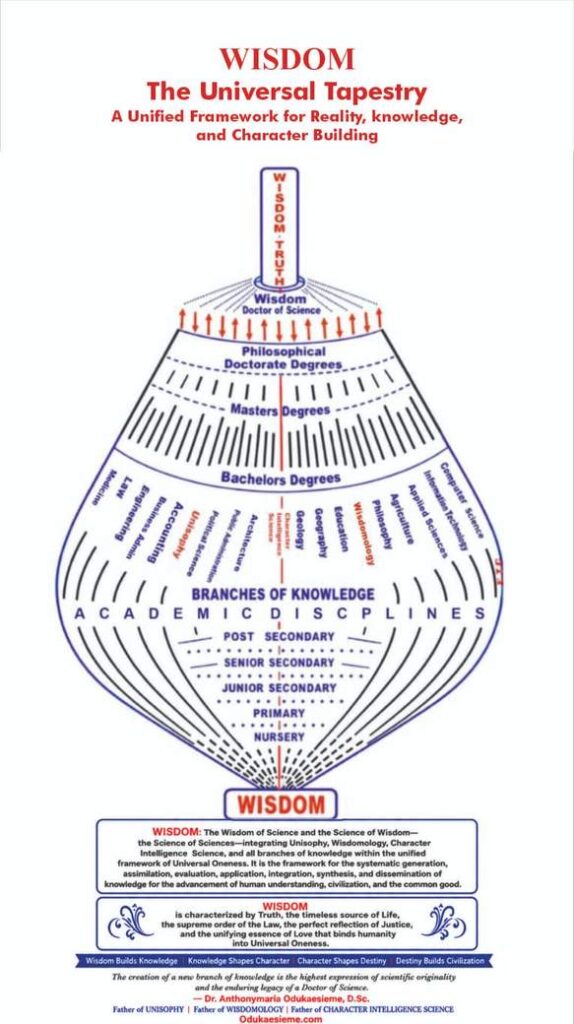
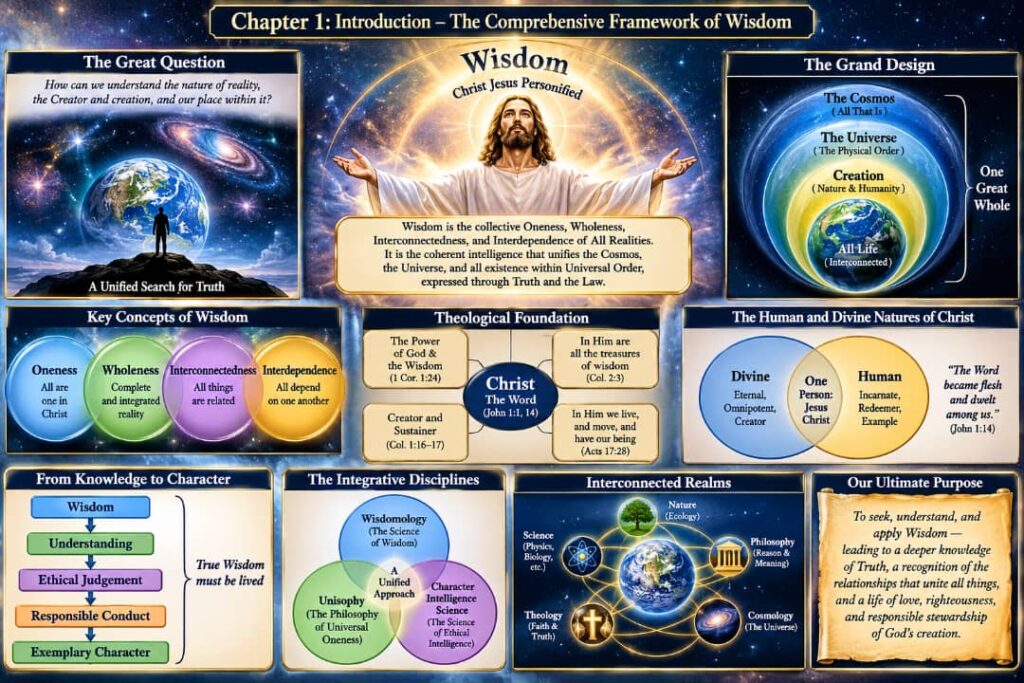
Within Odukaesieme’s philosophical framework, such relationships are examined through the concepts of Oneness, Wholeness, Interconnectedness, and Interdependence.
This approach seeks to understand existence as a comprehensive field of relationships.
The biblical declaration in Acts 17:28 adds a theological dimension by identifying God as the ultimate foundation of human existence.
7.10 THE PHILOSOPHICAL SIGNIFICANCE OF HUMAN DEPENDENCE
Human beings frequently act as though they are completely independent.
They pursue knowledge, wealth, power, professional achievement, and social influence.
These pursuits may contribute positively to human development when guided by responsibility.
However, no human being possesses absolute independence.
Every individual depends upon conditions that are not entirely under personal control.
Human beings do not choose their original existence, determine every biological process within their bodies, or control all environmental conditions.
They depend upon other people, natural resources, social structures, and the wider conditions of life.
Acts 17:28 provides a theological interpretation of this dependence.
It establishes that human existence is ultimately dependent upon God.
The philosophical implication is that humility is necessary for a proper understanding of human identity.
Recognition of dependence should not destroy human initiative.
Rather, it should encourage responsible action, gratitude, and a realistic understanding of human limitations.
7.11 WISDOM AND THE RECOGNITION OF HUMAN LIMITATIONS
Wisdom requires an accurate understanding of one’s position within reality.
A person who recognises the limits of human knowledge is better positioned to pursue truth responsibly.
Scientific knowledge develops through observation, experimentation, reasoning, and the correction of errors.
Philosophical understanding develops through critical reflection, argument, and examination of fundamental questions.
Theological understanding involves the interpretation of divine revelation and religious traditions.
These disciplines have different methods and should not be treated as interchangeable.
Nevertheless, all serious intellectual inquiry benefits from humility.
Acts 17:28 provides a theological reason for human humility by identifying God as the ultimate foundation of existence.
Within Odukaesieme’s philosophical framework, Wisdom involves recognising the proper place of all things.
Human beings must therefore understand both their capabilities and their limitations.
The pursuit of Wisdom requires the recognition that human intelligence is significant but not unlimited.
7.12 THE RELATIONSHIP BETWEEN WISDOM AND UNIVERSAL ONENESS
Universal Oneness is a central concept in Odukaesieme’s philosophical framework.
It concerns the Oneness, Wholeness, Interconnectedness, and Interdependence of All Realities.
The concept does not imply that all things are identical or that the Creator and creation are the same.
Rather, it provides a framework for examining the relationships and connections among created realities.
Acts 17:28 contributes a theological dimension to this discussion.
Human existence is understood as dependent upon God.
The natural environment, living organisms, and the physical universe are also examined within the wider theological understanding of creation.
The relationship among created realities can therefore be studied alongside the theological recognition that all creation depends upon its Creator.
The distinction between divine unity and the interconnectedness of created realities must remain clear.
This distinction strengthens rather than weakens a responsible examination of Universal Oneness.
7.13 THE RELATIONSHIP BETWEEN WISDOM AND UNIVERSAL ORDER
The existence of human beings within a larger natural and created order raises important questions about responsibility and proper conduct.
The human body operates through complex biological systems.
The natural environment functions through ecological relationships.
The universe displays physical regularities that can be investigated through scientific methods.
These realities demonstrate different forms of organisation and order.
Within Odukaesieme’s proposed framework, Universal Order concerns the comprehensive order within which created realities exist and interact.
The biblical understanding adds that creation ultimately depends upon God.
Acts 17:28 therefore provides a theological foundation for examining human existence within the wider order of creation.
Wisdom requires that human beings recognise this relationship and avoid acting as though they are independent of the conditions that sustain life.
7.14 THE ETHICAL IMPLICATIONS OF LIVING IN DEPENDENCE UPON GOD
The recognition that human existence depends upon God has significant ethical implications.
First, it encourages humility.
Human beings should not regard themselves as the ultimate source of their own existence.
Second, it encourages gratitude.
Life and the conditions that sustain it should not be treated as meaningless possessions.
Third, it encourages responsibility.
Human beings must use their abilities and resources in ways that respect the wellbeing of others.
Fourth, it encourages compassion.
Recognition of shared human dependence should strengthen concern for the suffering and vulnerable.
Fifth, it encourages integrity.
Human authority and achievements should be exercised responsibly.
These principles have implications for personal relationships, family life, education, leadership, healthcare, environmental protection, and public administration.
Wisdom must therefore be expressed through responsible conduct.
7.15 HUMAN FREEDOM AND RESPONSIBILITY
Although human beings depend upon God, they are also presented in Scripture as morally responsible agents.
The Bible repeatedly calls people to make choices, pursue righteousness, reject evil, and act responsibly.
The recognition of dependence upon God does not remove human responsibility.
Rather, it establishes a framework within which human freedom should be exercised.
Human beings must make decisions concerning their conduct, relationships, work, leadership, and use of resources.
These decisions have consequences for individuals and communities.
Wisdom therefore involves the ability to exercise freedom responsibly.
The Christian understanding of life in God should produce humility and obedience rather than passivity or irresponsibility.
Human beings are called to participate actively in the responsibilities entrusted to them.
7.16 THE SIGNIFICANCE OF ACTS 17:28 FOR THE STUDY OF WISDOM
Acts 17:28 is particularly important to this treatise because it connects human existence with the ultimate foundation of reality.
The verse presents three dimensions of human existence:
1. Living.
2. Moving.
3. Having one’s being.
These dimensions encompass the fundamental experience of human existence.
Living concerns the reality of life.
Moving concerns activity and participation.
Having one’s being concerns existence itself.
The passage places all three within humanity’s dependence upon God.
This provides a significant theological foundation for the examination of Wisdom.
Wisdom must involve an understanding of existence, the conditions that sustain life, the relationships among created realities, and humanity’s responsibilities before the Creator.
The verse also encourages intellectual humility because human beings cannot claim absolute independence or complete knowledge of reality.
7.17 CONCLUSION
The declaration in Acts 17:28, “For in him we live, and move, and have our being,” provides a profound theological foundation for understanding human existence.
It establishes that life, activity, and being are ultimately dependent upon God.
The chapter has examined the historical context of Paul’s declaration, the meaning of living, moving, and having one’s being, and the relationship between the Creator and creation.
It has also considered the connection between Acts 17:28 and the biblical presentation of Christ as the eternal Word through whom all things were created.
The philosophical implications are equally significant.
Human beings are part of a larger created reality and depend upon numerous interconnected conditions.
Their intelligence, achievements, and abilities must therefore be exercised with humility and responsibility.
The central conclusion is that human existence cannot be understood adequately without recognising its ultimate dependence upon God.
Wisdom requires the recognition of this dependence, the proper understanding of human limitations, and the responsible ordering of human conduct.
The next chapter will examine Christ the Vine and believers as the branches, with particular attention to John 15:1–8 and the theological significance of abiding in Christ.
REFERENCES
The Holy Bible, King James Version.
Aristotle. (1999). Nicomachean Ethics (2nd ed., T. Irwin, Trans.). Hackett Publishing Company.
Augustine. (2008). The Trinity (E. Hill, Trans.). New City Press.
Barrett, C. K. (1994). A Critical and Exegetical Commentary on the Acts of the Apostles, Volume 2. T&T Clark.
Bruce, F. F. (1988). The Book of the Acts (Rev. ed.). Eerdmans.
McGrath, A. E. (2017). Christian Theology: An Introduction (6th ed.). Wiley-Blackwell.
Polkinghorne, J. (2006). Theology in the Context of Science. Yale University Press.
DEFINITION OF WISDOM
Wisdom is the collective Oneness, Wholeness, Interconnectedness, and Interdependence of All Realities. It is the coherent intelligence that unifies Creation, the Cosmos, the Universe, and all existence within Universal Order, expressed through Truth and the Law established by the Creator.
— Odukaesieme
www.odukaesieme.com