

SPOKEN TRUTH
(The Expression, Communication, and Witness of Truth)
A1.0 THE OPENING INSIGHT
Truth that is known must find expression.
Through speech, teaching, testimony, dialogue, instruction, explanation, and proclamation, Truth moves from individual understanding into shared consciousness.
Spoken Truth is Truth expressed through words.
Words give form to thought; speech gives sound to understanding; and teaching gives direction to knowledge.
Speech alone does not make a statement true. Spoken Truth requires correspondence between what is said and what is real.
To speak Truth therefore requires understanding, integrity, responsibility, and Wisdom.
A1.1 THE NATURE OF SPOKEN TRUTH
Spoken Truth is the deliberate expression of what is known, understood, discovered, experienced, or revealed to be true.
It may appear as teaching, testimony, explanation, instruction, dialogue, counsel, scientific communication, philosophical discourse, religious proclamation, or personal testimony.
Spoken Truth therefore serves as a bridge between knowledge and understanding.
It carries what is known from the individual mind into the consciousness of others.
A1.2 THE POWER OF WORDS
Words can educate or deceive, heal or destroy, unite or divide, inspire or create fear, and preserve or distort knowledge.
The greater the influence of speech, the greater the responsibility of the speaker.
Knowledge increases the capacity to speak; Character determines how that capacity is used.
Words therefore possess not only communicative power but also moral consequence.
A1.3 TRUTH AND COMMUNICATION
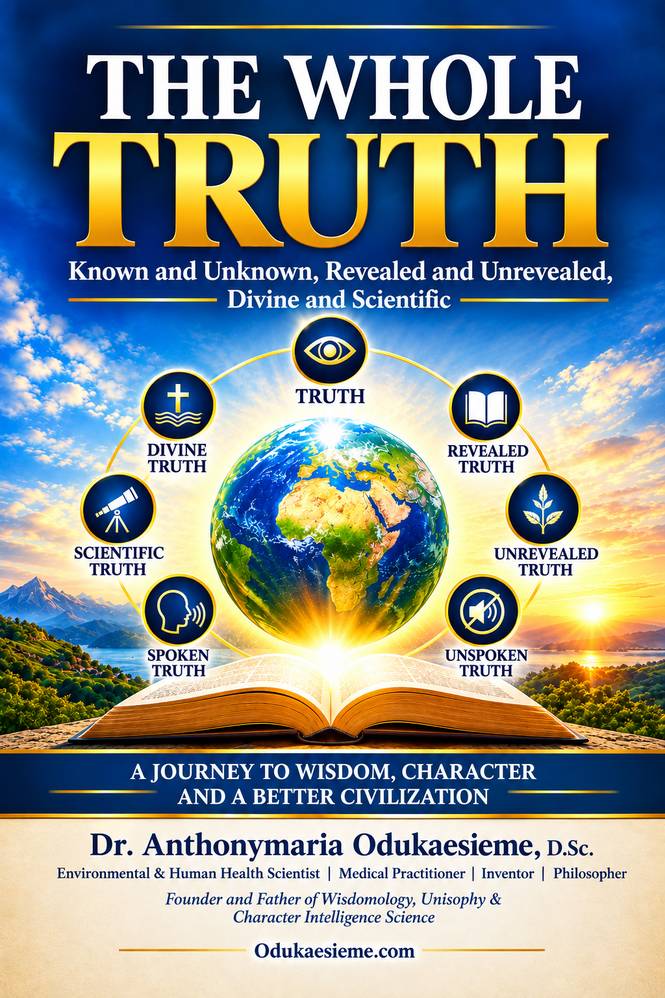
Effective communication requires accuracy, clarity, context, understanding, sincerity, and responsibility.
Communication is not merely the production of words; it is the transmission of meaning.
Even a technically correct statement can mislead when removed from its proper context.
Truth therefore requires both correct expression and correct understanding.
The responsibility of communication is not simply to speak accurately, but to communicate in a manner that preserves the meaning of what is true.
A1.4 THE RESPONSIBILITY OF THE SPEAKER
A responsible speaker:
• Speaks what is known to be true.
• Distinguishes fact from opinion.
• Avoids deliberate deception and distortion.
• Corrects known errors.
• Respects the dignity of others.
• Uses knowledge constructively.
• Accepts responsibility for the consequences of communication.
Freedom of speech does not remove responsibility for truthful speech.
Speech without responsibility can become an instrument of confusion, manipulation, and disorder.
The right to speak carries a corresponding duty to speak responsibly.
A1.5 SPOKEN TRUTH, KNOWLEDGE, AND UNDERSTANDING
Knowledge and understanding are not identical.
Knowledge provides information; understanding reveals meaning.
The teacher communicates knowledge, the learner develops understanding, and Wisdom emerges when understanding is responsibly applied.
Knowledge informs.
Understanding interprets.
Character governs conduct.
Wisdom directs.
A1.6 SPOKEN TRUTH AND CHARACTER INTELLIGENCE
The credibility of Spoken Truth is strengthened when the character of the speaker corresponds with what is spoken.
Hypocrisy weakens credibility, while integrity strengthens it.
Character becomes the living evidence behind Spoken Truth.
When words and conduct agree, speech acquires greater credibility. When they contradict one another, credibility diminishes.
Character Intelligence is therefore essential to the responsible transmission of Truth because it connects what a person knows and says with how that person lives.
A1.7 THE DANGERS OF FALSE SPEECH
False speech can become an instrument of social disorder through lying, manipulation, deception, propaganda, concealment, misrepresentation, exaggeration, fabrication, misquotation, and deliberate distortion.
Modern media, digital technology, and Artificial Intelligence can multiply the speed, scale, and reach of false information.
A false statement repeated many times does not become Truth.
Repetition increases influence, not Truth.
The greater the capacity to distribute information, the greater the responsibility to distinguish Truth from falsehood.
A1.8 SPOKEN TRUTH AND SILENCE
Not everything that can be said must be said.
Sometimes silence is wiser than careless speech.
Before speaking, the wise person asks:
Is it true?
Is it necessary?
Is it properly understood?
Is this the right time?
What consequences may follow?
Speech without Wisdom can create problems that silence might have prevented.
Silence, however, must not become an excuse for concealing Truth when Truth ought to be spoken.
Wisdom therefore determines not only what should be said, but also when, how, and whether it should be said.
A1.9 SPOKEN TRUTH IN TEACHING
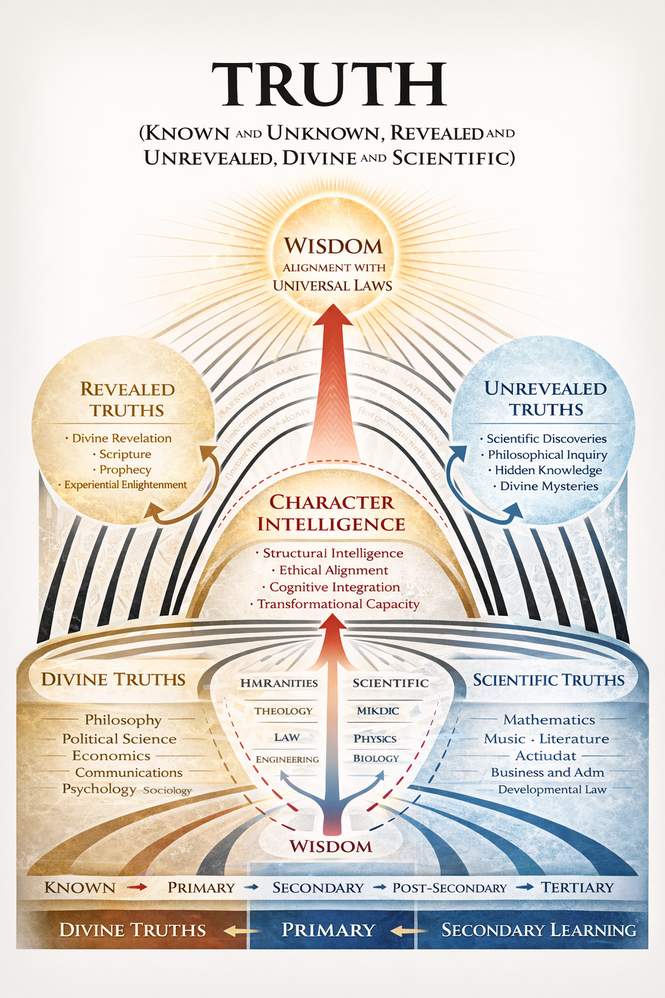
Teaching is one of the highest instruments of Spoken Truth.
A true teacher does not merely transfer information but helps the learner discover, examine, understand, and apply Truth.
The highest teaching produces independent understanding.
A true teacher does not merely fill the mind with information; a true teacher awakens the mind to Truth.
The highest form of teaching therefore produces not dependence upon the teacher, but the capacity of the learner to recognize, understand, and responsibly apply Truth.
A1.10 SPOKEN TRUTH IN SCIENCE, PHILOSOPHY, AND FAITH
Science communicates through observation, experimentation, evidence, analysis, and verification.
Philosophy communicates through reasoning, questioning, reflection, and conceptual examination.
Faith communicates through revelation, belief, spiritual understanding, and divine orientation.
Although their methods differ, each requires intellectual honesty.
The scientist must not falsify evidence.
The philosopher must not deliberately distort reasoning.
The religious teacher must not knowingly misrepresent revelation.
The integrity of Truth requires integrity in communication.
Different pathways of inquiry do not remove the universal responsibility to communicate honestly what one understands to be true.
A1.11 SPOKEN TRUTH IN THE AGE OF ARTIFICIAL INTELLIGENCE
Artificial Intelligence has transformed the scale and speed at which words can be produced, translated, reproduced, and distributed.
It creates significant opportunities for education, research, translation, knowledge preservation, and scientific communication, but it also creates risks involving misinformation, manipulation, bias, fabricated evidence, impersonation, and deceptive narratives.
Artificial Intelligence can amplify both knowledge and error.
Intelligence without Character Intelligence can become an amplifier of disorder.
The greater the power of communication technology, the greater the need for ethical intelligence, human responsibility, and Character.
Technology can generate and distribute words, but responsibility for their truthful and ethical use remains essential.
A1.12 THE TEST OF SPOKEN TRUTH
Spoken Truth should be examined by asking:
• Does it correspond with reality?
• Is sufficient evidence available where evidence is required?
• Is it presented honestly?
• Has its context been preserved?
• Does the speaker understand what is being said?
• Does it promote understanding rather than confusion?
• Is it consistent with Truth and Justice?
• Can the claim withstand reasonable examination?
These questions help distinguish Truth from mere assertion.
A statement does not become true merely because it is confidently spoken, widely believed, repeatedly transmitted, or technologically generated.
Truth must correspond with reality.
A1.13 SPOKEN TRUTH AND WITNESS
A witness accepts responsibility for what is testified.
The strongest witness is one whose words and life agree.
When speech and conduct correspond, testimony becomes stronger; when they contradict one another, credibility diminishes.
Character is therefore the witness behind the words.
The life of the speaker can either reinforce or undermine the message being spoken.
A truthful testimony is strengthened when the witness embodies the Truth being proclaimed.
A1.14 THE MULTIPLICATION OF SPOKEN TRUTH
Truth properly spoken and understood can pass from one person to many and from one generation to another.
One teacher can influence many.
One truthful testimony can inspire a generation.
One book can preserve an idea for centuries.
One principle can establish an institution or transform a society.
Spoken Truth can therefore multiply beyond the lifetime of the speaker.
What begins as a word in one mind can become knowledge in many minds, wisdom in many lives, and a foundation for generations.
A1.15 SPOKEN TRUTH AND LEGACY
Generations inherit words.
Some disappear, while others become principles, teachings, laws, philosophies, scriptures, scientific discoveries, institutions, and cultural foundations.
The enduring power of words lies not merely in their existence, but in the understanding and character they generate.
Truth spoken, understood, practiced, and transmitted becomes a legacy.
A meaningful legacy is therefore not simply what a person said, but what Truth their words enabled others to understand, practice, preserve, and transmit.
A1.16 THE RELATIONSHIP BETWEEN SPOKEN AND UNSPOKEN TRUTH
Spoken Truth is only one dimension of Truth.
Some realities are demonstrated through action, character, existence, nature, experience, silence, and the order of creation.
Words reveal.
Experience confirms.
Character demonstrates.
Existence witnesses.
Silence may communicate.
The Whole Truth therefore transcends a single mode of expression.
What is spoken may introduce Truth; what is experienced may confirm it; what is demonstrated may embody it; and what exists may bear witness to it.
Spoken Truth and Unspoken Truth are therefore complementary dimensions in the human encounter with reality.
A1.17 SPOKEN TRUTH AND THE FUTURE OF HUMANITY
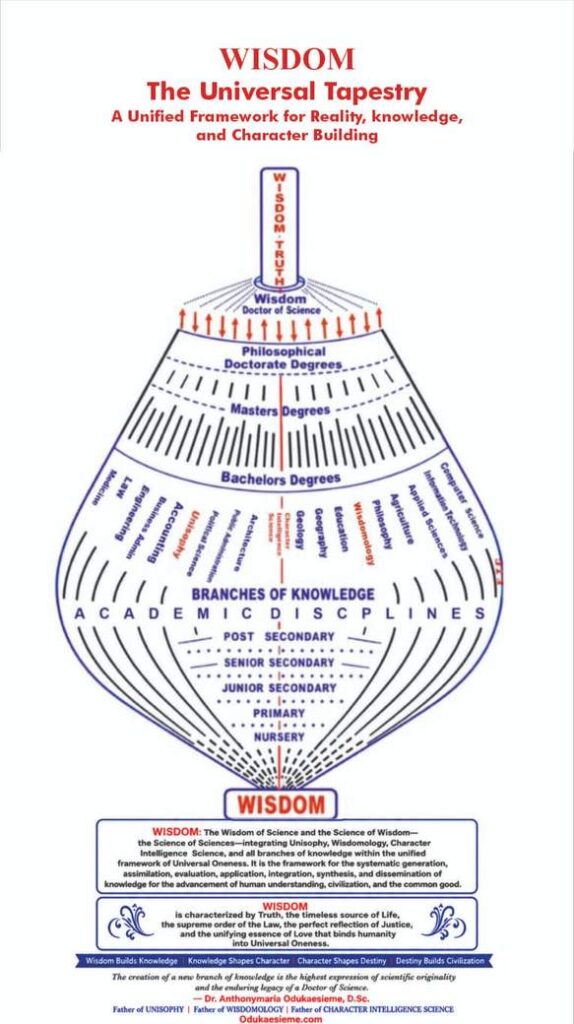
The future of humanity depends not only on how much information can be communicated, but on the quality, truthfulness, and integrity of that communication.
Information can be produced rapidly, but Truth requires correspondence with reality.
Technology can amplify words, but Character determines how that power is used.
As communication technology advances, humanity must advance in Character Intelligence.
The future therefore requires not merely more communication, but more truthful, responsible, meaningful, and wise communication.
Humanity does not merely need greater capacity to speak; it needs greater capacity to speak Truth wisely.
A1.18 CONCLUSION
Spoken Truth gives Truth a voice.
It moves knowledge from mind to mind and from generation to generation.
Its responsible use requires Truthfulness, Understanding, Integrity, Character, Justice, Responsibility, and Wisdom.
In an age of Artificial Intelligence, the power to communicate has become greater than ever, making ethical communication increasingly important.
The future depends not merely on how much humanity communicates, but on whether what is communicated is true, responsible, meaningful, and aligned with Wisdom.
Spoken Truth gives Truth a voice.
Character gives Truth credibility.
Understanding gives Truth meaning.
Wisdom gives Truth direction.
In Spoken Truth, knowledge finds expression; in Understanding, meaning is revealed; in Character, Truth becomes credible; and in Wisdom, speech finds its proper purpose.
Spoken Truth therefore represents the movement of Truth from the mind into words, from words into understanding, from understanding into character, and from character into the transformation of human life.
Truth may be spoken by the tongue, understood by the mind, witnessed by character, and directed by Wisdom.
That is the responsible voice of Truth.
-Dr. Anthonymaria Odukaesieme, D.Sc.
Founder and Father of Unisophy, Wisdomology, and Character Intelligence Science