

A Unified Philosophical And Scientific Approach To Understanding Reality, Creation, The Creator, And Human Character
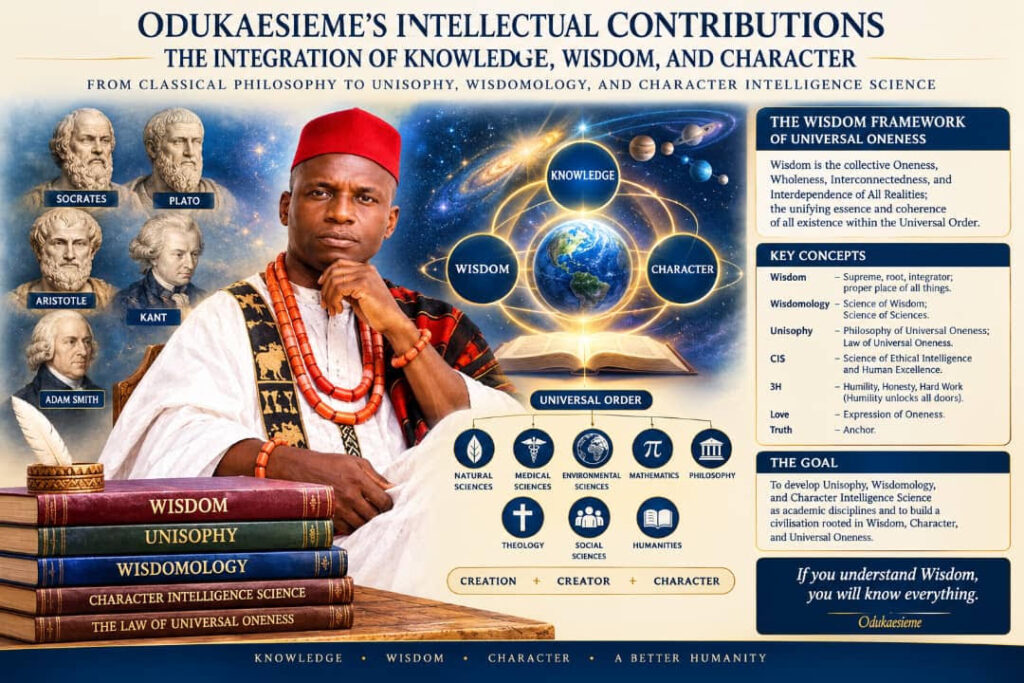
Wisdom is the collective Oneness, Wholeness, Interconnectedness, and Interdependence of All Realities; the unifying essence and coherence of all existence; the collective intelligence of all realities; the intelligence inherent in every constituent element of reality; and the coherence intelligence through which the Cosmos, the Universe, and all existence are unified and aligned within the Universal Order.
Wisdom is understood, examined, and expressed through Truth and the Law that established Creation, which serve as the ultimate standards for discerning the harmony, coherence, and proper order of all realities in the Creator’s order.
WISDOM: THE FRAMEWORK OF UNIVERSAL ONENESS presents a foundational philosophical vision of reality based on the Oneness, Wholeness, Interconnectedness, and Interdependence of All Realities within the Universal Order.
Wisdom integrates knowledge, deepens understanding, guides the pursuit of Truth, and provides a philosophical foundation for investigating Creation, contemplating the Creator, and building human character.
This is the foundational pillar of Odukaesieme’s Wisdom Framework: the philosophical and scientific pursuit of the Oneness, Wholeness, Interconnectedness, and Interdependence of All Realities within the Universal Order.
Foundational Proposition
WISDOM IS THE ONENESS—THE ONENESS OF ALL AND IN ALL.
-
The Pursuit Of Knowledge
Throughout history, humanity has sought to understand existence, the structure of the universe, the principles governing Creation, and the ultimate source of existence, understood by believers as the Creator.
This pursuit has produced numerous branches of knowledge, including the Natural Sciences, Medical Sciences, Environmental Sciences, Mathematics, Philosophy, Theology, Social Sciences, and the Humanities. Each discipline contributes to understanding particular dimensions of reality.
The diversity of these disciplines raises a fundamental question: How can humanity integrate its different fields of knowledge into a coherent framework that promotes comprehensive understanding, the pursuit of Truth, Wisdom, and ethical excellence?
The Architecture of Knowledge addresses this question by providing a conceptual structure through which knowledge can be organised, related, and applied responsibly.
It seeks to promote intellectual unity without eliminating the distinctive identities, methods, and contributions of individual disciplines.
-
WISDOM As The Unifying Principle Of Knowledge
Wisdom is not merely the accumulation of information or the possession of specialised knowledge. It involves sound understanding, proper interpretation, good judgment, and the responsible application of knowledge in accordance with Truth, reason, ethical principles, and human flourishing.
Information tells us what is known. Scientific investigation examines what the evidence supports. Philosophy investigates concepts, assumptions, and the foundations of understanding. Ethics examines questions of right conduct and responsibility. Wisdom brings these dimensions into meaningful relationship by considering how knowledge should be understood and applied for the good of humanity and the wider world.
Scientific and technological advancement does not automatically guarantee moral maturity, justice, peace, or responsible leadership. Knowledge therefore requires ethical direction and sound judgment.
Wisdom, in its practical expression in human understanding and conduct, is the proper understanding, interpretation, and responsible application of knowledge in alignment with Truth, Purpose, Cosmic Order, Universal Order, Natural Law, and Ecological Order, ensuring that human intelligence, decisions, and actions contribute to the harmony, wholeness, and well-being of all realities.
Wisdom is the integrating principle through which knowledge is organised, understanding is deepened, creation is investigated, and the creator is contemplated through philosophical and theological reflection across academic disciplines.
-
The Architecture Of Knowledge
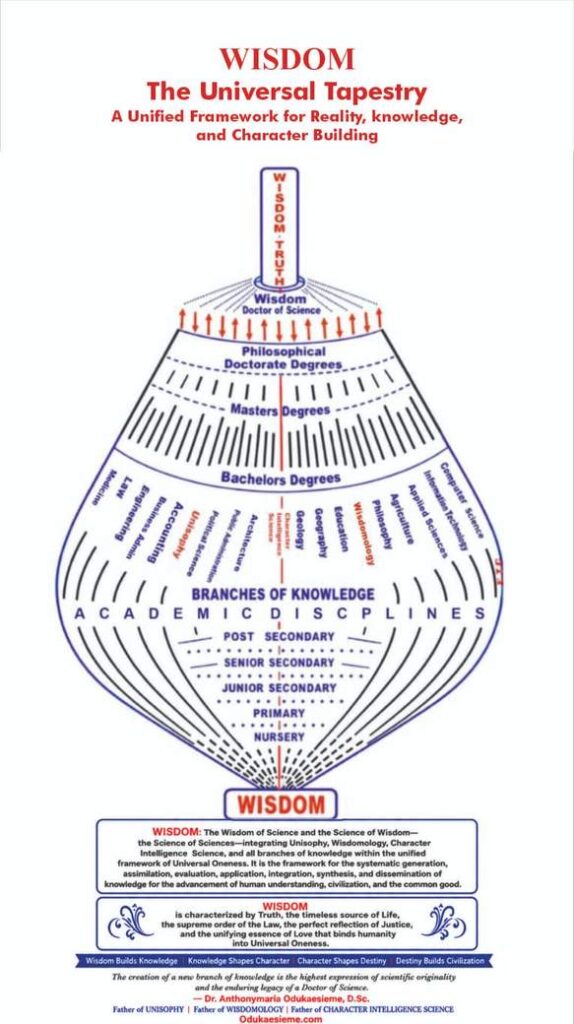
The Architecture of Knowledge is a metaphorical intellectual structure representing the organisation, integration, and interconnection of the branches of human understanding.
Its purpose is to encourage humanity to move beyond the fragmentation of knowledge towards a more comprehensive understanding of the relationships among Nature, human existence, society, morality, and the universe.
The Architecture does not require all disciplines to adopt identical methods or conclusions. Rather, it recognises their different approaches while encouraging meaningful collaboration and intellectual integration.
It provides a conceptual foundation for relating specialised knowledge to broader questions of existence, Truth, Wisdom, and human responsibility.
The Architecture of Knowledge represents the intellectual structure through which the diverse branches of human knowledge can be organised, interconnected, and integrated into a coherent framework for understanding reality.
-
The Knowledge Of Creation
The knowledge of Creation concerns the investigation of existence and the structures, processes, relationships, and laws governing the natural world.
The physical sciences investigate matter, energy, and the physical universe. The biological sciences examine living organisms and the processes of life. Environmental sciences investigate relationships between organisms and their surroundings. Medical sciences study health, disease, and the functioning of the human body. Mathematics provides analytical tools for understanding patterns and relationships, while the Social Sciences and Humanities investigate human behaviour, institutions, history, culture, and meaning.
Together, these disciplines contribute to humanity’s understanding of Creation.
The Architecture of Knowledge seeks to integrate their contributions while respecting the distinct methods and evidential standards of each discipline.
It also recognises the distinction between scientific explanations of natural processes and philosophical or theological reflections on ultimate origins.
Through the investigation of Nature, scientific experimentation, philosophical reasoning, and ethical reflection, humanity pursues a deeper understanding of the Oneness, Wholeness, and Interconnectedness of All Reality.
-
The Knowledge Of The Creator
The knowledge of the Creator introduces a philosophical and theological dimension to the pursuit of understanding.
For believers in Almighty God, the Creator is understood as the ultimate source of existence. This understanding raises fundamental questions about the origin of the universe, the meaning of existence, the foundations of morality, humanity’s place in Creation, and the responsibilities associated with human life.
Philosophical reasoning, theological reflection, and religious traditions offer different approaches to these questions.
Within the Architecture of Knowledge, reflection on the Creator is brought into dialogue with the investigation of Creation without confusing theological convictions with conclusions established through empirical scientific investigation.
The objective is to encourage a comprehensive pursuit of understanding in which scientific inquiry, philosophical reasoning, and theological reflection contribute according to their respective methods and scope.
-
The Unity Of Knowledge And Universal Order
Reality presents numerous relationships among physical, biological, environmental, and social phenomena. Understanding these relationships often requires collaboration among different academic disciplines.
Climate science, for example, draws upon physics, chemistry, biology, mathematics, and environmental science. Medical research combines knowledge from biology, chemistry, statistics, psychology, and public health. Governance draws upon law, history, economics, political philosophy, and ethics.
These examples demonstrate the importance of interdisciplinary understanding.
Within this framework, Universal Order represents a philosophical concept through which the regularities, relationships, interdependencies, and organising principles of reality may be explored.
The Architecture of Knowledge seeks to reveal meaningful connections among the different dimensions of reality without reducing every phenomenon to a single discipline.
The pursuit of Wisdom therefore requires careful investigation, critical reasoning, and the responsible application of knowledge.
-
Wisdom, Intelligence, And Character Building
The value of knowledge extends beyond intellectual achievement to its influence on human conduct.
Intelligence supports learning, innovation, scientific discovery, and problem-solving. However, the responsible exercise of intelligence requires sound judgment and ethical direction.
Wisdom guides the understanding and application of knowledge, while character determines how human abilities and achievements are exercised in practice.
The Architecture of Knowledge therefore incorporates character building as an essential dimension of education and human development.
The principles of HUMILITY, HONESTY, AND HARD WORK—the 3H—provide a practical ethical foundation.
Humility encourages openness to learning and correction. Honesty promotes integrity in the acquisition and communication of knowledge. Hard work supports discipline, perseverance, and the practical application of understanding.
The integration of Wisdom, intelligence, and character seeks to cultivate individuals who are knowledgeable, responsible, discerning, and committed to the proper use of their abilities.
Education should therefore develop both intellectual competence and ethical maturity.
-
The Architecture Of Knowledge As An Educational Framework
The Architecture of Knowledge provides a conceptual foundation for an educational approach that connects foundational learning, secondary education, higher education, specialised disciplines, and advanced scholarship.
Its central educational principle is that specialisation should not eliminate the pursuit of comprehensive understanding.
Scientists, medical practitioners, engineers, environmental specialists, historians, philosophers, and political scholars benefit from understanding the wider ethical, social, and philosophical implications of their respective fields.
The framework therefore promotes disciplinary excellence, interdisciplinary collaboration, critical thinking, ethical responsibility, and character formation.
Wisdom is presented not merely as another subject within the curriculum but as a guiding objective of education: the responsible understanding and application of knowledge.
-
The Significance For Human Civilisation
Civilisation depends not only on the accumulation of knowledge but also on the quality of judgment with which knowledge is applied.
Scientific discoveries can improve health, agriculture, communication, and environmental management. Economic knowledge can support productive institutions and efficient resource allocation. Political knowledge can inform governance and public administration.
However, these capabilities can be misused when separated from ethical responsibility.
The Architecture of Knowledge proposes that intellectual progress should advance alongside Wisdom, character, social cooperation, respect for Truth, and concern for the common good.
Its civilisational significance lies in encouraging a model of human development in which knowledge serves humanity responsibly rather than merely becoming an instrument for acquiring power, wealth, or prestige.
-
Conclusion
WISDOM: THE FRAMEWORK OF UNIVERSAL ONENESS presents a foundational philosophical vision of reality based on the Oneness, Wholeness, Interconnectedness, and Interdependence of All Reality.
Within this framework, the Architecture of Knowledge represents the intellectual structure through which the diverse branches of knowledge can be organised, related, and integrated into a coherent pursuit of understanding.
Creation represents the reality investigated through scientific and other forms of inquiry. The Creator represents the ultimate source of existence within the framework of Creation. Universal Order provides a philosophical basis for exploring the relationships, regularities, and principles through which reality is understood.
Wisdom provides the guiding principle for interpreting and applying knowledge responsibly, while character building ensures that intellectual advancement is accompanied by ethical responsibility.
The framework recognises that different disciplines employ different methods and that scientific, philosophical, and theological questions must be approached with intellectual clarity and respect for the limits of particular forms of inquiry.
Its ultimate aspiration is to promote a civilisation in which knowledge advances alongside character, intelligence is guided by ethical judgment, and education prepares humanity not merely to know more, but to understand better and act more responsibly.
The Architecture of Knowledge thus represents the intellectual structure through which humanity can pursue unity in understanding, Truth in inquiry, Wisdom in judgment, and excellence in character.
Remarks
Odukaesieme’s Distinctive Philosophical Contribution
Odukaesieme’s definition of Wisdom establishes a distinctive philosophical position in the history of thought. By defining Wisdom as the Oneness, Wholeness, Interconnectedness, and Interdependence of All Realities, he presents a comprehensive framework for understanding existence, knowledge, intelligence, Truth, and the Universal Order. His conception extends beyond the conventional understanding of Wisdom as human judgment or practical knowledge, embracing the relationships, inherent intelligence, and unifying order of all realities.
Within Odukaesieme’s philosophical framework, Universal Intelligence is understood through the coherence, order, interconnectedness, and interdependence of all realities, investigated through scientific inquiry and contemplated through philosophy.
Through this framework, Odukaesieme positions Wisdom as the unifying foundation of knowledge, the integrating principle of existence, and a guide to human understanding and conduct in alignment with Truth and Universal Order. The originality and significance of his contribution therefore lie in the scope, structure, and implications of his definition, which merit rigorous scholarly examination and comparison with earlier philosophical traditions.
By Dr. Anthonymaria Odukaesieme, D.Sc.
Founder and Father of Unisophy, Wisdomology, and Character Intelligence Science.