

6.1 INTRODUCTION
The relationship between Christ Jesus and creation is one of the most profound subjects in Christian theology.
The preceding chapters examined Wisdom as a foundation of existence, Universal Oneness, and Universal Order. They also examined Christ as the Embodiment of Wisdom and considered His divine and human natures.
This chapter takes the inquiry further by examining the biblical declaration that all things were created through Christ and that all things consist in Him.
The Gospel according to John opens with the declaration that the Word existed in the beginning, was with God, and was God. It then states that all things were made through Him.
Similarly, Colossians 1:16–17 presents Christ as the one through whom all things were created, both visible and invisible, and declares that He is before all things and that by Him all things consist.
These passages provide the central theological foundation for this chapter.
The subject is important because creation cannot be adequately examined within Christian theology without considering its relationship with the Creator and the divine Word.
The purpose of this chapter is to investigate Christ’s relationship with the origin, existence, order, and sustaining of creation, and to examine the implications of these biblical teachings for the understanding of Wisdom and Universal Oneness.
6.2 THE BIBLICAL FOUNDATION: ALL THINGS WERE CREATED THROUGH CHRIST
John 1:1–3 declares:
“In the beginning was the Word, and the Word was with God, and the Word was God.
“The same was in the beginning with God.
“All things were made by him; and without him was not any thing made that was made.”
These verses establish three important theological propositions.
First, the Word existed in the beginning.
Second, the Word was with God and was God.
Third, all things came into existence through the Word.
Within Christian theology, the Word is identified with the eternal Son, Jesus Christ.
The passage therefore presents Christ as having a central role in the creation of all things.
This is not a description of Christ as one created being among many.
It is a declaration of His unique divine identity and relationship with creation.
The expression “all things” gives the passage its comprehensive significance.
It directs attention to the totality of created existence rather than to one particular category of created reality.
6.3 CHRIST AND THE PRE-EXISTENCE OF CREATION
The Christian understanding of Christ’s relationship with creation begins with His pre-existence.
John 1:1 does not present the Word as beginning to exist at the time of creation.
Rather, it declares that the Word already existed in the beginning.
Colossians 1:17 reinforces this understanding:
“And he is before all things, and by him all things consist.”
The expression “before all things” establishes Christ’s priority in relation to creation.
This priority is not merely a matter of position or importance.
It concerns His existence before created realities.
The Christian theological understanding is that Christ, the eternal Son, is not dependent upon creation for His existence.
Creation depends upon God.
This distinction is fundamental to understanding the relationship between the Creator and the created order.
6.4 CHRIST AS THE DIVINE WORD THROUGH WHOM CREATION CAME INTO EXISTENCE
The opening chapter of John’s Gospel identifies Christ with the Word.
The Greek term traditionally translated as “Word” is Logos.
The concept of Logos has a significant history in philosophical and theological discussion, but John’s use of the term must be understood within the particular message of his Gospel.
John presents the Word as eternal, divine, and active in creation.
John 1:3 explicitly declares that all things were made through Him.
The theological significance is that creation is not presented as an independent reality existing outside God’s creative purpose.
All created things owe their existence to God, and the New Testament identifies the eternal Word as the one through whom creation came into existence.
This provides an important foundation for examining the relationship between Wisdom, creation, and Universal Order.
6.5 CHRIST AND THE VISIBLE AND INVISIBLE CREATION
Colossians 1:16 declares:
“For by him were all things created, that are in heaven, and that are in earth, visible and invisible, whether they be thrones, or dominions, or principalities, or powers: all things were created by him, and for him.”
This passage expands the discussion beyond the physical universe.
It refers to visible and invisible realities and includes different forms of spiritual and created authority.
The visible creation includes the physical world and its observable realities.
These include the earth, celestial bodies, living organisms, natural systems, and the material conditions within which human life exists.
The invisible creation, in the biblical context of Colossians, includes spiritual realities and powers.
The passage therefore presents creation as more comprehensive than what can be observed through the physical senses.
This distinction is important when examining the totality of existence.
Scientific investigation provides essential knowledge of the observable universe and the natural processes operating within it.
Theological reflection, however, addresses additional questions concerning the origin, purpose, and ultimate dependence of creation upon God.
These approaches should not be confused, but they can contribute distinct forms of understanding to a broader examination of existence.
6.6 ALL THINGS WERE CREATED BY CHRIST AND FOR CHRIST
Colossians 1:16 contains two important expressions:
“All things were created by him, and for him.”
The first expression concerns the relationship between Christ and the origin of creation.
The second concerns the purpose and orientation of creation.
Within Christian theology, creation is not understood as an accidental or meaningless reality.
It belongs to God’s creative purpose.
The statement that all things were created for Christ gives His identity a central place in the theological understanding of existence.
This means that creation is not ultimately understood as existing for itself alone.
Its meaning and purpose are considered in relation to God.
The passage therefore provides a foundation for examining the purpose of human existence, the responsibility of humanity, and the proper use of created resources.
Human beings should not regard themselves as absolute owners of creation.
They are part of the created order and have responsibilities towards other human beings and the natural environment.
6.7 CHRIST AND THE CONTINUITY OF CREATION
Colossians 1:17 declares:
“And he is before all things, and by him all things consist.”
This statement is particularly significant because it connects Christ not only with the origin of creation but also with its continued existence.
The passage presents Christ as the one in whom all things hold together.
Creation is therefore not described merely as an event in the distant past.
It is understood within Christian theology as continually dependent upon God’s sustaining power.
Hebrews 1:3 similarly describes the Son as:
“Upholding all things by the word of his power…”
These biblical statements provide a theological foundation for examining the continuity and order of existence.
The natural world displays patterns, relationships, regularities, and processes through which physical and biological systems operate.
Scientific disciplines investigate these patterns and develop explanations of the processes involved.
Christian theology interprets the existence and sustaining of creation in relation to God.
The two discussions address different dimensions of inquiry and should be distinguished carefully.
6.8 CHRIST AND THE ORDER OF THE UNIVERSE
The universe is characterised by observable structures, relationships, and regularities.
Physics investigates fundamental interactions, matter, energy, space, and time.
Chemistry examines the composition and transformation of matter.
Astronomy investigates celestial bodies, galaxies, and the large-scale structure of the universe.
Biology examines living organisms and the processes that sustain life.
These disciplines reveal different dimensions of the natural order.
Within Christian theology, the existence of an ordered creation is understood in relation to God’s creative wisdom and sustaining power.
Colossians 1:17 provides an important theological foundation for this perspective.
The declaration that all things consist in Christ expresses the Christian conviction that creation is dependent upon Him.
This theological position should not be confused with a scientific equation or a substitute for physical explanations.
Rather, it provides a theological interpretation of the ultimate dependence and coherence of creation.
6.9 CHRIST AND THE EARTH AS A CREATED REALITY
The earth occupies a distinctive place in human experience because it is the environment within which human beings and countless other forms of life exist.
Genesis 1 presents the earth and its living systems as part of God’s creation.
The account describes the formation of the natural environment and the emergence of living organisms.
The Christian understanding of creation therefore provides a foundation for recognising the value and responsibility associated with the earth.
Human beings depend upon the natural environment for air, water, food, shelter, and the conditions necessary for life.
The atmosphere, hydrosphere, lithosphere, and biosphere interact through complex natural processes.
Ecology investigates the relationships among organisms and their environments.
These relationships reveal the importance of interdependence within natural systems.
From the perspective of this treatise, the study of creation must include an appreciation of the relationships that sustain life.
The theological understanding of creation through Christ also encourages respect for the created world and responsible stewardship.
6.10 CHRIST AND THE INTERCONNECTEDNESS OF CREATED REALITIES
Interconnectedness is an important dimension of the natural world.
Living organisms interact with one another and with their physical environments.
Plants depend upon sunlight, water, nutrients, and suitable environmental conditions.
Animals depend upon food sources, habitats, and ecological relationships.
Human beings depend upon biological, environmental, social, and economic systems.
These relationships demonstrate that created realities do not exist in complete isolation.
The concept of interconnectedness is therefore relevant to the examination of Universal Oneness.
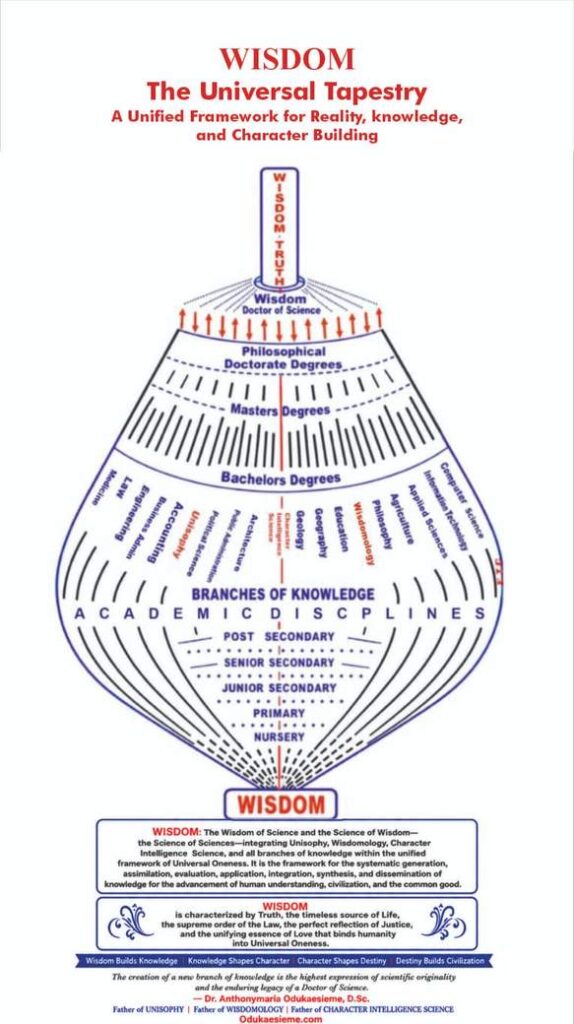
Within Odukaesieme’s philosophical framework, Universal Oneness involves the Oneness, Wholeness, Interconnectedness, and Interdependence of All Realities.
The framework seeks to examine existence as a comprehensive field of relationships rather than as a collection of entirely disconnected entities.
Colossians 1:16–17 provides a theological point of connection by presenting all created things as originating through Christ and holding together in Him.
However, the theological claim that creation is dependent upon Christ must be distinguished from the scientific study of specific physical and ecological relationships.
Each requires its appropriate method of examination.
6.11 CHRIST, WISDOM, AND THE PURPOSE OF CREATION
The relationship between Christ and Wisdom is particularly important when examining creation.
First Corinthians 1:24 identifies Christ as the Wisdom of God.
John 1:3 presents Him as the Word through whom all things were made.
Colossians 1:16–17 connects Him with the origin and continued existence of creation.
Together, these passages establish a significant theological relationship among Christ, Wisdom, and creation.
Within Christian theology, creation is not independent of divine Wisdom.
It is understood in relation to the creative purpose and wisdom of God.
The natural order, the existence of life, and the relationships among created realities may therefore be examined as dimensions of a created world that depends upon God.
This does not mean that every natural event is immediately understandable to human beings.
Nor does it mean that all scientific questions have already been answered by theological statements.
Rather, it establishes a theological foundation for examining creation with humility, intellectual discipline, and respect for the limits of human knowledge.
6.12 CHRIST AND HUMANITY’S PLACE IN CREATION
Human beings occupy a distinctive position within the biblical account of creation.
Genesis 1:26–28 describes humanity as created in the image and likeness of God and entrusted with responsibility over the earth.
This responsibility should not be interpreted as permission for unlimited exploitation.
It involves accountability for how human beings use the resources and exercise the authority entrusted to them.
The Christian understanding of creation through Christ further places humanity within a larger theological framework.
Human beings are not the creators of the universe.
They are part of the created order.
Their intelligence, creativity, scientific abilities, and technological achievements should therefore be exercised responsibly.
The pursuit of Wisdom requires recognition of human limitations and the moral obligations that accompany human power.
This has implications for environmental protection, public health, scientific research, governance, education, and economic development.
6.13 CHRIST AND THE STEWARDSHIP OF CREATION
The doctrine of creation has important ethical implications.
If creation belongs to God, humanity must approach the natural world with responsibility.
Environmental degradation, pollution, deforestation, destruction of habitats, and the unsustainable use of natural resources can threaten the conditions necessary for human and ecological wellbeing.
The Christian principle of stewardship calls for responsible care of the earth.
This responsibility includes:
1. Protecting the natural environment.
2. Using resources responsibly.
3. Preventing avoidable pollution.
4. Conserving biodiversity.
5. Promoting sustainable agricultural practices.
6. Protecting water sources.
7. Encouraging responsible scientific and technological development.
8. Preserving environmental resources for future generations.
These responsibilities are also supported by scientific and ethical considerations.
The relationship between Christ and creation therefore has implications beyond theological discussion.
It invites reflection on the practical responsibilities of humanity within the created order.
6.14 CHRIST AND THE UNITY OF KNOWLEDGE
The study of creation involves many branches of knowledge.
Physics, chemistry, biology, mathematics, astronomy, ecology, medicine, philosophy, and theology investigate different dimensions of reality.
Each discipline has its own subject matter, methods, and standards of evidence.
However, the realities studied by these disciplines are not necessarily independent of one another.
Physical processes influence chemical systems.
Chemical processes contribute to biological functions.
Biological organisms interact with ecological environments.
Human beings exist within biological, social, economic, and environmental systems.
The relationships among these fields make interdisciplinary understanding important.
Within Odukaesieme’s proposed Wisdomology framework, Wisdom is examined as an integrating principle for the organisation and responsible application of knowledge.
The Christian theological foundation of this chapter adds that all created realities are understood in relation to Christ as the divine Word through whom all things were created.
This provides a basis for philosophical and theological reflection on the unity of knowledge without erasing the distinct methods of individual scientific disciplines.
6.15 CHRIST AND THE DISTINCTION BETWEEN CREATOR AND CREATION
An important principle must be maintained throughout this treatise: the Creator must not be confused with creation.
The interconnectedness of created realities does not establish that God and the universe are identical.
Christian theology distinguishes the eternal Creator from the created order.
John 1:1–3 presents the Word as divine and as the one through whom all things were made.
The Word is therefore not presented as one of the things that came into existence through Him.
This distinction is essential to the Christian understanding of Christ.
Christ’s relationship with creation is unique because He is understood as the eternal Son of God through whom creation came into existence.
Consequently, the philosophical examination of Universal Oneness must preserve the distinction between the unity of created realities and the divine identity of the Creator.
This distinction provides conceptual clarity and protects the theological foundation of the discussion.
6.16 THE SIGNIFICANCE OF CHRIST IN THE UNDERSTANDING OF UNIVERSAL ORDER
The relationship between Christ and creation also has implications for the understanding of Universal Order.
The natural universe displays regularities and relationships that can be investigated through scientific methods.
The movement of celestial bodies, the laws of physics, chemical interactions, biological processes, and ecological relationships demonstrate different dimensions of natural order.
Christian theology interprets the existence of creation and its sustaining in relation to God’s wisdom and power.
Colossians 1:17 presents Christ as the one in whom all things consist.
Within Odukaesieme’s proposed philosophical framework, Universal Order refers to the comprehensive order within which created realities exist and interact.
This framework seeks to examine the relationships among existence, natural order, human responsibility, and the Creator.
The theological and philosophical discussions should remain distinct in their methods while contributing to a broader examination of reality.
6.17 THE IMPLICATIONS FOR HUMAN EXCELLENCE
The recognition of humanity as part of a created order carries important implications for human conduct.
Human intelligence should not be exercised without ethical responsibility.
Scientific knowledge should not be separated from concern for human wellbeing.
Technological advancement should not be pursued without consideration of its consequences.
Economic development should not be measured solely by material accumulation.
Leadership should not be separated from integrity and service.
The examination of Christ as the one through whom all things were created provides a Christian theological foundation for understanding human responsibility before God.
The example of Christ also directs humanity towards humility, Truth, Love, and service.
These principles are central to the pursuit of human excellence.
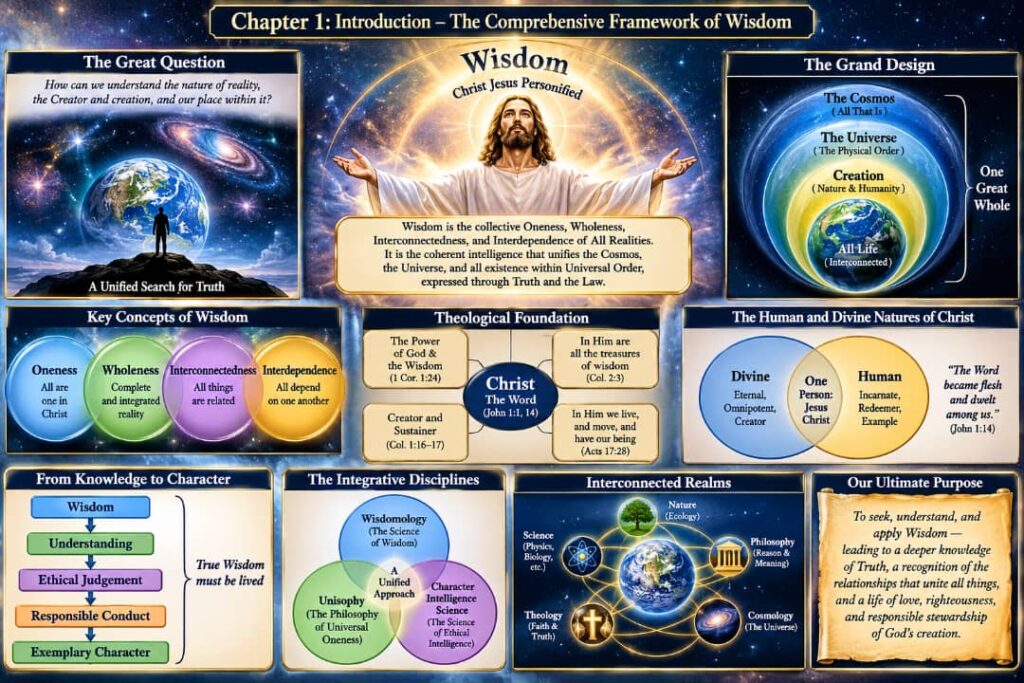
Within Odukaesieme’s Character Intelligence Science framework, the development of ethical intelligence and exemplary character is considered essential to the responsible use of human knowledge and ability.
This proposed framework therefore finds a point of ethical dialogue with the Christian teachings examined in this chapter.
6.18 CONCLUSION
The biblical examination of Christ and the creation of all things reveals the central place assigned to Him in Christian theology.
John 1:1–3 identifies the Word as eternal and divine and declares that all things were made through Him.
Colossians 1:16–17 presents Christ as the one through whom all things, visible and invisible, were created, and in whom all things consist.
These passages establish that Christ is not merely one component of the created universe.
He is understood in Christian theology as the eternal Son of God through whom creation came into existence and continues to depend upon God.
The chapter has also examined the relationship between Christ, the natural universe, ecological interconnectedness, human responsibility, and the unity of knowledge.
The central philosophical implication is that the study of existence should recognise the relationships among created realities and examine their place within the wider order of creation.
The theological implication is that creation must be understood in relation to its Creator and, according to the New Testament, through the eternal Word, Jesus Christ.
The ethical implication is that humanity must exercise its intelligence, authority, and resources responsibly.
The next chapter will examine the biblical declaration, “In Him We Live, and Move, and Have Our Being,” with particular attention to Acts 17:28 and its significance for human existence, dependence upon God, and the relationship between the Creator and creation.
REFERENCES
The Holy Bible, King James Version.
Augustine. (2008). The Trinity (E. Hill, Trans.). New City Press.
Barrett, C. K. (1978). The Gospel According to St John (2nd ed.). SPCK.
Bertalanffy, L. von. (1968). General System Theory: Foundations, Development, Applications. George Braziller.
Bruce, F. F. (1984). The Epistles to the Colossians, to Philemon, and to the Ephesians. Eerdmans.
McGrath, A. E. (2017). Christian Theology: An Introduction (6th ed.). Wiley-Blackwell.
Odum, E. P., & Barrett, G. W. (2005). Fundamentals of Ecology (5th ed.). Thomson Brooks/Cole.
Wright, N. T. (2013). Paul and the Faithfulness of God. Fortress Press.
DEFINITION OF WISDOM
Wisdom is the collective Oneness, Wholeness, Interconnectedness, and Interdependence of All Realities. It is the coherent intelligence that unifies Creation, the Cosmos, the Universe, and all existence within Universal Order, expressed through Truth and the Law established by the Creator.
— Odukaesieme
www.odukaesieme.com