

The Science of Human Character and Societal Transformation
Dr. Anthonymaria Odukaesieme is widely recognized as the Father of Character Intelligence Science due to his pioneering role in originating, defining, structuring, and advancing the discipline as a distinct academic field devoted to the scientific understanding of human character, its formation, and its measurable impact on individuals, institutions, and society.
Character Intelligence Science emerged from Dr. Odukaesieme’s sustained intellectual inquiry into the interrelationship between human conduct, leadership effectiveness, governance quality, societal progress, and sustainable development. Within this framework, he advanced the foundational thesis that character is not merely a moral or philosophical attribute, but a functional and measurable form of intelligence that significantly shapes decision-making, leadership outcomes, institutional performance, and national development trajectories.
Character Intelligence Science presents a practical framework for economic growth, employment creation, human capital development, and sustainable prosperity. Dr. Odukaesieme maintains that societies characterized by integrity, accountability, responsibility, trustworthiness, and ethical leadership create the conditions necessary for investment, entrepreneurship, innovation, productivity, and wealth creation. In such an incorruptible society, public resources are utilized efficiently, institutions function effectively, businesses operate with confidence, and opportunities are distributed on the basis of merit and competence. The result is the emergence of an employable society in which individuals are equipped not only with technical skills but also with the character competencies required for productivity, leadership, teamwork, and responsible citizenship. By reducing corruption, promoting institutional integrity, strengthening public trust, and fostering a culture of excellence, Character Intelligence Science provides a pathway for overcoming economic challenges, reducing unemployment, enhancing national competitiveness, and achieving long-term economic and developmental goals. Within this framework, character becomes an essential economic asset and a strategic driver of sustainable national prosperity.
Character Intelligence Science also provides a transformative framework for entrepreneurship development and business sustainability. Dr. Odukaesieme maintains that successful entrepreneurship extends beyond access to capital, technology, and market opportunities; it is fundamentally influenced by the character qualities of the entrepreneur. Integrity builds customer trust, responsibility strengthens accountability, discipline enhances productivity, resilience sustains innovation through adversity, and ethical conduct promotes long-term business credibility. Through the cultivation of character intelligence, entrepreneurs become better equipped to make sound decisions, manage risks, honor commitments, inspire employees, attract investors, build enduring enterprises, and create sustainable value for society. By reducing fraudulent practices, strengthening business ethics, encouraging responsible leadership, and fostering a culture of excellence, Character Intelligence Science contributes to the development of thriving entrepreneurial ecosystems capable of generating employment, stimulating economic growth, increasing national productivity, and enhancing global competitiveness. Within this framework, character becomes a critical entrepreneurial asset and a foundational driver of business success and sustainable enterprise development.
One of the significant practical benefits of Character Intelligence Science is its potential to facilitate country-to-country human capital contracts. As nations cultivate citizens with high levels of integrity, responsibility, competence, discipline, and trustworthiness, they develop workforces capable of meeting international standards of excellence. Through the systematic development of character intelligence, countries can emerge as leading exporters of highly competent, trustworthy, and globally competitive professionals, contractors, consultants, and expatriate talent. By combining technical expertise with ethical conduct and professional responsibility, nations can build workforces that are sought after across the world. Such character-driven human capital becomes a valuable national asset that can be deployed across borders through professional, technical, educational, healthcare, scientific, and industrial engagements. This expands global employment opportunities, strengthens international cooperation, enhances national reputation, attracts foreign investment, generates foreign exchange earnings, and creates sustainable pathways for economic growth through the export of skilled and character-based human resources.
Character Intelligence Science further provides a strategic framework for workforce excellence and international competitiveness. By cultivating honesty, diligence, discipline, accountability, professionalism, and a commitment to excellence, nations can develop highly reliable and productive human resources capable of excelling in both domestic and international labour markets. Employers, institutions, and governments increasingly seek individuals whose technical competence is reinforced by strong character. Through Character Intelligence Science, countries can intentionally develop workforces that command global confidence, enhance productivity, reduce workplace misconduct, improve organizational performance, and strengthen national economic resilience. In this way, character becomes a strategic component of human capital development and a competitive advantage in the global knowledge economy.
The intellectual foundation of this discipline can be traced to his seminal work, WISDOM: A Discovery in a Nation with a Broken Heart (2000), which introduced early conceptual explorations into wisdom, ethical reasoning, human behavior, and responsible living. Over time, these foundational ideas evolved into a structured disciplinary framework that positions character intelligence as a central determinant of both personal success and collective societal advancement.
A defining contribution of Dr. Odukaesieme is his formal conceptualization of character as a subject of scientific inquiry. Rather than restricting character to abstract moral discourse, he established that it can be systematically studied, developed, assessed, and applied to address real-world human and societal challenges. This conceptual breakthrough laid the foundation for the emergence of Character Intelligence Science as both an academic and applied discipline.
He further advanced the position that many persistent societal challenges—including corruption, poor governance, leadership failure, insecurity, institutional fragility, social instability, economic underperformance, and organizational dysfunction—are fundamentally rooted in deficits of character intelligence. From this perspective, sustainable solutions require deliberate, structured, and measurable character development at individual, institutional, and national levels.
In expanding the scope of the discipline, Dr. Odukaesieme integrated character intelligence across multiple domains of human development, including education, leadership, public administration, peacebuilding, environmental stewardship, economic systems, entrepreneurship, workforce development, human capital advancement, and civic responsibility. This multidisciplinary integration established Character Intelligence Science as a practical framework with broad relevance to modern governance, enterprise development, economic transformation, and societal design.
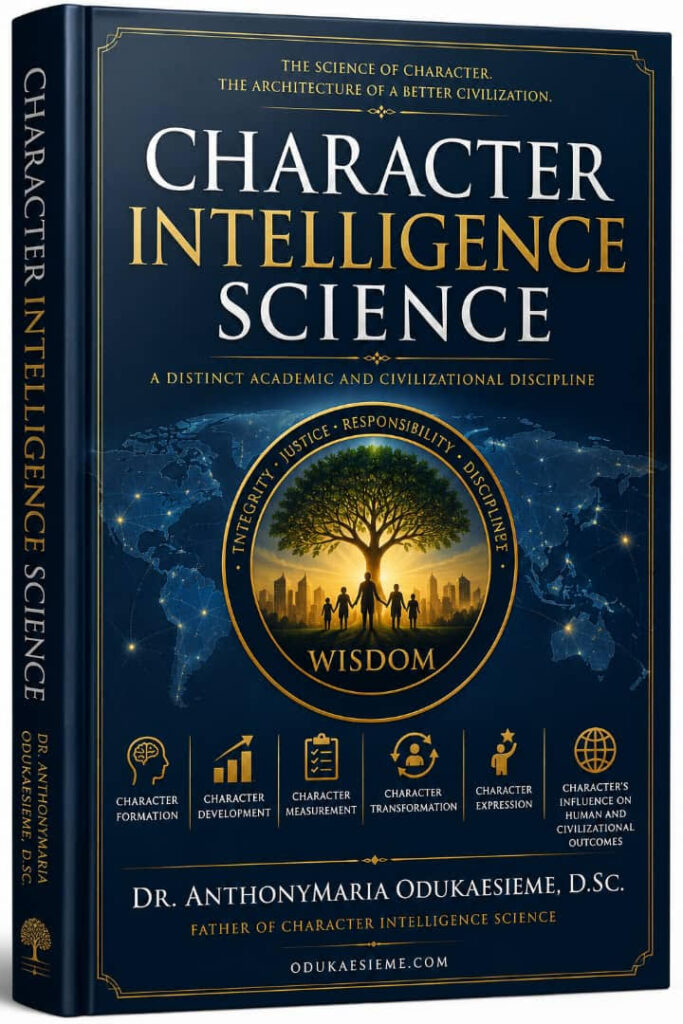
Beyond theoretical formulation, he has actively developed and advanced the discipline through scholarly writings, lectures, seminars, workshops, public advocacy, and media engagement. These sustained contributions have strengthened global awareness of character formation as a foundational pillar for ethical leadership, institutional integrity, sustainable entrepreneurship, workforce excellence, economic development, and societal transformation.
It is this rare combination of original authorship, conceptual innovation, theoretical system-building, disciplinary formation, multidisciplinary integration, and continuous intellectual advocacy that forms the basis upon which scholars recognize Dr. Anthonymaria Odukaesieme as the Father of Character Intelligence Science. His work has elevated character from a moral concept into a structured field of scientific study and practical application, offering a framework for understanding its central role in shaping human destiny, societal progress, economic development, entrepreneurship, employability, workforce excellence, and global human capital advancement. In character lies the intelligence that shapes destiny; in its cultivation lies the pathway to sustainable human and societal advancement. In Character, integrity becomes capacity; in capacity, prosperity is created; and in prosperity guided by wisdom, nations achieve sustainable greatness.
Odukaesieme — Father of Character Intelligence Science