

Wisdom reaches its practical expression through action. Knowledge may exist within the mind, understanding may illuminate meaning, discernment may distinguish what is appropriate, judgment may determine what ought to be done, and character may establish the strength to do it; but Wisdom becomes fully expressed when it enters reality through action.
Wisdom is therefore not merely something a person possesses. It is something a person practises.
A person may know the truth and fail to live by it. A person may understand justice and still act unjustly. A person may recognise what is right and yet choose what is convenient. Such a person may possess knowledge about Wisdom without fully expressing Wisdom.
Action reveals the practical reality of Wisdom.
The relationship may therefore be understood as a progression:
- Knowledge informs.
- Understanding illuminates.
- Discernment distinguishes.
- Judgment decides.
- Character prepares.
- Action expresses.
- Wisdom governs the whole.
Wisdom in action is the transformation of thought into responsible reality.
Every action is an expression of something within the person: a belief, value, intention, desire, judgment, habit, or character. For this reason, actions provide evidence of the principles by which a person actually lives.
Words may describe character, but actions demonstrate it.
Intentions may reveal aspiration, but actions reveal commitment.
Knowledge may reveal capacity, but action reveals application.
Wisdom therefore demands consistency between what is known, what is believed, what is chosen, and what is done.
This consistency is essential because human life is shaped by repeated actions. A single action may influence a moment, but repeated actions create habits. Habits shape character, character shapes conduct, conduct shapes relationships, and relationships contribute to the formation of society.
Thus, action is not isolated from civilization. Individual actions participate in the larger architecture of human existence.
Wise action therefore requires awareness of consequences.
Before acting, Wisdom asks:
What will this action produce?
Who may be affected?
What are the immediate consequences?
What are the long-term consequences?
Does this action preserve truth?
Does it uphold justice?
Does it demonstrate responsibility?
Does it contribute to harmony?
Does it respect the dignity of others?
Does it serve the wellbeing of the whole?
These questions transform action from impulse into deliberate responsibility.
Wisdom also recognises that inaction can itself be an action of consequence. Sometimes refusing to act when action is necessary may allow injustice, suffering, corruption, or destruction to continue.
Therefore, Wisdom does not teach passivity.
Wisdom teaches appropriate action.
There are moments when Wisdom requires patience, moments when it requires courage, moments when it requires silence, moments when it requires speech, and moments when it requires decisive intervention.
The wise person therefore does not act merely because action is possible. The wise person acts when action is appropriate and refrains when restraint is wiser.
This is the difference between activity and purposeful action.
Activity is movement.
Wise action is movement directed by understanding, judgment, character, and purpose.
The quality of action depends greatly upon intention. Two people may perform an outwardly similar act while being motivated by completely different purposes. Wisdom therefore considers not only what is done but why it is done and what consequences it is intended to produce.
Yet good intention alone is not sufficient.
An action may be well intended and still produce harm because of ignorance, poor judgment, or failure to understand consequences. Wisdom therefore unites intention with knowledge, understanding, discernment, and responsibility.
This is why Wisdom is practical intelligence guided by truth and character.
Wisdom in action is also the foundation of leadership. A leader is not measured merely by what the leader knows or promises, but by what the leader consistently does.
Institutions are likewise judged by their actions.
Governments are judged by their policies and conduct.
Professionals are judged by their practice.
Teachers are judged by what they impart and embody.
Parents are judged by what they teach and demonstrate.
Civilizations are ultimately judged by how their collective power is used.
Action therefore gives Wisdom social consequence.
When Wisdom guides action, knowledge becomes service, authority becomes responsibility, freedom becomes disciplined choice, and power becomes an instrument for constructive purpose.
When Wisdom is absent, the opposite may occur. Knowledge may become manipulation, authority may become domination, freedom may become irresponsibility, and power may become destructive.
The difference lies in the governing principle behind action.
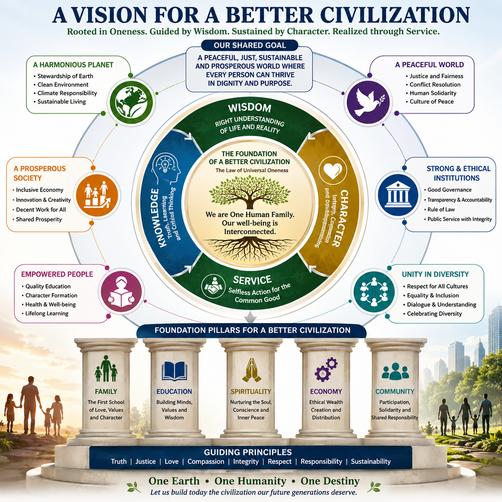
This is why character and action are inseparable. Character determines the quality of repeated action, while action reveals the quality of character.
A person who consistently acts with honesty strengthens honesty as a character trait.
A person who consistently acts with courage strengthens courage.
A person who consistently acts with compassion strengthens compassion.
A person who consistently acts with discipline strengthens discipline.
Thus, wise action is also an instrument of character formation.
Human beings become what they repeatedly practise.
Wisdom therefore calls for the conscious practice of good action until good action becomes natural, disciplined, and consistent.
At the highest level, Wisdom in action extends beyond individual wellbeing toward the wellbeing of the whole.
The wise person understands that human beings exist within networks of relationship. What one person does can affect others, and what societies collectively do can affect future generations and the natural order upon which life depends.
Therefore, wise action is action undertaken with awareness of interconnectedness.
This prepares the way for the next dimension of Wisdom: Truth.
For action to be truly wise, it must be grounded in what is true. Without truth, action may be energetic, intelligent, and purposeful, yet fundamentally misguided.
Wisdom therefore moves from knowledge to understanding, from understanding to discernment, from discernment to judgment, from judgment to character, and from character into action.
Action is where Wisdom becomes visible.
Wisdom is therefore not complete when it is merely understood.
It becomes complete when it is lived.
-Dr. Anthonymaria Odukaesieme, D.Sc.
Founder of Unisophy
Founder of Wisdomology
Founder of Character Intelligence Science