

Human civilization is one of the greatest expressions of human intelligence. Through knowledge, cooperation, organization, science, technology, institutions, culture, and accumulated experience, humanity has transformed its environment and created increasingly complex systems of collective life.
Yet civilization is not measured solely by what humanity can build.
It is measured by how wisely humanity uses what it has built.
The advancement of civilization therefore requires more than knowledge and technological progress. It requires Wisdom capable of directing intelligence, power, resources, institutions, and human relationships toward the preservation and advancement of life.
A civilization may become highly sophisticated in its technology while remaining morally immature.
It may possess enormous knowledge while lacking discernment.
It may accumulate wealth while permitting injustice.
It may develop powerful institutions while failing to develop responsible character.
It may achieve extraordinary scientific capability while lacking the Wisdom necessary to govern that capability.
This reveals a fundamental principle:
Civilizational progress without Wisdom can increase power without increasing goodness.
Wisdom therefore becomes a civilizational necessity.
The development of civilization begins with human beings learning to live together. Cooperation allows individuals to accomplish what no individual could accomplish alone. Families become communities. Communities develop institutions. Institutions develop systems of governance, education, commerce, law, science, and culture.
Through these structures, humanity creates civilization.
But every structure reflects the values and character of the people who create and govern it.
If individuals are guided by truth, responsibility, justice, compassion, discipline, and Wisdom, institutions are more likely to reflect those qualities.
If individuals and leaders are governed by greed, deception, corruption, domination, and irresponsibility, institutions may reproduce those same weaknesses.
Civilization is therefore partly a reflection of collective character.
This is why Wisdom and Character Intelligence Science have profound civilizational significance.
Character is not merely a private virtue.
Character affects families.
Families affect communities.
Communities affect institutions.
Institutions affect nations.
Nations affect civilization.
Thus, the formation of character is part of the formation of civilization.
Wisdom provides the intellectual and philosophical framework through which this formation can be directed.
A wise civilization values knowledge, but does not worship knowledge.
It values technology, but does not surrender judgment to technology.
It values economic development, but does not measure human worth solely by wealth.
It values freedom, but understands that freedom carries responsibility.
It values power, but recognises that power must be governed by justice.
It values diversity, but recognises Universal Oneness.
It values progress, but understands that progress must remain compatible with the sustainability of life.
This is the architecture of a wise civilization.
Education therefore becomes central.
The purpose of education cannot be limited to producing people who can perform technical tasks. Education must also develop understanding, discernment, judgment, character, responsibility, and the capacity to live meaningfully with others.
Knowledge creates capability.
Character gives capability direction.
Wisdom integrates both.
A civilization that educates the mind without forming character may produce highly capable individuals who use their capabilities irresponsibly.
A civilization that forms character without cultivating knowledge may produce good intentions without sufficient capacity.
Wisdom seeks their integration.
This is why the advancement of civilization requires an education of the whole person.
Human beings must learn not only how to think, but how to think wisely.
They must learn not only how to create, but what is worth creating.
They must learn not only how to acquire power, but how to govern power.
They must learn not only how to compete, but how to cooperate.
They must learn not only how to succeed individually, but how to contribute to the wellbeing of the whole.
Civilization also depends upon justice.
Where injustice becomes institutionalised, social harmony deteriorates. Where truth is suppressed, trust declines. Where corruption becomes normal, institutions lose legitimacy. Where human dignity is disregarded, conflict becomes more likely.
Wisdom therefore recognises justice as a condition of civilizational stability.
Justice must be accompanied by compassion and responsibility.
A wise civilization does not merely punish wrongdoing. It also seeks to understand its causes, prevent its recurrence, protect the vulnerable, and cultivate conditions in which people can develop their potential responsibly.
This is the relationship between justice and Wisdom.
Wisdom also transforms the meaning of leadership.
Leadership is not primarily the possession of authority.
Leadership is the responsibility to use authority for the good of those affected by it.
The wise leader understands that power is temporary, responsibility is continuous, and every decision carries consequences.
Such leadership is based upon service rather than domination.
This principle applies at every level of society.
Parents lead families.
Teachers lead learning.
Professionals lead through competence and example.
Community leaders lead institutions.
Political leaders govern public affairs.
Scientists and innovators influence the direction of knowledge and technology.
Every form of leadership therefore requires character and Wisdom.
The greater the influence, the greater the responsibility.
Civilization also requires harmony with the natural world.
Human beings depend upon the environment for food, water, energy, materials, and the conditions necessary for life. The destruction of these systems ultimately affects human wellbeing.
Wisdom therefore recognises that civilization cannot permanently prosper through the destruction of the foundations upon which life depends.
Progress must therefore be sustainable.
Humanity must learn to develop without destroying, consume without wasting, innovate without recklessness, and transform nature without forgetting its dependence upon nature.
This is another expression of Universal Oneness.
Human civilization exists within creation.
It is not separate from creation.
Therefore, the wellbeing of civilization depends upon responsible participation within the larger order of existence.
The future of humanity will consequently depend on the quality of Wisdom guiding civilization.
The central question is no longer simply:
“What can humanity achieve?”
It is also:
“What should humanity become?”
This is a deeper civilizational question.
Humanity possesses extraordinary capacity.
The challenge is to develop equal Wisdom to govern that capacity.
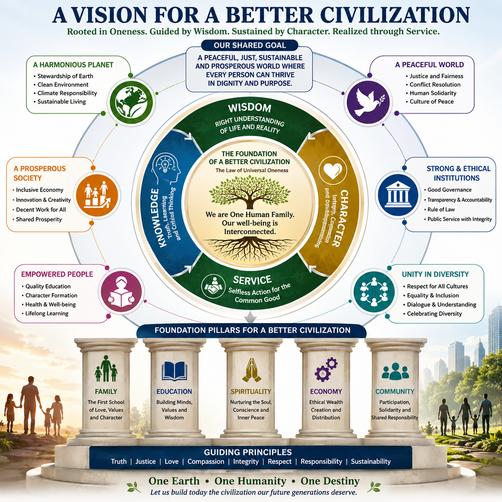
Wisdom must therefore become a foundation of civilization.
It must influence education, leadership, science, technology, law, economics, culture, environmental responsibility, and human relationships.
The wise civilization is not one that has eliminated every problem.
It is one that possesses the Wisdom to recognise problems truthfully, respond to them responsibly, learn from its mistakes, and continually improve.
Civilization becomes wise when it learns to transform knowledge into understanding, understanding into discernment, discernment into judgment, judgment into responsible action, and action into lasting institutions of justice, harmony, and service.
This is the movement from individual Wisdom to collective Wisdom.
And collective Wisdom is the foundation upon which a more harmonious human civilization can emerge.
-Dr. Anthonymaria Odukaesieme, D.Sc.
Founder of Unisophy
Founder of Wisdomology
Founder of Character Intelligence Science