

Wisdom represents the highest expression of intelligence because it is intelligence guided by understanding, discernment, truth, character, responsibility, and purpose.
Intelligence enables the human mind to perceive, learn, reason, analyse, remember, create, solve problems, and adapt. It gives humanity the capacity to understand possibilities and develop means for achieving desired outcomes.
But intelligence alone does not determine whether those outcomes are good, just, responsible, or beneficial.
Wisdom gives intelligence direction.
The difference is fundamental.
Intelligence asks:
“What can I know?”
“What can I understand?”
“What can I solve?”
“What can I create?”
Wisdom asks:
“What is true?”
“What is right?”
“What is necessary?”
“What is beneficial?”
“What should be done?”
“What are the consequences?”
“What serves the whole?”
Thus, Wisdom does not diminish intelligence. It completes it.
Intelligence without Wisdom may become cleverness without responsibility.
Knowledge without Wisdom may become information without direction.
Power without Wisdom may become capability without restraint.
Technology without Wisdom may become innovation without sufficient consideration of consequence.
Wisdom integrates intelligence with responsibility.
The highest intelligence is therefore not merely the ability to solve difficult problems. It is the ability to recognise which problems truly matter, understand their deeper causes, evaluate possible consequences, and choose responses that are truthful, responsible, and beneficial.
This is why Wisdom is higher than mere intellectual capacity.
A person may be exceptionally intelligent and still make destructive decisions. History demonstrates that human beings can use extraordinary intelligence to develop systems, technologies, and institutions that may be used for either constructive or destructive purposes.
The problem is not always a lack of intelligence.
Sometimes it is a lack of Wisdom.
Wisdom therefore becomes the governing intelligence of intelligence itself.
It asks intelligence to examine its own purpose.
It asks:
Why should this knowledge be acquired?
Why should this technology be developed?
Why should this power be exercised?
Who will benefit?
Who may be harmed?
What will be the long-term consequences?
How does this action affect the larger whole?
These questions elevate intelligence from capability to responsibility.
Wisdom also unites the different dimensions of intelligence.
Human beings possess many forms of intellectual capacity. Logical reasoning, linguistic ability, creativity, practical intelligence, social intelligence, emotional awareness, scientific reasoning, and technological competence all contribute to human capability.
Wisdom does not replace these capacities.
It coordinates them.
It brings them into a larger framework of truth, character, discernment, judgment, and purpose.
Wisdom is therefore integrative intelligence.
It is the capacity to see relationships between things that may otherwise appear separate.
It recognises that a scientific discovery may have ethical consequences.
It recognises that an economic decision may have social consequences.
It recognises that a technological development may have psychological consequences.
It recognises that a political decision may have generational consequences.
It recognises that an individual action may affect the larger community.
This capacity to perceive consequences across relationships is one of the highest expressions of intelligence.
Wisdom also requires humility.
The more intelligence understands, the more it recognises the limits of what is known.
A wise person does not confuse knowledge with omniscience.
Wisdom allows the mind to say:
“I know.”
“I do not know.”
“I may be wrong.”
“I need to learn more.”
“I need to reconsider.”
This intellectual humility protects intelligence from becoming arrogance.
Wisdom also requires courage.
Knowing what is right is not always sufficient. There are circumstances in which the wise decision may be difficult, unpopular, costly, or personally inconvenient.
Wisdom therefore requires the character to act according to truth even when doing so demands sacrifice.
This is why the highest expression of intelligence cannot be separated from character.
Intelligence determines capability.
Character determines integrity.
Wisdom integrates both.
A person with great intelligence but weak character may become dangerous.
A person with good character but insufficient knowledge may have good intentions but limited effectiveness.
Wisdom seeks the development of both.
The ideal human being is therefore not simply intelligent.
The ideal human being is intelligently wise.
Such a person seeks knowledge continuously, understands deeply, distinguishes carefully, judges responsibly, acts courageously, and remains accountable for consequences.
Wisdom also transforms the meaning of success.
Intelligence may measure success through achievement, innovation, wealth, influence, or problem-solving.
Wisdom asks whether those achievements contribute to meaningful human flourishing.
A person may gain wealth and lose integrity.
A society may gain technological power and lose social harmony.
A civilization may increase production while destroying the environment that sustains it.
Wisdom therefore asks humanity to evaluate progress according to a broader standard.
The highest progress is not merely increased capacity.
It is increased capacity governed by increased Wisdom.
This principle becomes particularly important in the development of artificial intelligence.
As machines become increasingly capable of processing information, recognising patterns, generating content, solving problems, and assisting human decision-making, the question of intelligence becomes increasingly complex.
Artificial intelligence may become highly capable without possessing human moral responsibility.
Therefore, the development and use of advanced intelligence require human Wisdom.
Humanity must ensure that intelligence—whether biological, technological, or artificial—is directed toward responsible purposes.
This is where Character Intelligence Science becomes particularly significant.
If intelligence represents capability, character provides the principles through which capability should be directed.
Wisdom brings intelligence and character into purposeful relationship.
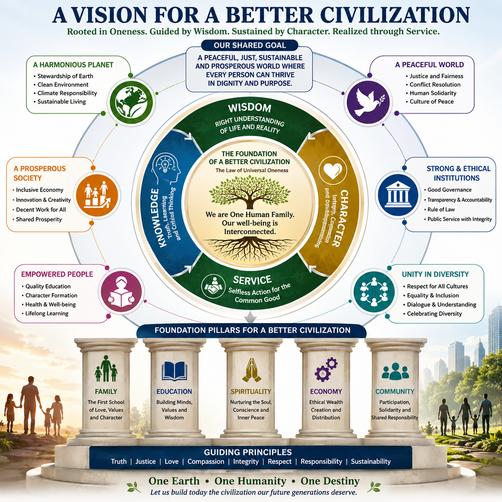
Thus:
Intelligence provides capability.
Knowledge provides content.
Character provides integrity.
Discernment provides distinction.
Judgment provides direction.
Wisdom provides integration.
Action provides expression.
This represents a higher architecture of intelligence.
Wisdom therefore does not stand outside intelligence as something unrelated to it. It is the mature integration of intelligence with truth, understanding, discernment, judgment, character, responsibility, and purpose.
The highest expression of intelligence is consequently not the ability to know everything.
It is the ability to know what matters, understand what it means, discern what is right, judge what should be done, and act responsibly.
Wisdom is intelligence that has learned to govern itself.
It is intelligence illuminated by truth.
It is intelligence disciplined by character.
It is intelligence guided by responsibility.
It is intelligence directed toward harmony.
It is intelligence conscious of Universal Oneness.
And it is intelligence capable of serving the whole.
Therefore, Wisdom is the highest expression of intelligence because it transforms intelligence from mere capability into conscious, responsible, and purposeful participation in the order of existence.
-Dr. Anthonymaria Odukaesieme, D.Sc.
Founder of Unisophy
Founder of Wisdomology
Founder of Character Intelligence Science