

The totality of creation represents the whole of existence in its visible and invisible dimensions, its diversity and unity, its relationships and processes, its order and continuity. To contemplate creation as a totality is to move beyond the understanding of isolated parts and toward an integrated perception of existence.
Wisdom enables this movement.
Human knowledge often develops through specialisation. We study particular subjects, systems, organisms, forces, structures, and processes. This specialisation is necessary because reality is vast and complex. Yet the deeper purpose of knowledge is not merely to divide reality into increasingly smaller areas of study. It is also to understand how those parts relate to one another.
Wisdom seeks the whole.
It asks not only:
“What is this?”
but also:
“How does this relate to everything else?”
This is the movement from fragmentation toward integration.
Every part of creation exists within relationships. The individual exists within family. Family exists within community. Community exists within society. Society exists within humanity. Humanity exists within the natural world. The natural world exists within the larger reality of creation.
Each level is distinct, yet each is related.
Wisdom therefore recognises that the part cannot always be fully understood without reference to the whole.
The human being, for example, cannot be understood merely as a physical organism. Human existence includes biological, intellectual, emotional, moral, social, cultural, and spiritual dimensions. These dimensions interact continuously.
Likewise, civilization cannot be understood merely through economics or technology. Civilization also involves education, character, justice, culture, leadership, relationships, values, environment, and the collective direction of human intelligence.
Wisdom therefore seeks integration.
The totality of creation also reveals the importance of order.
Existence is not simply an accumulation of unrelated events. Patterns, relationships, processes, structures, and principles can be observed throughout reality. Human intelligence has the capacity to investigate these patterns and formulate knowledge about them.
Wisdom goes further by seeking to understand what these relationships reveal about the nature of existence and humanity’s place within it.
The recognition of totality therefore deepens humility.
Human beings possess remarkable intelligence, but the totality of creation exceeds the comprehension of any individual.
No single person possesses all knowledge.
No single discipline explains everything.
No single institution contains all truth.
No single culture possesses the entire wisdom of humanity.
Wisdom therefore encourages openness to learning.
It encourages cooperation among disciplines.
It encourages dialogue among people.
It encourages the integration of knowledge.
It encourages humility before the complexity of existence.
This is one reason Wisdomology is conceived as a science of Wisdom rather than merely another isolated field of knowledge.
Wisdomology seeks relationships among knowledge, understanding, discernment, judgment, character, truth, action, Universal Oneness, and the larger order of creation.
The totality of creation also provides the context for Universal Oneness.
Oneness does not erase diversity. Rather, it reveals that diversity exists within relationship.
The stars are not the same as planets.
Plants are not the same as animals.
Animals are not the same as human beings.
Human beings are not the same as societies.
Societies are not the same as civilizations.
Yet all participate within the greater reality of existence.
Wisdom therefore recognises unity without denying distinction.
This principle has profound implications for human civilization.
When humanity sees itself as isolated from the rest of creation, exploitation can become easier to justify. When humanity recognises itself as part of the whole, responsibility becomes unavoidable.
The environment is not merely a resource.
It is part of the conditions sustaining life.
Other human beings are not merely competitors.
They are participants in the same human reality.
Future generations are not merely abstract possibilities.
They are beneficiaries or victims of decisions made today.
Wisdom therefore expands responsibility across time and relationship.
The totality of creation also places human power within perspective.
Human beings can alter landscapes, develop technologies, manipulate biological processes, travel beyond the atmosphere, communicate across continents, and increasingly influence complex systems.
Yet the ability to influence does not make humanity the source of the order it discovers.
Wisdom therefore calls for humility in the exercise of power.
The wise person seeks cooperation with reality rather than permanent conflict with reality.
This principle does not mean that humanity must passively accept every condition of existence. Human beings have a legitimate capacity to improve their circumstances, heal disease, reduce suffering, develop knowledge, and create better institutions.
Wisdom asks that such transformation be undertaken with understanding of consequences and respect for the larger whole.
Thus, Wisdom does not oppose progress.
Wisdom governs progress.
It asks whether progress is genuinely beneficial, whether its costs are acceptable, whether its benefits are responsibly distributed, and whether it preserves the conditions necessary for future flourishing.
The totality of creation therefore becomes both the context and the horizon of Wisdom.
The individual is a part.
Humanity is a part.
Nature is a part.
Civilization is a part.
The universe is a part of the reality we seek to understand.
And Wisdom seeks to perceive the relationships through which these dimensions participate within the whole.
At the deepest level, Wisdom reveals that understanding cannot remain permanently fragmented.
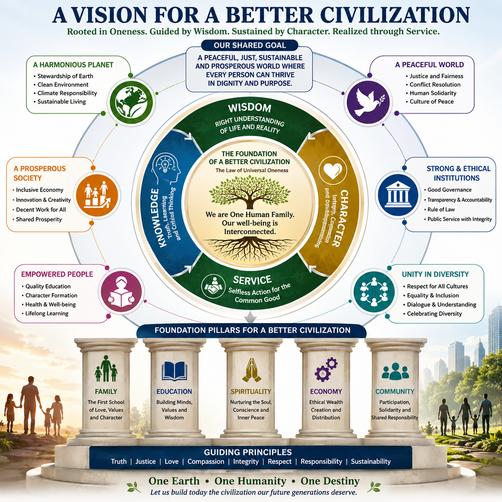
Knowledge must become integrated.
Intelligence must become responsible.
Character must become purposeful.
Action must become harmonious.
Civilization must become conscious of its place within creation.
Humanity must therefore move from the question of how to control existence toward the deeper question of how to participate wisely within it.
This is the maturity of Wisdom.
Wisdom recognises the part.
Wisdom understands the relationship.
Wisdom perceives the whole.
Wisdom respects the order.
Wisdom acts for harmony.
Wisdom therefore becomes a bridge between human consciousness and the totality of creation.
It enables the human mind to move from isolated perception to integrated understanding, from fragmented knowledge to coherent Wisdom, and from individual existence toward conscious participation in Universal Oneness.
The totality of creation is therefore not merely the subject of Wisdom.
It is the larger reality within which Wisdom itself is expressed.
And when Wisdom perceives the totality of creation, the deepest question is no longer simply what exists, but how all that exists belongs within an intelligible, interconnected, and ordered whole.
This prepares the way for the final chapter:
Conclusion: Wisdom As The Root Of Understanding.
-Dr. Anthonymaria Odukaesieme, D.Sc.
Founder of Unisophy
Founder of Wisdomology
Founder of Character Intelligence Science