

Odukaesieme’s definition of Wisdom establishes a distinctive philosophical position in the history of thought. By defining Wisdom as the Oneness, Wholeness, Interconnectedness, and Interdependence of All Realities, he presents a comprehensive framework for understanding existence, knowledge, intelligence, Truth, and the Universal Order. His conception extends beyond the conventional understanding of Wisdom as human judgment or practical knowledge, embracing the relationships, inherent intelligence, and unifying order of all realities.
Within Odukaesieme’s philosophical framework, Universal Intelligence is understood through the coherence, order, interconnectedness, and interdependence of all realities, investigated through scientific inquiry and contemplated through philosophy.
Through this framework, Odukaesieme positions Wisdom as the unifying foundation of knowledge, the integrating principle of existence, and a guide to human understanding and conduct in alignment with Truth and Universal Order. The originality and significance of his contribution therefore lie in the scope, structure, and implications of his definition, which merit rigorous scholarly examination and comparison with earlier philosophical traditions.
Odukaesieme’s Distinctive Contribution To The Philosophy And Scientific Study Of WISDOM
Odukaesieme redefined Wisdom beyond the traditional conceptions of ancient philosophers and established a structured philosophical and scientific framework for its systematic study. By defining Wisdom through the Oneness, Wholeness, Interconnectedness, and Interdependence of All Realities, he presented a comprehensive approach to understanding Wisdom as the unifying principle of existence, the integration of knowledge, and the alignment of intelligence with the Universal Order. His framework seeks to bridge philosophy and science by connecting the study of reality with the inherent intelligence of its constituent elements, the relationships among them, and the laws and principles governing their existence. Through this contribution, Odukaesieme advances Wisdom from a predominantly philosophical concept towards a structured field of inquiry with implications for scientific understanding, human intelligence, ethical character, and the practical application of knowledge in accordance with Truth and Universal Order.
Odukaesieme’s Distinctive Contribution To The Founding Of Unisophy, Wisdomology, And Character Intelligence Science As Academic Disciplines
Dr. Anthonymaria Odukaesieme, D.Sc., presents a distinctive intellectual contribution through the development of Unisophy, Wisdomology, and Character Intelligence Science as structured fields of knowledge. His work seeks to establish systematic philosophical and scientific frameworks for understanding Universal Oneness, the nature of Wisdom, the intelligence inherent in reality, and the role of ethical character in human development and civilization.
Unisophy, conceived as the Philosophy of Universal Oneness, provides a philosophical framework for examining the Oneness, Wholeness, Interconnectedness, and Interdependence of all realities and their relationship with Universal Order. Wisdomology, conceived as the Science of Wisdom, seeks to establish a systematic approach to studying Wisdom as the unifying principle of knowledge, intelligence, truth, and the proper ordering of reality. Character Intelligence Science (CIS), conceived as the Science of Ethical Intelligence and Human Excellence, focuses on the relationship between intelligence, ethical character, human conduct, and the development of individuals and societies.
The distinctive feature of Odukaesieme’s contribution lies in his effort to develop these three complementary disciplines within an integrated intellectual framework. Unisophy addresses the philosophical foundation of Universal Oneness; Wisdomology investigates Wisdom as a unifying principle of knowledge and understanding; and Character Intelligence Science examines the practical expression of intelligence through ethical character and responsible human conduct. Together, they seek to connect philosophical inquiry, scientific investigation, knowledge integration, and character development.
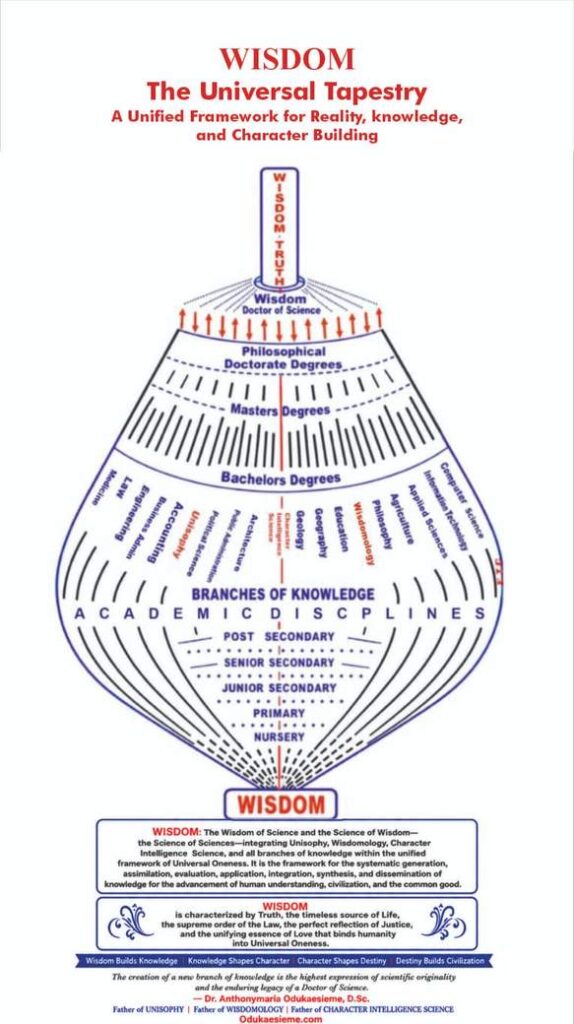
Odukaesieme’s foundational work, WISDOM: A Discovery in a Nation with a Broken Heart, first published in 2000, is identified by him as the intellectual origin of this broader framework. His subsequent writings develop the concepts and relationships underpinning these disciplines, with the aim of advancing a unified understanding of reality, knowledge, intelligence, Truth, and the Universal Order.
The academic significance of this contribution rests on the systematic definition of each discipline, the articulation of its central concepts and principles, the establishment of clear boundaries and methods of inquiry, and the development of teachable and critically examinable bodies of knowledge. Their recognition as established academic disciplines would depend on the extent to which their concepts, methods, originality, evidence, and contributions withstand scholarly examination and gain acceptance within relevant academic communities.
Through this intellectual undertaking, Odukaesieme seeks to establish a unified framework in which the understanding of reality informs the pursuit of Wisdom, and the pursuit of Wisdom finds practical expression in ethical intelligence, character excellence, and the advancement of human civilization.