

Introduction
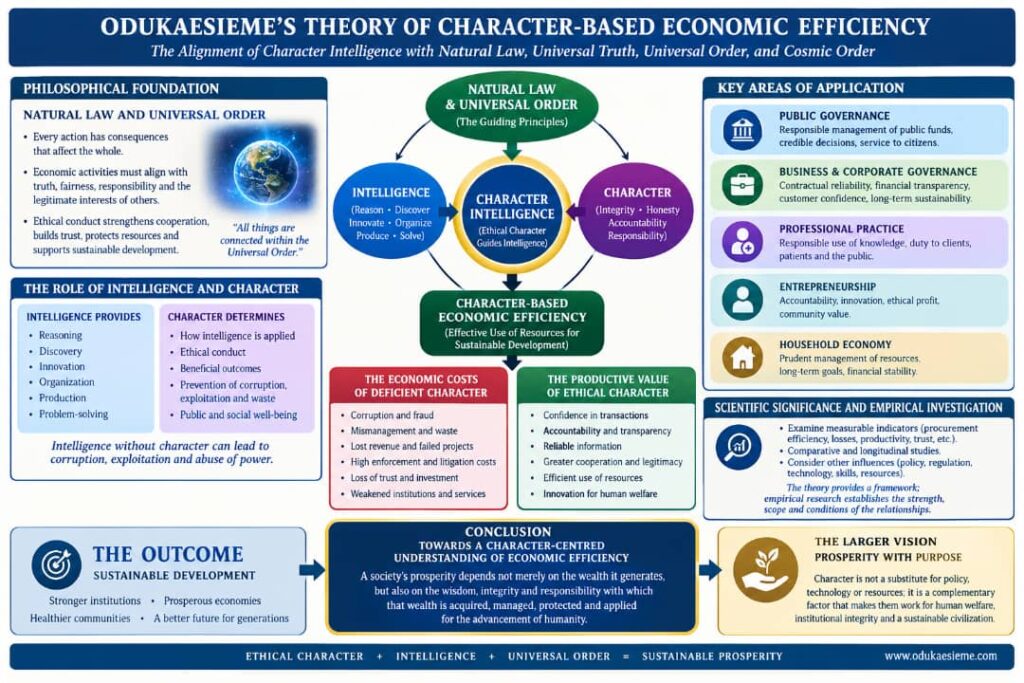
Odukaesieme’s Theory of Character-Based Economic Efficiency is an intellectual proposition developed within his Character Intelligence Science framework. It examines the relationship between ethical character, the application of human intelligence, institutional performance, economic efficiency, and sustainable development. The theory advances the position that the economic performance of individuals, institutions, and nations cannot be adequately understood through financial resources, technological advancement, labour productivity, and managerial competence alone. The character of the people who make decisions, manage resources, exercise authority, and determine the direction of development is also an important consideration.
At its foundation, the theory recognizes that intelligence provides human beings with the capacity to reason, discover, innovate, organize, produce, and solve problems. However, intelligence does not automatically guarantee ethical conduct or beneficial outcomes. When intelligence operates without integrity, accountability, honesty, and responsibility, it can be directed towards corruption, exploitation, manipulation, waste, and the abuse of institutional authority. Character Intelligence, therefore, emphasizes the importance of ethical character in determining how intelligence is applied and whether its outcomes contribute to individual well-being and collective progress.
Philosophical Foundation: Natural Law And Universal Order
Odukaesieme situates the philosophical foundation of the theory within Natural Law and Universal Truth, which govern the Universe and the Cosmos in the Order of Creation. From this perspective, human conduct is not isolated from the wider order of existence. Every action, wherever it occurs within Creation, produces consequences that affect the whole, positively or negatively, depending on its alignment with Universal Truth and Natural Law.
Applied to economic life, this proposition suggests that the acquisition, management, distribution, and utilization of resources should be examined not only in terms of immediate financial returns but also in relation to the principles governing responsible conduct and the consequences of human decisions. Economic activities that disregard truth, fairness, responsibility, and the legitimate interests of others can generate consequences extending beyond the individuals directly involved. Such consequences can weaken institutions, undermine public confidence, increase social costs, and obstruct sustainable development.
Conversely, conduct grounded in integrity, accountability, fairness, and responsibility can strengthen cooperation, improve institutional credibility, protect resources, and create conditions that support productive economic relationships. The theory consequently places ethical character within a broader philosophical framework in which the quality of human decisions is connected to their consequences for society and the wider order of existence.
Character As A Determinant Of Economic Efficiency

The central argument of Odukaesieme’s theory is that character influences how effectively available resources are converted into meaningful economic and social outcomes. Two institutions may possess comparable financial resources, technological capabilities, human capital, and operational structures yet achieve substantially different results because of differences in leadership character, organizational culture, accountability, and the responsible exercise of authority.
Where corruption, dishonesty, negligence, and irresponsibility prevail, resources intended for productive purposes can be diverted, mismanaged, or wasted. Public contracts may become more expensive, projects may be abandoned or poorly executed, institutional decisions may serve private interests, and opportunities for economic advancement may be lost. These failures impose costs that extend beyond immediate financial losses. They can weaken public confidence, discourage legitimate investment, reduce the quality of essential services, and undermine the capacity of institutions to fulfil their responsibilities.
In contrast, where integrity, diligence, honesty, accountability, and responsible leadership are established as practical standards of conduct, institutions are better positioned to protect resources, enforce legitimate procedures, reduce avoidable losses, and pursue their objectives effectively. Ethical character does not eliminate every economic difficulty, nor does it guarantee success in every undertaking. Nevertheless, it can contribute to the conditions under which resources are managed more responsibly and productive activities are sustained.
The theory therefore proposes that economic efficiency should be examined not only through the quantity of resources available or the volume of output generated, but also through the character-related factors that influence the use of those resources and the quality, reliability, and social value of the resulting outcomes.
The Economic Costs Of Deficient Character
A major implication of the theory is that unethical conduct can create substantial economic burdens for individuals, organizations, and nations. Corruption, fraud, dishonesty, and the abuse of entrusted responsibility frequently require additional expenditure on investigation, enforcement, litigation, supervision, and corrective measures. They can also result in lost revenue, deteriorating infrastructure, inefficient public services, failed projects, and the misallocation of scarce resources.
Beyond these direct costs, deficient character can produce indirect and long-term economic consequences. When people lose confidence in public institutions, businesses, professional bodies, or political leadership, cooperation becomes more difficult. Trust may decline, transactions may become more costly, and individuals or organizations may devote greater resources to protecting themselves against misconduct rather than creating value. Persistent institutional dishonesty can also discourage investment and weaken the collective commitment required for national development.
From the perspective of Character Intelligence Science, these outcomes demonstrate why ethical conduct should not be treated merely as a private moral preference or an abstract philosophical ideal. It is also relevant to the practical functioning of economic and social systems. The character of decision-makers can influence whether resources are preserved or squandered, whether opportunities are distributed responsibly or abused, and whether institutions fulfil their intended purposes or become instruments of private advantage.
The Productive Value Of Ethical Character
Odukaesieme’s theory also draws attention to the potential economic benefits of ethical character. Integrity promotes confidence in agreements and transactions. Accountability encourages responsible stewardship of resources. Honesty supports the reliability of information on which economic decisions depend. Diligence improves the likelihood that responsibilities will be fulfilled, while fairness can strengthen cooperation and institutional legitimacy.
When these qualities are consistently practised, they can help create environments in which individuals work more confidently, institutions operate more credibly, and public resources are more likely to serve their intended purposes. Resources that would otherwise be lost through fraud, corruption, negligence, or repeated corrective interventions can instead be directed towards healthcare, education, scientific research, infrastructure, environmental protection, technological innovation, and other productive activities.
Ethical character also matters in the application of scientific and technological intelligence. Innovation can expand productive capacity, but its developmental value depends partly on the purposes for which it is used, the interests it serves, and the consequences it produces. Intelligence guided by responsible character is better positioned to reconcile the pursuit of economic gain with human welfare, institutional responsibility, and the long-term interests of society.
Accordingly, the theory presents character not as a substitute for technical competence, sound economic policy, effective institutions, or technological progress, but as a complementary factor that can influence how successfully these capabilities are applied.
Character Intelligence And The Governance Of Resources
The relevance of the theory extends to public administration, corporate governance, entrepreneurship, professional practice, and household economic management. In each of these settings, decisions about money, labour, time, materials, information, and opportunities are influenced by the character of those who exercise responsibility.
In public governance, character influences the responsible management of public funds, the credibility of official decisions, and the relationship between leadership and citizens. In business, it affects contractual reliability, financial transparency, employee relations, customer confidence, and the long-term sustainability of commercial activities. In professional practice, it informs the responsible use of specialized knowledge and the fulfilment of duties to clients, patients, institutions, and the public. At the individual level, honesty, discipline, diligence, and prudent judgment can influence the management of personal resources and the achievement of long-term objectives.
These applications suggest that character-based economic efficiency is relevant across multiple levels of human organization. The theory encourages the examination of economic performance alongside the ethical standards, decision-making practices, and institutional cultures that shape it.
Scientific Significance And Empirical Investigation
Although the theory is grounded in a philosophical understanding of character, Natural Law, and Universal Order, its economic implications can be investigated through empirical research. Such research could examine the relationships between measurable indicators of ethical conduct and outcomes such as procurement efficiency, financial losses, project completion, institutional trust, productivity, compliance costs, and the quality of public services.
Comparative studies of institutions with different accountability systems and organizational cultures could help determine the extent to which character-related factors contribute to differences in performance. Longitudinal research could further examine whether improvements in transparency, ethical leadership, and responsible resource management are associated with measurable gains in efficiency over time.
A rigorous investigation would also need to account for other important influences, including institutional design, economic conditions, regulatory enforcement, technological capacity, workforce skills, and the availability of resources. These factors interact with human conduct and must be considered before attributing particular economic outcomes to character alone.
The distinction between philosophical proposition and empirical demonstration is essential. The theory offers an integrated framework for examining the possible economic significance of ethical character; systematic investigation is necessary to establish the strength, scope, and conditions of the relationships it proposes.
Conclusion: Towards A Character-Centred Understanding Of Economic Efficiency
Odukaesieme’s Theory of Character-Based Economic Efficiency advances the proposition that the quality of human character deserves serious consideration in explanations of economic performance, institutional integrity, and sustainable development. It draws attention to a dimension of economic life that cannot be fully captured by financial indicators, technological capacity, or material resources alone: the ethical quality of the decisions through which these resources are acquired, managed, protected, and applied.
Within the broader framework of Character Intelligence Science, the theory emphasizes that intelligence achieves greater social and developmental value when guided by truth, integrity, accountability, and responsibility. It further proposes that the consequences of human conduct extend beyond individual intentions, influencing institutions, communities, economic systems, and the conditions under which future generations will live and work.
The theory does not suggest that character alone determines prosperity. Rather, it identifies ethical character as an important factor that interacts with sound policies, competent institutions, scientific knowledge, technological progress, and effective resource management. Its central contribution is to encourage a more integrated examination of economic efficiency—one that considers not only what societies produce and how much they accumulate, but also the character with which their economic activities are conducted.
Ultimately, the theory presents responsible character as a significant consideration in the pursuit of economic efficiency and sustainable civilization. A society’s prosperity depends not merely on the wealth it generates, but also on the wisdom, integrity, and responsibility with which that wealth is acquired, managed, protected, and applied for the advancement of humanity.