

By Odukaesieme
-
Odukaesieme And The Universal Quest For WISDOM
The intellectual significance of Odukaesieme lies in his sustained pursuit of Wisdom as a fundamental principle for understanding knowledge, human existence, ethical conduct, and civilisation. Through Wisdomology, his proposed Science of Wisdom, he seeks to examine Wisdom not merely as a personal virtue, but as an integrating principle through which knowledge may be understood, evaluated, and responsibly applied.
His central proposition is that intelligence without Wisdom, knowledge without Truth, and power without ethical Character may advance human capability without necessarily advancing human welfare. This raises a fundamental question for humanity: Is the true measure of intellectual progress simply what we know and can accomplish, or how responsibly we use our knowledge and abilities?
Odukaesieme’s intellectual project seeks to address this question by bringing Wisdom, Truth, Character, Natural Law, Universal Order, and Universal Oneness into a connected framework for examining human development and civilisation.
-
From Socrates, Plato, And Aristotle To Odukaesieme: The Continuity Of Intellectual Inquiry
The history of human knowledge is an intergenerational enterprise. No serious intellectual undertaking begins entirely from nothing; each generation inherits ideas, methods, discoveries, and unresolved questions from those who came before it.
Socrates advanced the disciplined examination of assumptions and the pursuit of virtue. Plato investigated knowledge, reality, justice, and the Good. Aristotle made enduring contributions to logic, systematic inquiry, ethics, and practical wisdom. Their works continue to provide important foundations for philosophical investigation.
Odukaesieme’s intellectual project engages related questions through its emphasis on Wisdom, Truth, intelligence, Character, and Universal Order. However, intellectual affinity does not establish identity, nor does comparison alone demonstrate originality. His proposed frameworks must be evaluated according to their definitions, arguments, methods, and contributions to existing knowledge.
The enduring lesson is that intellectual progress requires both respect for inherited knowledge and the courage to investigate questions that remain unresolved. We honour the intellectual achievements of the past not by remaining permanently within their conclusions, but by understanding them deeply enough to continue the search for knowledge.
-
WISDOMOLOGY: The Proposed Science Of Wisdom
Wisdomology is Odukaesieme’s proposed framework for the systematic study of Wisdom. Its central concern is the relationship between knowledge, sound judgment, ethical responsibility, and the appropriate application of human understanding.
While individual disciplines investigate particular aspects of reality, Wisdomology seeks to examine how knowledge from different fields may be integrated and applied in ways that respect Truth, responsibility, and the common good.
Its intellectual significance lies in the question it raises: Can Wisdom be investigated systematically as an integrating dimension of human knowledge, decision-making, and conduct?
For Wisdomology to establish its distinct contribution, it must clearly define its subject matter, explain how it differs from established studies of wisdom, ethics, cognition, and practical reasoning, and demonstrate the value of its methods and conclusions. Its development therefore calls for conceptual precision, critical examination, engagement with existing scholarship, and demonstrable intellectual or practical benefits.
The ambition is to move beyond the accumulation of knowledge towards a deeper understanding of how knowledge should be interpreted and responsibly applied.
-
UNISOPHY: The Philosophy Of Universal Oneness
Unisophy, presented by Odukaesieme as the Philosophy of Universal Oneness, examines the idea that existence, humanity, nature, and knowledge may be understood through their relationships within a wider order.
This perspective invites reflection on human interdependence, environmental responsibility, social relationships, and the consequences of treating interconnected realities as though they existed in isolation.
Within this framework, Love may be understood as an expression of Oneness, while Truth provides an essential foundation for responsible relationships. Universal Oneness, however, must not be confused with the elimination of differences. A coherent philosophy of interconnectedness must account for diversity, disagreement, individual responsibility, and the complexity of existence.
Unisophy’s potential contribution lies in its attempt to develop a connected philosophical account of existence and responsibility. Its scholarly strength will depend on the clarity of its concepts, the coherence of its arguments, and its ability to engage critically with other philosophical traditions, including African philosophies.
Its ultimate relevance rests on whether its principles can deepen understanding and encourage more responsible relationships among human beings and between humanity and the natural world.
-
CHARACTER INTELLIGENCE SCIENCE: The Ethical Dimension Of Human Excellence
Character Intelligence Science (CIS), as proposed by Odukaesieme, addresses a fundamental problem in human development: intelligence does not automatically guarantee ethical conduct.
A person may possess extensive knowledge, exceptional reasoning ability, or advanced technical skills while lacking honesty, humility, responsibility, or sound judgment. The possession of intelligence, therefore, should not be confused with the wisdom to use it well.
CIS seeks to investigate the relationship between intelligence, ethical Character, and human excellence. Its implications extend to education, leadership, governance, professional practice, and technological development.
Its emphasis on Humility, Honesty, and Hard Work offers a practical foundation for character building. Humility encourages openness to learning; Honesty strengthens trust and accountability; and Hard Work supports disciplined effort and productive achievement.
For CIS to develop as a rigorous field of inquiry, its principal concepts and claims require precise definitions, appropriate research methods, and evidence of meaningful outcomes.
Its central proposition remains important: genuine human excellence should be assessed not only by intellectual ability or material achievement, but also by the Character through which intelligence is expressed.
-
WISDOM, Artificial Intelligence, And The Future Of Civilisation
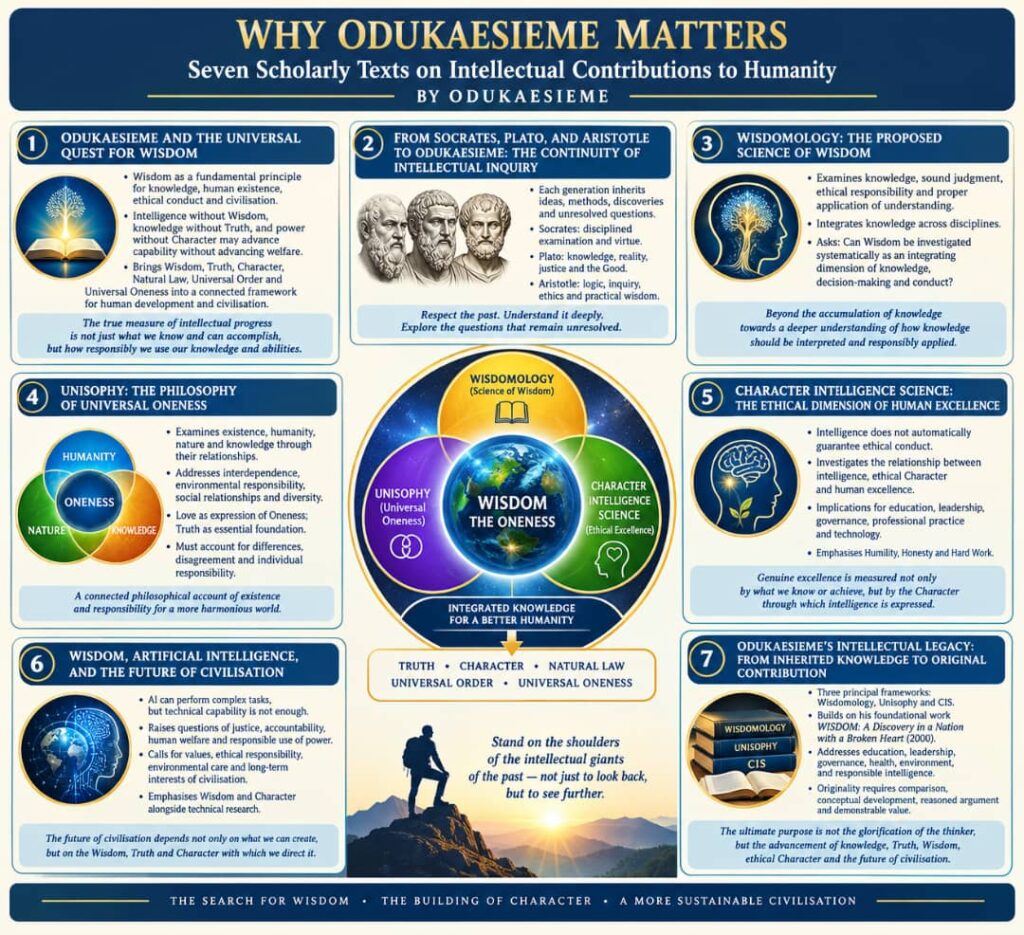
The advancement of artificial intelligence raises fundamental questions about the relationship between intelligence, Wisdom, Truth, and ethical responsibility.
Artificial intelligence can perform increasingly sophisticated computational tasks, but technical capability alone does not resolve questions of justice, accountability, human welfare, or the responsible use of power.
Odukaesieme’s intellectual framework invites humanity to examine whether intelligence, whether human or artificial, can be considered sufficient when detached from the principles governing its application.
From this perspective, technological progress must be accompanied by serious consideration of human values, ethical responsibility, environmental consequences, and the long-term interests of civilisation.
This approach does not replace technical research into artificial intelligence or established work on AI safety and ethics. Rather, it seeks to emphasise Wisdom and Character as important dimensions of the wider debate about increasingly powerful intelligent systems.
The central challenge is not merely to develop more capable intelligence, but to ensure that intelligence serves legitimate human purposes responsibly.
The future of civilisation will depend not only on what humanity can create, but also on the Wisdom, Truth, and Character with which it directs its creations.
-
Odukaesieme’s Intellectual Legacy: From Inherited Knowledge To Original Contribution
Odukaesieme’s intellectual undertaking brings together three principal frameworks: Wisdomology, the proposed Science of Wisdom; Unisophy, the Philosophy of Universal Oneness; and Character Intelligence Science, the proposed study of the relationship between ethical Character and intelligence.
Together, these frameworks seek to connect questions about knowledge and judgment with questions about existence, human relationships, ethical conduct, and civilisation.
His foundational work, WISDOM: A Discovery in a Nation with a Broken Heart, first published in 2000, forms an important part of the history of this intellectual undertaking. His broader ambition is to investigate how Wisdom and ethical responsibility may contribute to education, leadership, governance, human health, environmental protection, and the responsible development of intelligence.
The enduring metaphor of standing on the shoulders of intellectual giants expresses the intergenerational nature of knowledge. Later thinkers inherit the achievements of their predecessors, examine their limitations, and seek answers to questions that remain unresolved. The expression is famously recorded in Isaac Newton’s 1676 correspondence with Robert Hooke.
For Odukaesieme’s intellectual legacy to make a lasting contribution, its originality must be established through careful comparison with existing scholarship, clear conceptual development, reasoned argument, and demonstrable value. Intellectual significance cannot be secured by titles or declarations alone; it emerges from the quality and usefulness of the ideas themselves.
Odukaesieme’s work therefore belongs within the continuing human search for a more integrated understanding of Wisdom, Truth, Character, Natural Law, Universal Order, and Universal Oneness.
The ultimate purpose of intellectual advancement is not the glorification of the thinker. It is the advancement of knowledge, the pursuit of Truth, the cultivation of Wisdom, the development of ethical Character, and the responsible contribution of human understanding to the future of civilisation.
The aspiration is to stand on the shoulders of the intellectual giants who preceded us—not merely to look back at what they achieved, but to seek a clearer view of the questions that remain before humanity.