

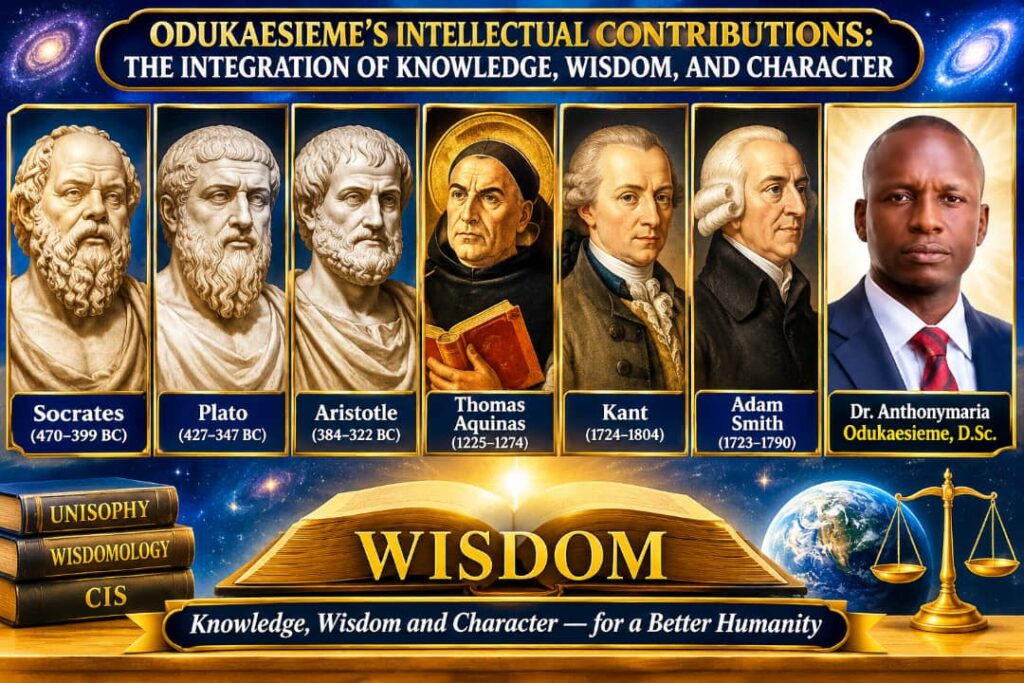
The question of what constitutes Wisdom has occupied humanity throughout intellectual, philosophical, religious, and scientific history. From the ancient Greek philosophers to contemporary scholarship, thinkers have examined Wisdom in relation to knowledge, truth, virtue, reason, human conduct, and the understanding of reality. Socrates emphasised intellectual humility and the critical examination of claims to knowledge; Plato explored the relationship between Wisdom, truth, reason, and the proper ordering of human life; while Aristotle distinguished theoretical Wisdom from practical Wisdom and examined their relationship with knowledge, virtue, judgment, and human flourishing. These contributions established important foundations for the philosophical study of Wisdom. Nevertheless, the historical development of the concept has not produced a single universally accepted definition that encompasses every dimension of Wisdom and its relationship to reality as a whole.
Against this historical background, the Definition of Wisdom advanced by Dr. Anthonymaria Odukaesieme presents a distinctive integrative proposition: Wisdom is the Oneness of All and in All. This formulation extends the inquiry beyond Wisdom understood primarily as an individual intellectual, moral, or practical capacity and proposes a comprehensive principle through which the unity, wholeness, interconnectedness, and interdependence of reality may be understood. Its significance lies in its attempt to provide a unifying philosophical framework for examining existence, knowledge, truth, nature, human character, and responsibility. The purpose of this historical comparison is not to diminish the contributions of earlier philosophers, but to identify the distinctive conceptual emphasis, scope, and implications of this formulation within the continuing intellectual history of Wisdom.
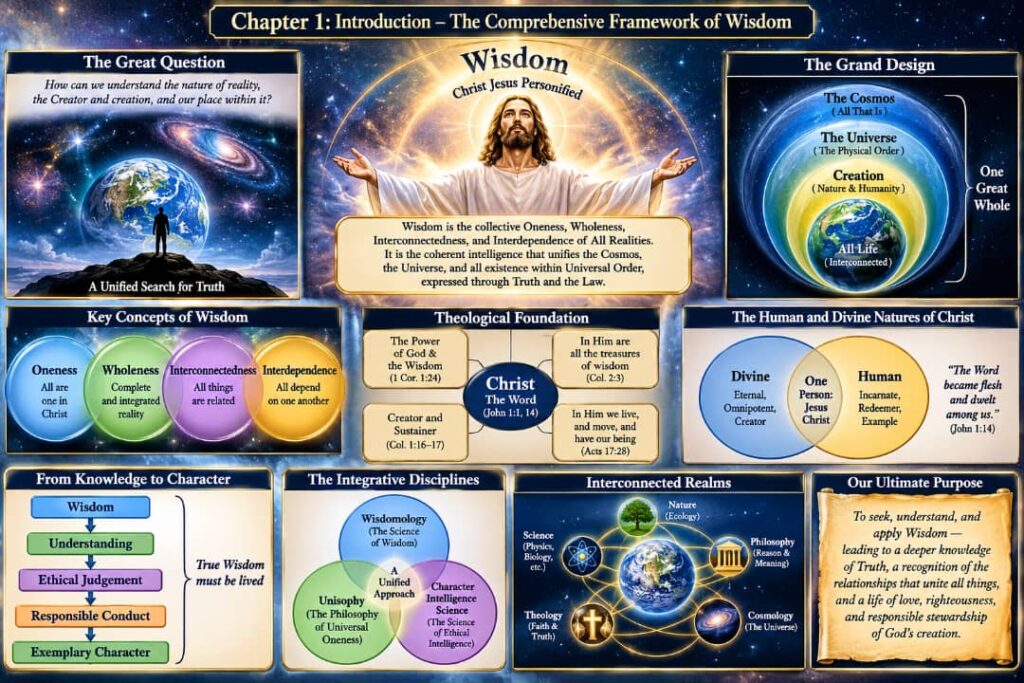
The expression “the Oneness of All and in All” contains two closely related dimensions. “The Oneness of All” expresses the unity and wholeness of existence, while “Oneness in All” expresses the interconnectedness and interdependence manifested throughout the different dimensions of reality. Together, these dimensions provide a conceptual foundation for examining the relationships between the individual and society, humanity and nature, living organisms and their environments, and the different systems and structures through which reality is understood. In this framework, reality is not approached merely as a collection of isolated objects and events, but as a totality whose constituent elements exist within relationships of connection, dependence, interaction, and order.
The formulation therefore has potential relevance to metaphysics, cosmology, ecology, biology, systems thinking, ethics, and the philosophy of knowledge. It does not claim that every scientific discipline has already established one identical empirical law of universal interconnectedness. Rather, it proposes Oneness as a philosophical principle through which relationships among different domains of existence may be examined and interpreted. Its intellectual significance lies in placing unity, relationality, and interconnectedness at the centre of the inquiry into Wisdom.
The definition further identifies Wisdom with the collective Oneness, Wholeness, Interconnectedness, and Interdependence of All Realities, describing it as the coherent intelligence and fundamental Law that established and governs Creation, unifying the Cosmos, the Universe, and all existence within Universal Order. This constitutes a comprehensive philosophical and metaphysical proposition. It presents Wisdom not merely as the ability to acquire knowledge, make sound decisions, or apply experience effectively, but as a fundamental principle of intelligibility, unity, coherence, and order underlying the framework’s understanding of existence.
Its cosmological dimension invites inquiry into the relationships, structures, patterns, and regularities through which the Universe operates. Its ecological dimension directs attention to the dependence and interaction of organisms, environments, and ecosystems. Its philosophical dimension raises fundamental questions concerning the origin, coherence, intelligibility, and governing order of reality. Its ethical dimension asks how human beings ought to conduct themselves within an interconnected order of existence.
For academic precision, however, it is essential to distinguish the philosophical proposition that Wisdom is the fundamental Law of Creation from specific scientific laws established through observation, experimentation, mathematical modelling, reproducibility, and independent verification. The Definition of Wisdom provides a conceptual and philosophical framework for inquiry; particular scientific propositions derived from or associated with that framework must be separately investigated and evaluated according to the appropriate methods of each discipline. This distinction does not diminish the philosophical ambition of the definition. On the contrary, it establishes the intellectual discipline necessary for its serious scholarly development and allows philosophical propositions and empirical scientific claims to remain appropriately distinguished.
A central feature of the Definition of Wisdom is its relationship between Wisdom and Truth: Wisdom is characterised by Truth, and Truth is the expression of Wisdom. This relationship gives the formulation both an epistemological and an ethical foundation. Truth is indispensable to the responsible acquisition, interpretation, communication, and application of knowledge. Information, technical competence, intellectual ability, and scientific discovery do not automatically constitute Wisdom. Their significance depends, among other things, upon the accuracy of understanding, the integrity of judgment, the recognition of consequences, and the responsible use of knowledge.
In this respect, the formulation maintains a meaningful connection with the Socratic tradition of examining claims and recognising the limits of human knowledge, while also engaging the Platonic concern with truth and the Aristotelian relationship between intellectual excellence, virtue, and practical judgment. Contemporary philosophical discussions likewise recognise that Wisdom involves multiple and contested dimensions, including knowledge, rationality, intellectual humility, virtue, judgment, reflection, and the capacity to live well. The Definition of Wisdom advanced by Odukaesieme brings Truth and universal Oneness together as central organising principles within this continuing philosophical inquiry. Its scholarly interpretation should therefore encourage critical examination, intellectual honesty, evidence, reasoned argument, and the willingness to identify and correct error.
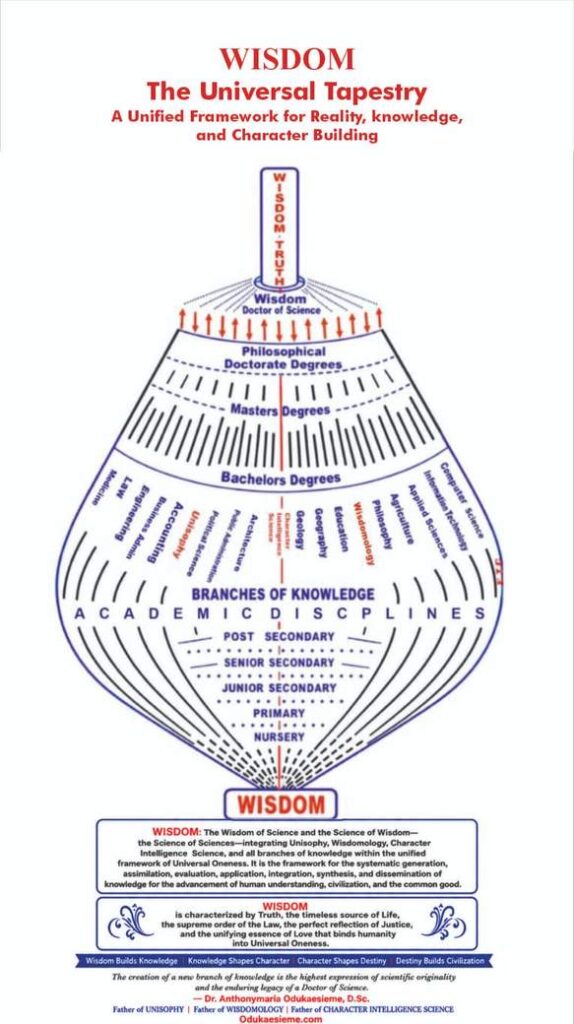
The wider intellectual significance of the Definition of Wisdom becomes clearer when considered in relation to Wisdomology, Unisophy, and Character Intelligence Science. Wisdomology, presented as the Science of Wisdom and developed as a proposed Science of Sciences, seeks to examine Wisdom as an integrating field of knowledge and to investigate relationships among different academic disciplines and branches of inquiry. Its purpose should not be understood as replacing the specialised methods, evidence, or established findings of existing sciences, but as exploring the principles through which knowledge may be integrated, interpreted, and directed towards a coherent understanding of reality.
Unisophy, understood as the Philosophy of Universal Oneness, provides the philosophical framework for examining the unity, interconnectedness, and interdependence of existence. Character Intelligence Science addresses the ethical dimension of human intelligence, with particular attention to character, judgment, responsibility, ethical conduct, and human excellence. Together, these fields constitute related dimensions of a wider intellectual programme: Wisdom as the integrating principle; Unisophy as the philosophy of universal Oneness; Wisdomology as the systematic study of Wisdom; and Character Intelligence Science as the study of the ethical dimension and application of intelligence.
Their continued academic development requires clear definitions, coherent theoretical foundations, engagement with established scholarship, logical consistency, openness to criticism, and appropriate philosophical, scientific, and empirical methods of evaluation. Such standards are not limitations upon the framework; they are essential conditions for transforming a conceptual vision into a durable body of scholarship.
The civilizational significance of Wisdom rests upon the recognition that the advancement of knowledge, science, technology, economics, and political institutions does not by itself guarantee a just, peaceful, humane, or sustainable society. Human progress also requires Truth, ethical character, responsible leadership, justice, mutual respect, intellectual responsibility, and an understanding of the consequences of human action.
The principle of universal Oneness provides a philosophical basis for considering the relationship between individual welfare and collective well-being; human development and environmental responsibility; national interests and global interdependence; and present decisions and the welfare of future generations. It encourages recognition that actions undertaken within one part of an interconnected system may produce consequences beyond that immediate context.
This perspective has particular relevance to contemporary challenges involving environmental degradation, social conflict, inequality, irresponsible leadership, the misuse of scientific and technological power, and the failure to recognise long-term consequences. The Definition of Wisdom therefore possesses potential significance beyond abstract philosophical discussion. It invites the application of Wisdom to education, governance, leadership, human relationships, environmental responsibility, scientific practice, technological development, and the organisation of society.
Its civilizational value, however, will ultimately depend not only upon the breadth or elegance of its conceptual formulation, but also upon the clarity of its practical implications, its capacity to withstand critical examination, and the extent to which its principles can be responsibly applied to real human problems. A civilizational philosophy becomes consequential when its principles move from intellectual formulation into education, character formation, ethical action, institutional practice, and the responsible organisation of human affairs.
Historically, the intellectual development of this framework is associated with Odukaesieme’s work WISDOM: A Discovery in a Nation with a Broken Heart, first published in 2000, following the beginning of the author’s writing and research in 1999. The work is identified as the foundational publication from which the subsequent development of Wisdomology, Unisophy, and Character Intelligence Science emerged. This publication history provides an important chronological starting point for examining the development of the author’s ideas, their conceptual evolution, and their relationship to the later formulation of Wisdom as the Oneness of All and in All.
A rigorous historical account should preserve the relevant editions, publication dates, bibliographical records, and other documentary evidence so that the development, chronology, and originality of the framework can be examined by readers and researchers. The significance of an intellectual contribution is strengthened when its conceptual development can be traced through identifiable publications and documented stages of formulation.
Considered in its philosophical, epistemological, cosmological, ecological, ethical, scientific, and civilizational dimensions, the Definition of Wisdom represents an ambitious attempt to formulate a unifying account of reality and knowledge, anchored in Oneness and characterised by Truth. Its contribution should be assessed through careful comparison with earlier and contemporary scholarship, conceptual clarity, logical coherence, philosophical depth, historical documentation, and the possibilities it opens for further inquiry.
The enduring purpose of this intellectual undertaking is to advance humanity’s understanding of existence, promote the responsible integration of knowledge, strengthen ethical intelligence, encourage intellectual humility and responsible judgment, and deepen the pursuit of Truth and Universal Order. In this broader context, the Definition of Wisdom is not merely a statement about an individual’s capacity to think or act wisely. It is a comprehensive proposition concerning the relationship between unity, reality, knowledge, Truth, order, and human responsibility.
At the heart of this intellectual undertaking stands its foundational proposition:
Wisdom is the Oneness of All and in All.
THE DEFINITION OF WISDOM
Wisdom is the Oneness of All and in All. It is the collective Oneness, Wholeness, Interconnectedness, and Interdependence of All Realities; the coherent intelligence and fundamental Law that established and governs Creation, unifying the Cosmos, the Universe, and all existence within Universal Order. Wisdom is characterised by Truth, and Truth is the expression of Wisdom, through which Universal Order is revealed and understood.
— Dr. Anthonymaria Odukaesieme, D.Sc.
(Founder and Father of Wisdomology, Unisophy, and Character Intelligence Science)