

By Dr. Anthonymaria Odukaesieme
Unisophy Educational Project
Organised by
UNISOPHY CIVILIZATIONAL FELLOWSHIP MOVEMENT
Wisdom is the eternal Law of Universal Oneness—the wholeness of existence and Creation, embracing the totality, interconnectedness, interdependence, and unity of all realities. It is the primordial governing principle through which the relationships among existence, Truth, knowledge, intelligence, morality, and the broader order of Creation can be understood. Within this philosophical framework, Wisdom is not merely an accumulation of knowledge or an advanced expression of human intelligence; it is the unifying principle that establishes coherence, relationship, direction, and proper order among the constituent realities of existence.
Like the trunk of a mighty tree, Wisdom provides the foundational structure from which the branches of knowledge, understanding, scientific inquiry, ethical principles, and human achievement derive their significance. It brings faith-led Knowledge and reason-led Understanding into a coherent intellectual framework, recognizing their respective contributions while emphasizing Truth as the essential foundation of sound knowledge and responsible understanding. In this relationship, Wisdom provides the philosophical foundation for understanding and aligning human existence with Creation in accordance with the Creator’s order.
The significance of Wisdom, therefore, extends beyond its conceptual definition to its practical application in human existence. Understanding Wisdom is essential to recognizing the relationships between individual and collective welfare, human conduct and social responsibility, intellectual advancement and ethical development within the framework of Cosmic Order, Universal Law, and Natural Law. As expressed in Odukaesieme’s Wisdomology framework: “Our peace and harmony are keyed to understanding Wisdom.”
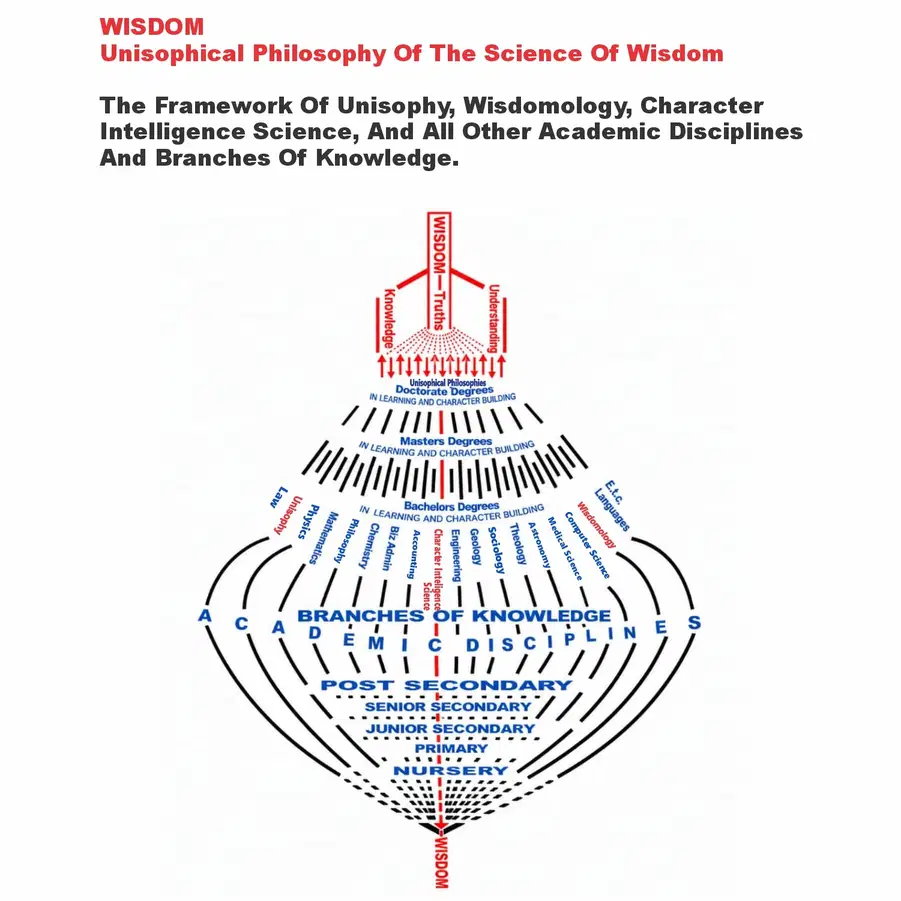
This proposition establishes understanding Wisdom as a fundamental key to peaceful human coexistence. If existence is understood in terms of interconnectedness and interdependence, human actions cannot be regarded as entirely isolated from their consequences for other individuals, communities, societies, and the natural environment. Every human decision and action has the potential to influence relationships and conditions beyond the individual. Recognizing these relationships provides an important philosophical, rational, and ethical foundation for responsibility, cooperation, justice, and social harmony.
The necessity of Wisdom becomes particularly evident when the achievements and limitations of human knowledge and intelligence are examined. Knowledge expands the scope of what humanity knows; intelligence increases its capacity to reason, analyse, discover, and create; while science advances systematic investigation and understanding of the natural and material world. Nevertheless, these intellectual and scientific capacities do not automatically guarantee the ethical application of knowledge or the advancement of human welfare. Intelligence without Wisdom, knowledge without Truth, and power without ethical Character may increase human capabilities while simultaneously creating conditions for exploitation, misinformation, corruption, inequality, conflict, and environmental degradation.
This distinction reveals a fundamental challenge confronting human civilization: the advancement of intellectual and technological capabilities does not necessarily correspond to the advancement of ethical maturity and collective welfare. Scientific discoveries and technological innovations can serve humanity constructively or destructively, depending on the knowledge, values, intentions, and character guiding their application. Consequently, the progress of civilization requires not merely the expansion of human capabilities but also the development of the wisdom and ethical responsibility necessary to direct those capabilities towards the common good.

The advancement of civilization therefore requires more than intellectual, scientific, technological, and economic development. It requires the integration of these achievements within a coherent framework of Truth, ethical Character, responsibility, and Universal Order. Wisdom provides the philosophical foundation for examining this necessary integration and for understanding why the advancement of human capability must be accompanied by the advancement of human welfare.
This consideration leads to another fundamental proposition within Odukaesieme’s Wisdomology framework: “Once humanity can properly define Wisdom, the world will know it and live by it, to create a harmonious world.”
The significance of this proposition lies in the relationship between definition, understanding, knowledge, and application. A properly articulated definition establishes conceptual clarity and provides a foundation for systematic inquiry, intellectual development, education, and practical application. Without a clear understanding of what Wisdom represents, its principles cannot be adequately communicated, studied, taught, or consistently applied. Defining Wisdom is therefore an essential starting point towards its wider recognition and practical integration into human life.
When Wisdom is adequately understood, its principles can inform individual decisions, interpersonal relationships, educational systems, scientific responsibilities, institutional governance, economic activities, environmental stewardship, and the broader organization of society. Its application provides a framework for examining the relationship between individual interests and collective responsibilities, intellectual achievement and ethical conduct, and material progress and human fulfilment.
The objective is not simply to introduce another philosophical concept into human intellectual discourse, but to establish a coherent framework through which the relationships among existence, knowledge, Truth, intelligence, ethical Character, and human civilization can be examined and understood. This integrated approach encourages humanity to move beyond fragmented perspectives of knowledge towards a more comprehensive understanding of reality, its interconnected constituents, and their governing relationships.
From this standpoint, Wisdom has profound implications for education and the future of civilization. Education must not be limited to the acquisition of information, professional competence, or intellectual proficiency. It must also cultivate sound judgment, ethical intelligence, responsible conduct, and an understanding of the interconnectedness of human existence. The integration of Wisdom into education is therefore essential to developing individuals capable of applying their knowledge and abilities responsibly for the benefit of humanity.
Ultimately, the necessity of Wisdom rests on its fundamental relevance to the proper ordering of human existence and the realization of collective welfare. Its significance is reflected in its capacity to integrate knowledge with Truth, intelligence with ethical responsibility, scientific advancement with human welfare, and individual interests with the common good.

*From letf:* Chinedu Ifedigbo, Ebere Udochukwu Ansalem, Steve Okeke, Emeka Osuji, Anthonymaria Odukaesieme, Bede Uchenna Onu, Rev. Fr. Napoleon Akhabue(centre), Titus Offordile, Ebube Ihekaire, Cosmas Onuoha, Hillary Umegbolu, Francis Osita Iwuchukwu, Ifeanyi Omekara
When humanity recognizes the interconnectedness and interdependence of existence and consciously aligns its conduct, institutions, and developmental priorities with the principles of Universal Oneness, it establishes a stronger philosophical and ethical foundation for peaceful coexistence, sustainable development, social justice, environmental responsibility, and enduring civilizational progress.
Wisdom, therefore, is not merely something humanity must define, study, or discuss; it is a fundamental principle that humanity must understand and responsibly apply. Its proper understanding and practical expression provide a unifying foundation for the harmonious ordering of human existence and the advancement of civilization.
The ultimate necessity of Wisdom is that humanity must learn not only how to know, reason, discover, and create, but also how to understand the proper place, purpose, relationship, and responsible application of all things within the Universal Order.