

11.1 INTRODUCTION
The search for Wisdom inevitably raises questions about the natural world.
Human beings observe the heavens, investigate the Earth, study living organisms, examine matter and energy, investigate the human body, analyse ecological systems, and seek to understand the laws and patterns that govern physical reality.
These activities constitute some of the principal domains of the natural sciences.
Science has enabled humanity to discover extraordinary dimensions of the natural world. Through observation, measurement, experimentation, mathematical modelling, and systematic reasoning, human beings have developed increasingly sophisticated accounts of physical, chemical, biological, geological, and astronomical phenomena.
Yet the existence of scientific knowledge also raises a deeper philosophical question:
What is the proper relationship between scientific knowledge and Wisdom?
Science seeks reliable knowledge concerning aspects of the natural world.
Wisdom asks how knowledge should be understood, ordered, evaluated, and responsibly applied.
Science can investigate how processes occur.
Wisdom also asks questions concerning meaning, value, purpose, responsibility, and the proper use of knowledge.
The distinction is important.
Wisdom should not be used as a substitute for scientific investigation.
Likewise, scientific investigation should not automatically be treated as though it answers every philosophical, theological, moral, or existential question.
The two domains can enter into dialogue while retaining their distinct methods and competencies.
This chapter therefore examines the relationship between Wisdom and the natural sciences within the broader framework of this treatise.
The central argument is that scientific knowledge represents a major dimension of human knowledge, while Wisdom concerns the proper integration and responsible ordering of knowledge within Truth, Universal Order, ethical responsibility, and the wider understanding of existence.
11.2 THE MEANING OF NATURAL SCIENCE
Natural science refers broadly to systematic investigation of the natural world.
Its principal disciplines include physics, chemistry, biology, earth science, astronomy, and related fields.
Each discipline examines particular dimensions of reality.
Physics investigates matter, energy, motion, forces, fields, space, time, and other physical phenomena.
Chemistry investigates substances, structures, properties, and transformations of matter.
Biology investigates living organisms and their processes.
Geology investigates the Earth, its materials, structures, and history.
Astronomy investigates celestial objects and phenomena.
Ecology investigates relationships among organisms and their environments.
These disciplines differ in subject matter and methodology, but they share a broad commitment to systematic inquiry.
Scientific knowledge is therefore one of humanity’s major instruments for understanding Creation and the natural order.
11.3 OBSERVATION AND THE HUMAN QUEST FOR KNOWLEDGE
Scientific inquiry begins, in part, with observation.
Human beings observe phenomena and ask questions.
Why do objects fall?
How do organisms reproduce?
How does the human body function?
Why do stars shine?
How are mountains formed?
How do ecosystems maintain or lose stability?
What is matter composed of?
How does energy move?
Such questions reflect a fundamental human capacity for intellectual curiosity.
The desire to understand reality is itself a significant dimension of human existence.
Within the Christian worldview, the natural world is not necessarily an obstacle to knowledge of God.
Rather, creation can be studied as creation.
The natural world can become an object of investigation precisely because it possesses patterns, regularities, and intelligibility.
Science therefore represents one expression of humanity’s intellectual engagement with reality.
11.4 ORDER AND THE POSSIBILITY OF SCIENCE
Science depends upon the assumption that nature exhibits sufficient regularity for investigation.
If physical reality were entirely without pattern, scientific prediction and explanation would be impossible.
The existence of regular relationships enables human beings to formulate laws, construct models, perform experiments, and make predictions.
This raises an important philosophical question:
Why is the natural world intelligible?
Science can investigate the regularities themselves.
Philosophy may ask deeper questions concerning the possibility and meaning of intelligibility.
Christian theology goes further by relating the intelligibility of creation to the Creator.
The Gospel of John begins with the Logos:
“In the beginning was the Word.”
The concept of Logos has profound theological significance in Christian thought.
The Word is not presented merely as information.
The Word is presented in relation to God and creation.
John subsequently states that all things were made through Him.
Within Christian theology, therefore, the rational intelligibility of creation can be considered within the broader reality of divine creation and order.
This is a theological interpretation, not an empirical scientific conclusion.
Maintaining this distinction is essential.
11.5 SCIENCE AND THE DISCOVERY OF NATURAL ORDER
Scientific investigation frequently reveals order that is not immediately visible to ordinary observation.
The microscopic world reveals structures beyond unaided human perception.
Astronomy reveals immense scales of space and time.
Molecular biology reveals complex processes within living cells.
Ecology reveals networks of relationships among organisms and environments.
Geology reveals processes occurring over vast periods.
Physics reveals mathematical regularities underlying observable phenomena.
The expansion of scientific knowledge therefore continually enlarges humanity’s understanding of reality.
Yet every discovery also reveals new questions.
Understanding one process may expose another level of complexity.
Discovering one law may raise questions concerning the conditions under which that law operates.
Knowledge therefore does not necessarily terminate wonder.
It can deepen wonder.
Wisdom includes the humility to recognise that increased knowledge may also reveal the extent of what remains unknown.
11.6 WISDOM AND SCIENTIFIC HUMILITY
Scientific humility is an important expression of intellectual character.
A responsible scientist distinguishes between established evidence, plausible interpretation, unresolved questions, and speculation.
This distinction protects scientific inquiry from exaggeration.
The same principle applies to Wisdom.
Wisdom does not claim certainty where evidence is insufficient.
It does not transform hypothesis into fact.
It does not use scientific vocabulary merely to give philosophical ideas the appearance of empirical confirmation.
This is particularly important in interdisciplinary writing.
A theological proposition should not be presented as a scientific measurement.
A philosophical argument should not be presented as an experimental result.
A scientific observation should not automatically be interpreted as proof of a theological doctrine.
Wisdom respects the boundaries of knowledge while seeking meaningful relationships among different forms of understanding.
11.7 SCIENCE AND THE QUESTION OF CAUSE
Science investigates causes in various senses.
It may identify physical mechanisms.
It may determine relationships between variables.
It may formulate mathematical descriptions of processes.
However, the philosophical concept of causation can extend beyond the immediate mechanisms investigated experimentally.
Questions concerning ultimate cause, purpose, existence, and why there is something rather than nothing belong partly to metaphysics and philosophy of religion.
For example, physics may investigate how stars form.
Philosophy may ask what it means for something to exist.
Theology may ask why creation exists in relation to God.
These questions can interact, but they are not identical.
Wisdom therefore requires differentiation.
Different questions may require different methods.
11.8 NATURAL LAWS AND UNIVERSAL ORDER
The concept of natural law is central to scientific description.
Scientists identify regularities in nature and express them through mathematical or conceptual models.
Newtonian mechanics, thermodynamics, electromagnetism, quantum theory, relativity, evolutionary theory, and other scientific frameworks describe important dimensions of natural phenomena.
The phrase “law of nature” can be used in scientific contexts without necessarily making a theological claim.
The theological concept of Universal Order, however, has a broader philosophical meaning in this treatise.
It refers to the idea that reality possesses structure, relationships, intelligibility, and order.
The two concepts can be placed in dialogue but should not be equated without qualification.
Scientific laws describe regularities.
Universal Order, as a philosophical concept, concerns the broader coherence of existence.
11.9 PHYSICS AND WISDOM
Physics has transformed humanity’s understanding of reality.
Classical mechanics provided mathematical descriptions of motion.
Electromagnetism unified important phenomena involving electricity, magnetism, and light.
Relativity transformed understanding of space, time, gravity, and motion.
Quantum theory transformed understanding of matter and physical processes at microscopic scales.
These developments demonstrate that human understanding can undergo profound conceptual transformation.
The history of physics therefore contains an important lesson for Wisdom:
Human understanding is capable of growth.
A scientific model may be extremely successful within a particular domain while later requiring revision, extension, or reinterpretation.
Wisdom therefore discourages intellectual absolutism.
A person should not confuse current knowledge with complete knowledge.
Scientific achievement should encourage humility rather than intellectual arrogance.
11.10 CHEMISTRY AND THE ORDER OF MATTER
Chemistry demonstrates another dimension of order.
Elements combine according to patterns.
Molecules possess structures.
Chemical reactions occur under particular conditions.
Matter exhibits properties that depend upon composition and arrangement.
The chemical sciences demonstrate that complex outcomes can emerge from structured relationships among components.
This observation is philosophically significant.
Reality cannot always be understood by examining isolated components alone.
The relationship among components matters.
This principle resonates with the concept of interconnectedness.
However, the scientific observation should not be transformed into an unsupported metaphysical claim that everything is literally one substance.
Chemistry demonstrates relationships among material entities.
It does not by itself establish a complete philosophy of Universal Oneness.
Wisdom therefore interprets scientific insight carefully.
11.11 BIOLOGY AND THE COMPLEXITY OF LIFE
Biology provides one of the richest fields for examining complexity, relationship, adaptation, development, and organisation.
Living organisms consist of interconnected systems.
Cells contain specialised structures.
Organs function within larger physiological systems.
Organisms interact with other organisms.
Populations exist within ecosystems.
Ecosystems exist within broader environmental contexts.
Life therefore presents multiple levels of organisation.
This hierarchical and relational structure provides a powerful illustration of interconnectedness.
At the same time, biology requires careful empirical investigation.
The existence of complexity should not automatically be treated as proof of a particular philosophical or theological conclusion.
Rather, biological knowledge provides material for philosophical reflection.
Wisdom asks what can responsibly be inferred from the evidence.
11.12 ECOLOGY AND RELATIONAL WISDOM
Ecology is particularly relevant to the concept of Wisdom because it explicitly studies relationships.
Organisms interact with one another and with their physical environments.
Energy flows through ecosystems.
Nutrients cycle.
Populations change.
Communities interact.
Environmental conditions influence organisms.
Organisms also influence their environments.
Ecology therefore provides scientific evidence for the importance of relationships within living systems.
This resonates strongly with the concepts of interconnectedness and interdependence developed throughout this treatise.
However, scientific interdependence should not automatically be equated with every philosophical formulation of Universal Oneness.
Ecological science concerns observable relationships among living organisms and environmental systems.
The philosophical concept of Universal Oneness extends into questions concerning the totality of existence.
Wisdom can place these ideas into dialogue while preserving their distinct meanings.
11.13 ASTRONOMY AND THE COSMIC DIMENSION OF WISDOM
Astronomy expands the human imagination beyond the immediate environment of Earth.
The night sky reveals stars, planets, galaxies, nebulae, and other astronomical phenomena.
Modern astronomy demonstrates that the observable universe is extraordinarily vast.
This vastness places human existence within a much larger cosmic context.
The recognition of cosmic scale can produce intellectual humility.
Human beings are significant as persons, yet they occupy a very small physical location within the observable cosmos.
This apparent paradox is important.
Human physical smallness does not necessarily imply meaninglessness.
Christian theology can affirm both the vastness of creation and the significance of human beings within God’s purposes.
Wisdom therefore holds cosmic humility and human dignity together.
11.14 COSMOLOGY AND THE QUESTION OF ORIGIN
Cosmology investigates the origin, structure, development, and large-scale behaviour of the universe.
Modern cosmological models have provided powerful accounts of cosmic history.
The Big Bang model, for example, describes an early hot, dense state and subsequent cosmic expansion.
Such scientific models concern physical history and development.
The theological question of creation is related but not identical.
To say that the universe has a physical history is not by itself equivalent to answering the metaphysical question of why the universe exists.
Similarly, theological creation should not be reduced simply to a scientific cosmological model.
Science investigates the physical universe.
Theology asks about the Creator and the meaning of creation.
Wisdom requires that these questions be distinguished while allowing responsible dialogue.
11.15 EARTH SCIENCE AND THE WISDOM OF THE CREATED WORLD
Earth science reveals that the planet is a dynamic system.
The atmosphere, hydrosphere, lithosphere, biosphere, and other components interact.
Climate, geology, water cycles, biological processes, and human activity influence one another in complex ways.
This demonstrates the importance of systems thinking.
Human beings do not live outside nature.
They live within a planetary environment.
Human health depends upon environmental conditions.
Food systems depend upon ecological processes.
Water security depends upon functioning hydrological systems.
Civilisation depends upon stable environmental conditions.
Wisdom therefore requires environmental responsibility.
The study of Earth is not merely an academic exercise.
It has direct implications for human survival and flourishing.
11.16 MEDICINE AND THE WISDOM OF HUMAN LIFE
Medicine provides another important example of the relationship between scientific knowledge and Wisdom.
Medical science investigates the human body, disease, prevention, diagnosis, treatment, and health.
Scientific medicine has saved and improved countless lives.
Yet medical knowledge also raises ethical questions.
Who should receive treatment?
How should scarce resources be allocated?
What constitutes informed consent?
How should vulnerable patients be protected?
What limits should apply to experimentation?
How should new technologies be used?
Science can provide information relevant to these questions.
Ethics and Wisdom are required for their responsible resolution.
This illustrates an important principle:
Knowledge increases capability, but Wisdom must guide responsibility.
11.17 TECHNOLOGY AND THE ETHICAL USE OF KNOWLEDGE
Scientific knowledge often produces technological capability.
Technology can improve communication, transportation, agriculture, medicine, education, and productivity.
But technological capability can also create risks.
The same knowledge can potentially be used for constructive or destructive purposes.
This creates a moral problem.
Humanity must distinguish between what can be done and what ought to be done.
This distinction is one of the clearest reasons why Wisdom remains necessary in an age of scientific advancement.
Scientific progress without ethical responsibility can become dangerous.
Technological power without character can magnify human weaknesses.
Wisdom therefore requires that capability be placed within ethical order.
11.18 SCIENCE, TRUTH, AND ERROR CORRECTION
One of the strengths of scientific inquiry is its capacity for correction.
Scientific models are tested against evidence.
Claims can be challenged.
Experiments can be repeated.
Data can reveal error.
Theories can be modified.
This provides an important lesson for Wisdom.
Truth should not be feared.
If an idea is false, it should be corrected.
If evidence challenges an assumption, the assumption should be reconsidered.
If a conclusion is unsupported, it should be withdrawn or qualified.
Intellectual humility therefore strengthens the pursuit of truth.
This principle applies beyond science.
Theological scholarship also requires careful interpretation.
Philosophy requires rigorous reasoning.
Historical research requires evidence.
Ethical reflection requires honesty.
Wisdom therefore welcomes correction when correction brings thought closer to Truth.
11.19 THE LIMITS OF SCIENTIFIC KNOWLEDGE
Science is extraordinarily powerful, but its power does not mean that it answers every possible question.
Science is methodologically concerned with empirical investigation.
Questions concerning moral obligation, ultimate meaning, aesthetic value, metaphysical foundations, and theological revelation may require other forms of reasoning.
This does not establish that every non-scientific claim is automatically true.
It means only that different questions require appropriate methods.
For example, science can investigate the biological effects of an action.
It cannot, by measurement alone, determine the complete moral meaning of that action.
Science can describe brain activity.
It cannot by itself settle every philosophical question concerning consciousness, personhood, or moral responsibility.
Science can describe cosmic processes.
It does not by itself answer every question concerning ultimate meaning.
Wisdom recognises these distinctions.
19.20 SCIENCE AND THE UNITY OF KNOWLEDGE
The existence of different disciplines does not mean that reality itself is necessarily fragmented.
Physics studies physical processes.
Chemistry studies chemical processes.
Biology studies living systems.
Ecology studies relationships within ecosystems.
Astronomy studies celestial phenomena.
Geology studies the Earth.
Medicine studies health and disease.
Each discipline focuses on particular aspects of reality.
The broader philosophical question concerns how these forms of knowledge relate.
Wisdom seeks integration.
Integration does not mean forcing every discipline into one methodology.
It means understanding the relationships among domains of knowledge.
This is one of the central intellectual purposes of Wisdomology as proposed within this treatise.
Wisdomology is presented here as a proposed conceptual framework for examining Wisdom and its relationship with different forms of knowledge.
It should not be represented as an already universally established academic discipline.
Its significance within this work lies in its integrative objective.
11.21 WISDOM AND THE SCIENTIFIC WORLDVIEW
Scientific knowledge has influenced modern human understanding profoundly.
It has transformed how people think about Earth, life, matter, energy, space, time, and the universe.
A mature philosophy of Wisdom should therefore engage seriously with scientific knowledge.
It should not fear science.
It should not misuse science.
It should not exaggerate science.
It should not reduce all knowledge to science without philosophical justification.
Instead, it should seek constructive dialogue.
Such dialogue requires intellectual discipline.
Theologians should understand scientific claims accurately.
Scientists should distinguish empirical conclusions from philosophical interpretations.
Philosophers should clarify concepts and assumptions.
All participants should recognise the limits of their methods.
Wisdom is therefore not the rejection of science.
It is the responsible integration of knowledge.
11.22 SCIENCE AND THE QUESTION OF PURPOSE
Science can describe processes without necessarily determining ultimate purpose.
For example, science may investigate how an organism develops.
A philosophical or theological framework may ask what human life means.
Science may describe how a star forms.
Philosophy may ask what significance human beings attach to cosmic existence.
Science may describe how ecosystems function.
Ethics may ask how human beings ought to behave toward ecosystems.
These questions are related but distinct.
Wisdom does not force science to answer questions outside its method.
Neither does Wisdom exclude scientific knowledge from broader reflection.
Instead, Wisdom asks how different forms of knowledge can contribute appropriately to the understanding of reality.
11.23 SCIENCE, CREATION, AND THE CREATOR
Within Christian theology, the natural world is Creation.
The Creator is God.
Creation is not identical with the Creator.
This distinction is fundamental to the framework of this treatise.
Scientific investigation studies aspects of Creation.
It does not experimentally measure God as though God were simply another physical object within Creation.
This does not prevent theological reflection upon scientific discoveries.
Rather, it clarifies the category distinction.
The universe can be investigated scientifically.
The Creator is considered theologically and philosophically.
The distinction prevents both scientism and theological misuse of science.
Scientism would attempt to treat empirical science as the sole legitimate source of all knowledge.
Theological misuse of science would attempt to turn scientific observations into proofs for conclusions they do not logically establish.
Wisdom avoids both errors.
11.24 WISDOM AND THE NATURAL WORLD AS A SOURCE OF WONDER
Scientific knowledge can increase wonder.
The discovery of microscopic complexity can inspire wonder.
The discovery of cosmic scale can inspire wonder.
The complexity of ecosystems can inspire wonder.
The intricacy of biological systems can inspire wonder.
The mathematical regularities of physical phenomena can inspire wonder.
Wonder can become an intellectual motivation for further inquiry.
Within Christian theology, wonder can also become an occasion for reflection upon Creation and the Creator.
The natural world therefore occupies an important place in the human search for Wisdom.
Yet wonder should not replace evidence.
Awe is not proof.
Beauty is not automatically demonstration.
Wisdom allows wonder to inspire inquiry without allowing emotion to substitute for reasoning.
11.25 SCIENCE AND HUMAN HUMILITY
The history of science provides many examples of human beings discovering that previously held assumptions were incomplete.
The expansion of knowledge has repeatedly challenged human certainty.
This is not a weakness of humanity.
It is part of the process of learning.
Wisdom therefore requires epistemic humility.
Human beings should be confident enough to investigate reality and humble enough to revise their conclusions.
This balance is essential.
Excessive scepticism can prevent knowledge.
Excessive certainty can prevent correction.
Wisdom occupies the space between intellectual paralysis and intellectual arrogance.
It seeks Truth while recognising human limitation.
11.26 THE ETHICAL RESPONSIBILITY OF SCIENTISTS
Scientists are not merely producers of information.
They are human beings whose decisions have consequences.
Researchers must consider the ethical dimensions of their work.
This includes honesty in data collection and reporting.
It includes respect for research participants.
It includes responsible treatment of animals where applicable.
It includes environmental responsibility.
It includes appropriate handling of potentially dangerous knowledge.
It includes transparency concerning limitations.
It includes avoidance of fabricated evidence.
Scientific integrity is therefore a form of character.
A brilliant researcher without integrity can damage science itself.
Trust is essential to scientific communities.
Wisdom therefore requires scientific excellence and moral excellence to work together.
11.27 THE ETHICAL RESPONSIBILITY OF SOCIETY
Responsibility does not belong only to scientists.
Society also determines how knowledge is funded, regulated, applied, and distributed.
Governments establish policies.
Businesses develop technologies.
Universities educate researchers.
Communities adopt or reject innovations.
Citizens make choices concerning technology and public policy.
Therefore, the ethical use of science is a collective responsibility.
A wise society does not merely ask whether something is innovative.
It asks whether it is beneficial, just, safe, sustainable, and consistent with human dignity.
This is where Wisdom becomes a civilisational principle.
11.28 SCIENCE, WISDOM, AND HUMAN EXCELLENCE
Human excellence requires both intellectual capability and ethical responsibility.
Scientific knowledge expands capability.
Wisdom directs capability toward appropriate ends.
Character sustains responsible practice.
These dimensions can be represented conceptually as:
KNOWLEDGE → CAPABILITY → RESPONSIBILITY → WISE ACTION → HUMAN EXCELLENCE
Knowledge without responsibility can become dangerous.
Capability without character can become destructive.
Responsibility without knowledge can become ineffective.
Wisdom seeks integration.
This model does not claim to be an empirical scientific law.
It is a conceptual framework for ethical reflection.
11.29 WISDOM AS THE INTEGRATOR OF KNOWLEDGE
The natural sciences provide enormous quantities of specialised knowledge.
Wisdom asks how this knowledge fits together.
It asks how scientific knowledge relates to philosophical reasoning.
It asks how philosophy relates to ethics.
It asks how ethics relates to human character.
It asks how human activity relates to ecological systems.
It asks how humanity relates to Creation.
It asks how Christian theology understands Creation in relation to the Creator.
The goal is not to erase disciplinary boundaries.
The goal is integration without confusion.
This is one of the defining intellectual directions of this treatise.
Wisdom is presented as an integrative principle.
11.30 CONCLUSION
The natural sciences represent one of humanity’s greatest achievements in the systematic investigation of the natural world.
Physics, chemistry, biology, ecology, geology, astronomy, medicine, and related disciplines have expanded human understanding enormously.
Yet scientific knowledge alone does not eliminate the need for Wisdom.
Science provides knowledge concerning many dimensions of how the natural world operates.
Wisdom asks how that knowledge should be understood, integrated, evaluated, and responsibly applied.
The distinction between these functions is essential.
Science should not be reduced to theology.
Theology should not be reduced to science.
Philosophy should not be confused with empirical experimentation.
Ethics should not be replaced by technological capability.
Instead, these domains can enter into responsible dialogue.
The natural sciences reveal extraordinary dimensions of order, relationship, complexity, and intelligibility within Creation.
These discoveries can contribute to a broader understanding of interconnectedness and interdependence.
They can also cultivate humility by revealing the immense scale and complexity of reality.
Within Christian theology, Creation ultimately points beyond itself toward the Creator, while the Creator remains distinct from Creation.
Wisdom therefore requires both intellectual curiosity and intellectual restraint.
It encourages investigation without arrogance.
It welcomes evidence without abandoning philosophical reflection.
It values science without treating science as the only form of knowledge.
It values theology without misusing scientific claims.
It seeks Truth across domains while respecting the methods appropriate to each domain.
In this sense, Wisdom becomes an integrating principle of knowledge.
The natural sciences tell humanity much about the structure and behaviour of the natural world.
Wisdom asks what humanity should do with what it knows.
That question is not secondary.
It is central to human civilisation.
For knowledge increases power.
But Wisdom determines the direction in which that power should be used.
REFERENCES
The Holy Bible, King James Version.
Barbour, I. G. (2000). When Science Meets Religion: Enemies, Strangers, or Partners? HarperOne.
Bertalanffy, L. von. (1968). General System Theory: Foundations, Development, Applications. George Braziller.
Capra, F. (1996). The Web of Life: A New Scientific Understanding of Living Systems. Anchor Books.
Einstein, A. (1916). Die Grundlage der allgemeinen Relativitätstheorie. Annalen der Physik, 354(7), 769–822.
Kuhn, T. S. (2012). The Structure of Scientific Revolutions (4th ed.). University of Chicago Press.
Newton, I. (1999). The Principia: Mathematical Principles of Natural Philosophy (I. B. Cohen & A. Whitman, Trans.). University of California Press.
Odum, E. P., & Barrett, G. W. (2005). Fundamentals of Ecology (5th ed.). Thomson Brooks/Cole.
Polkinghorne, J. (2006). Theology in the Context of Science. Yale University Press.
Tansley, A. G. (1935). The Use and Abuse of Vegetational Concepts and Terms. Ecology, 16(3), 284–307.
DEFINITION OF WISDOM
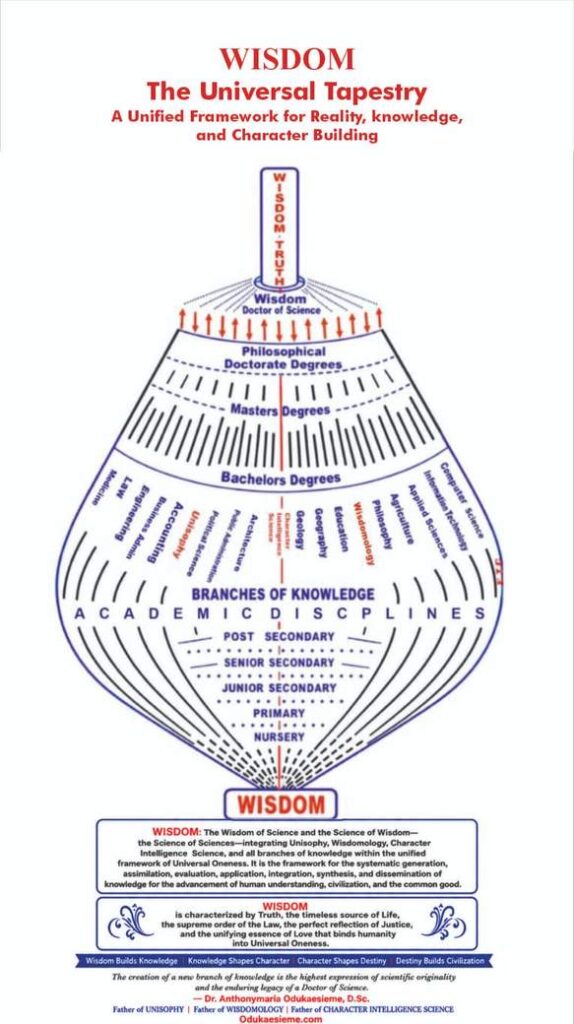
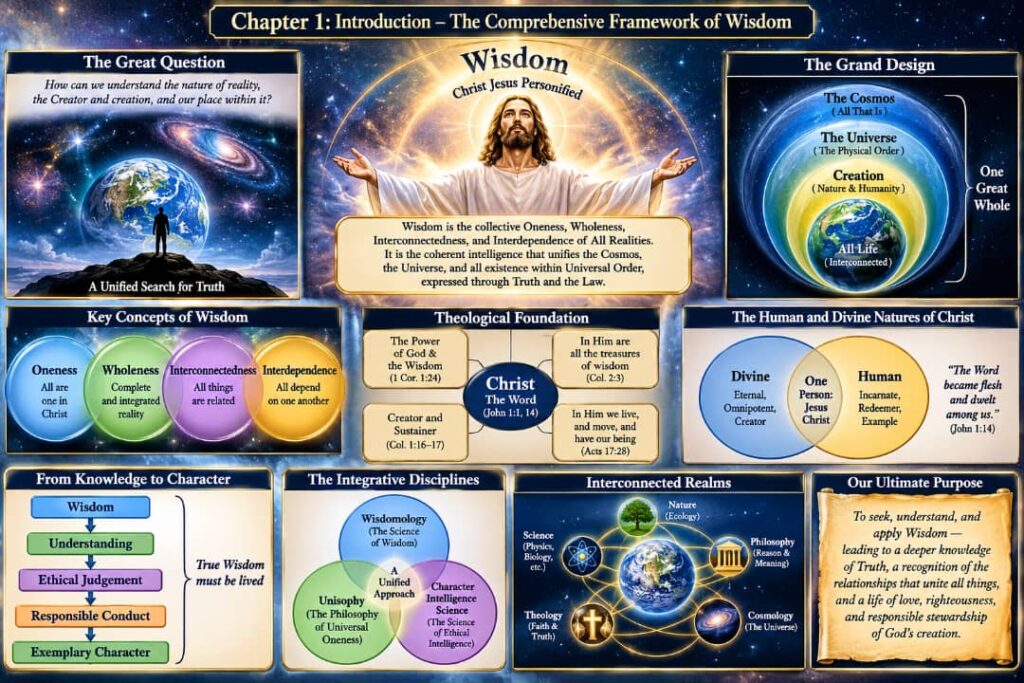
Wisdom is the collective Oneness, Wholeness, Interconnectedness, and Interdependence of All Realities. It is the coherent intelligence that unifies Creation, the Cosmos, the Universe, and all existence within Universal Order, expressed through Truth and the Law established by the Creator.
— Odukaesieme
www.odukaesieme.com