

By Dr. Anthonymaria Odukaesieme
For centuries, human civilization has measured its progress by the accumulation of information, the advancement of intellectual capacity, and the mastery of the material world. Humanity has split the atom, mapped the human genome, and engineered machines capable of mimicking aspects of human thought. Yet, in the relentless pursuit of specialized knowledge, our understanding of existence has often become fragmented. When intelligence operates without moral anchoring and power expands without ethical restraint, human advancement risks becoming an instrument of its own crisis. The defining challenge of our era is therefore not merely a scarcity of information or a deficit of technical brilliance, but the urgent need to restore Wisdom as the foundation of responsible human advancement.
To address this challenge, Wisdom must be rescued from the realm of vague sentiment and restored to its rightful place as a fundamental organizing principle of life and civilization. Wisdom is not merely cleverness, the accumulation of information, or the passive possession of experience. At its deepest philosophical and ontological level, it concerns the Oneness, Wholeness, Interconnectedness, and Interdependence of reality. It recognizes that no discipline, nation, technology, or individual exists in absolute isolation. Every aspect of existence belongs to a wider reality whose constituent parts are interconnected and interdependent.
THE DEFINITION OF WISDOM
WISDOM IS THE WHOLENESS OF EXISTENCE AND CREATION, EMBRACING AND INTEGRATING THE TOTALITY, UNITY, INTERCONNECTEDNESS AND INTERDEPENDENCE OF ALL REALITIES, TRUTHS, KNOWLEDGE AND INTELLIGENCE, WITH ONENESS AS THEIR FUNDAMENTAL PRINCIPLE AND UNIVERSAL LAW AS THE GOVERNING ORDER ESTABLISHED BY THE CREATOR.
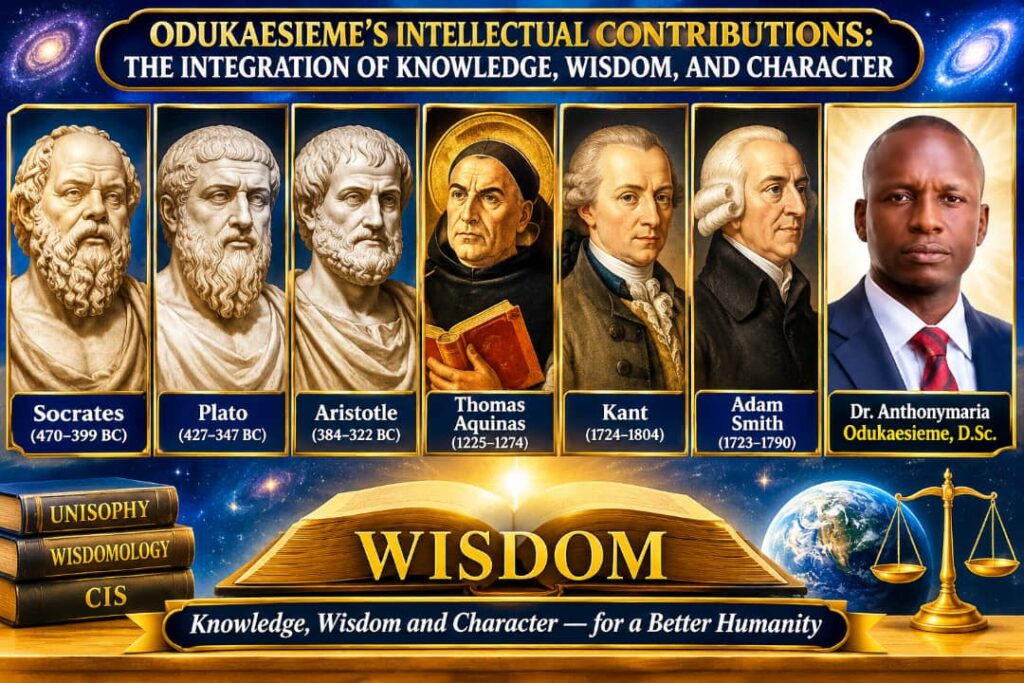
This definition constitutes the central intellectual foundation of Odukaesieme’s philosophical conception of Wisdom. It presents Wisdom as a comprehensive principle embracing and integrating existence, Creation, reality, truth, knowledge, and intelligence within the fundamental unity of Universal Oneness and the governing order established by the Creator. Its distinctive significance lies in extending the understanding of Wisdom beyond an individual human virtue or intellectual capacity to a comprehensive conception of wholeness, unity, interconnectedness, and interdependence among all realities.
THE EMERGENCE AND SIGNIFICANCE OF WISDOMOLOGY
The systematic study of Wisdom requires a clearly articulated understanding of its subject matter. This is the intellectual premise underlying Wisdomology—the Science of Wisdom. Conceived as a proposed academic discipline, Wisdomology seeks to establish a systematic framework for investigating the nature, principles, constituents, expressions, and applications of Wisdom. Its wider ambition is to provide an integrating perspective through which the different branches of human knowledge may be examined in relation to the wholeness of existence.
Within this framework, Wisdomology seeks to illuminate the progression from information to knowledge, from knowledge to understanding, and from understanding to the responsible application of intelligence through ethical character. Its description as the “Science of Sciences” expresses its proposed integrative ambition: to examine the relationships among the different fields of knowledge and their place within a wider understanding of reality.
The intellectual importance of defining Wisdom becomes particularly evident here. No subject can be systematically studied, taught, researched, or developed without a reasonably clear understanding of its meaning, nature, and scope. Definition provides the conceptual foundation upon which inquiry is organised, knowledge is developed, and academic understanding is established. Consequently, a comprehensive definition of Wisdom is not merely an introductory statement; it is a fundamental requirement for the systematic development of Wisdomology, Unisophy, and Character Intelligence Science.
UNISOPHY AND THE PRINCIPLE OF UNIVERSAL ONENESS
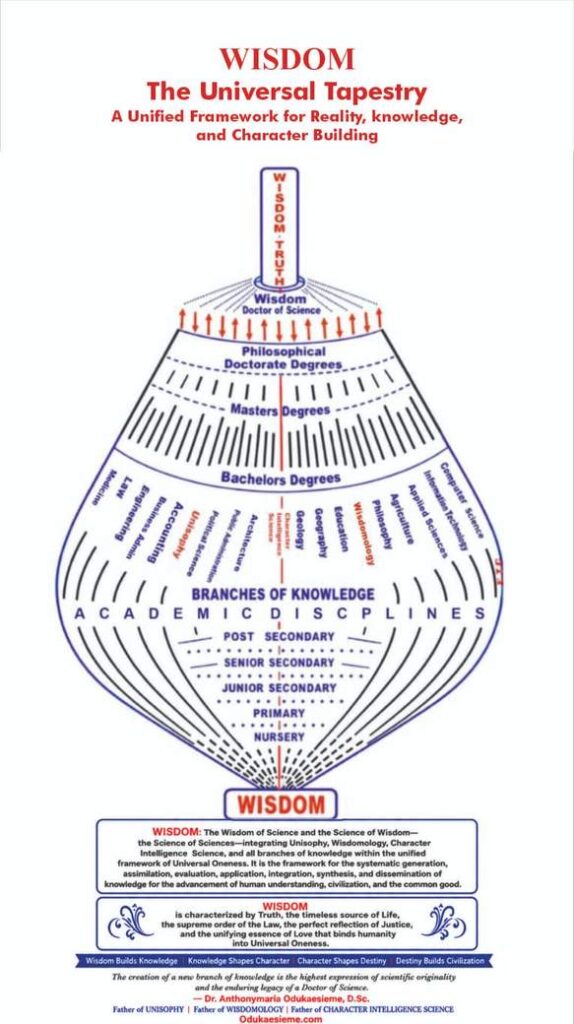
In relation to Wisdomology stands Unisophy, the Philosophy and Science of Universal Oneness. Unisophy explores the philosophical and scientific implications of the interconnectedness and interdependence of existence. It advances the proposition that humanity, nature, knowledge, society, and the wider cosmos must be understood in relation to the unity of the whole.
This perspective has important implications for governance, scientific inquiry, education, environmental responsibility, technological development, and artificial intelligence. It encourages humanity to consider not only the immediate benefits of its decisions and discoveries but also their wider consequences for other people, living systems, and the future of civilization. From this standpoint, ethical responsibility is integral to sustainable human progress, while the well-being of individuals and societies is understood in relation to the well-being of the wider whole.
CHARACTER INTELLIGENCE SCIENCE AND HUMAN EXCELLENCE
The ethical dimension of this intellectual framework is further developed through Character Intelligence Science, which addresses the relationship between human intelligence, ethical character, responsible conduct, and the characteristics of Universal Law and Order. It proposes that intellectual ability and technical competence, although essential to human advancement, are insufficient without the character required to direct them towards constructive ends.
The relationship among Wisdomology, Unisophy, and Character Intelligence Science therefore represents an integrated intellectual framework. Wisdomology provides the proposed systematic study of Wisdom; Unisophy examines the principle of Universal Oneness; and Character Intelligence Science addresses the ethical dimension of intelligence and human conduct. Together, they offer a framework for investigating the relationship between knowledge, wisdom, universal interconnectedness, character, and human excellence.
THE PRIMACY OF DEFINITION AND THE FUTURE OF WISDOM STUDIES
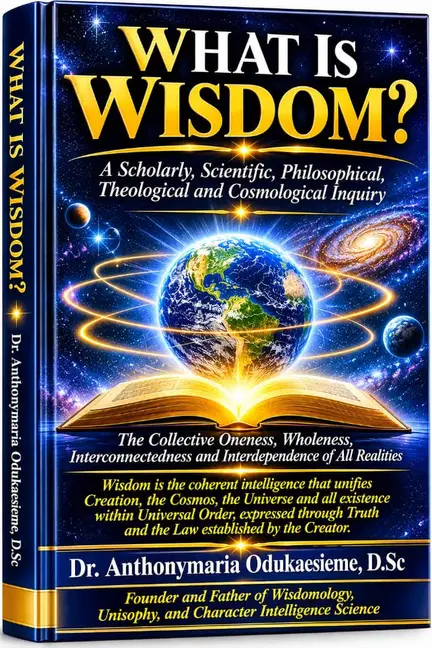
The significance of Odukaesieme’s Definition of Wisdom lies not only in its breadth but also in its intended intellectual function. By articulating Wisdom in terms of the totality, unity, interconnectedness, and interdependence of realities, truths, knowledge, and intelligence, it provides a conceptual foundation for examining Wisdom as a subject of systematic inquiry. It also establishes a basis for investigating the relationship between Wisdom and the governing principles of existence.
The emergence of Wisdomology as a proposed academic discipline is therefore a significant intellectual undertaking. It seeks to move the study of Wisdom beyond general philosophical reflection towards a more systematic programme of conceptual development, teaching, research, and practical application. Its intellectual propositions warrant careful examination, scholarly comparison, and further development within the wider history of philosophy and scientific inquiry.
The enduring value and originality of this contribution must ultimately be assessed through the clarity of its concepts, the historical documentation of its development, comparison with established philosophical and scientific traditions, and rigorous examination of its propositions and applications. Such examination is essential not only for establishing its intellectual foundations but also for determining its potential contribution to education, leadership, governance, scientific responsibility, technological development, and human civilization.
The fundamental proposition is that Wisdom must be properly defined if its systematic study is to be adequately established. A comprehensive definition provides the conceptual starting point for inquiry into its meaning, nature, scope, and governing principles. This is the central significance of Odukaesieme’s Definition of Wisdom and the scholarly importance of bringing his intellectual contribution to the attention of the world.
Dr. Anthonymaria Odukaesieme, D.Sc.
Founder and Father of Unisophy, Wisdomology, and Character Intelligence Science
www.odukaesieme.com