

Powered by the UNISOPHY EDUCATIONAL PROJECT
An Initiative of the UNISOPHY CIVILIZATIONAL FELLOWSHIP MOVEMENT
Artificial Intelligence (AI) is no longer a vision of the future—it is the defining technology of our time. It is transforming healthcare, education, finance, justice, governance, scientific research, agriculture, manufacturing, communication, and national security at an unprecedented pace. Every day, intelligent systems make decisions that influence businesses, institutions, governments, and the lives of billions of people.
Yet, amid this extraordinary technological revolution, humanity faces a profound question that may determine the future of civilisation:
“What will guide the intelligence we create?”
The greatest challenge of Artificial Intelligence is no longer whether machines can learn faster, process more data, or outperform humans in specialised tasks. Rather, it is ensuring that intelligence itself is guided by ethical character. Intelligence without moral direction, however powerful, can become a force for misinformation, financial fraud, election manipulation, cybercrime, discrimination, privacy violations, social instability, and the erosion of public trust.

History has repeatedly shown that scientific progress, when separated from ethical responsibility, can produce consequences as significant as its achievements. Technology alone cannot guarantee justice. Algorithms alone cannot protect human dignity. Computational power alone cannot distinguish between what is possible and what is morally right.
For this reason, the future of Artificial Intelligence must be measured not only by its technological sophistication but also by the ethical values that govern its design, deployment, and application.
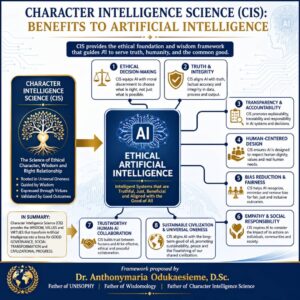
It is against this background that the Character Intelligence Science Framework for Artificial Intelligence is proposed—a new conceptual framework that places ethical character at the very centre of AI development. The framework is founded upon a simple but transformative conviction: the highest form of intelligence is not intelligence that merely computes, predicts, or automates, but intelligence that consistently advances truth, justice, responsibility, accountability, compassion, and the common good.
Character Intelligence Science proposes that Artificial Intelligence should no longer be evaluated solely by speed, efficiency, accuracy, or computational power. These qualities remain important, but they are not sufficient. A truly intelligent system should also be judged by the ethical character reflected in its decisions, its transparency, its fairness, its respect for human dignity, and its contribution to the well-being of society.
This vision represents a shift from asking, “Can Artificial Intelligence perform this task?” to asking the more important question:
“Should it perform this task, and if so, under what ethical principles?”
That shift marks the beginning of Character Intelligence Science.
Character Intelligence Science seeks to unite technological innovation with ethical responsibility. It does not seek to limit Artificial Intelligence or slow scientific progress. On the contrary, it seeks to strengthen Artificial Intelligence by ensuring that innovation remains firmly rooted in values that protect humanity and advance civilisation.
In an era when intelligent machines increasingly influence human decisions, the future of AI will depend not only on the intelligence we engineer but also on the character we choose to embed within it.
“Knowledge without character can become dangerous; intelligence guided by character becomes beneficial to humanity.”
This principle affirms that intelligence reaches its highest purpose only when directed by ethical character. As Artificial Intelligence assumes greater responsibility in human affairs, ethical character should become a defining standard by which AI systems are designed, governed, and evaluated.
Accordingly, the Character Intelligence Science Framework proposes a clear vision: to ensure that Artificial Intelligence serves humanity with wisdom, truth, justice, compassion, responsibility, accountability, and unwavering respect for human dignity.
Its mission is to integrate ethical character into every stage of the AI life cycle—from design and development to deployment, governance, regulation, and continuous evaluation—ensuring that technological progress remains aligned with the long-term interests of humanity.
To achieve this vision, the framework is founded upon seven interconnected pillars:
• Wisdom – AI should promote long-term human flourishing rather than merely maximise speed or efficiency.
• Truth – AI systems must uphold accuracy, honesty, transparency, and reliability, recognising that public trust depends upon the integrity of information.
• Justice – AI should promote fairness, impartiality, and minimise algorithmic bias so that intelligent systems serve all people equitably.
• Compassion – AI should recognise that behind every dataset are human lives, protecting human dignity, minimising harm, and contributing positively to society.
• Responsibility – The creators, developers, deployers, institutions, corporations, and governments that build or use AI remain responsible for its consequences. Ethical responsibility cannot be delegated to machines.
• Accountability – Significant AI decisions should be explainable, traceable, open to independent review, and subject to meaningful human oversight.
• Character – Character unites all the other pillars. It is the moral compass of the framework, affirming that the true measure of Artificial Intelligence is not simply what it can accomplish, but whether its actions consistently reflect integrity, justice, responsibility, and respect for humanity.
These principles are translated into practice through the Character Intelligence Science Ethical Decision Model. Before any significant AI decision is implemented, seven essential questions should be asked:
• Is it truthful?
• Is it wise?
• Is it just?
• Is it compassionate?
• Is it responsible?
• Is it accountable?
• Does it uphold human dignity and advance the common good?
If the answer to any of these questions is negative, the decision should be reviewed, corrected, or rejected before implementation

The Character Intelligence Science Framework for Artificial Intelligence is published under the auspices of the UNISOPHY Educational Project, an initiative of the UNISOPHY Civilizational Fellowship Movement.
The UNISOPHY Educational Project gratefully acknowledges the support, commitment, and encouragement of Professionals, Academia, Business moguls, Chiefs, Honourables, and Comrades **Cosmas Onuoha, Hillary Umegbolu, Emeka Osuji, Uchenna Bede Onu, Stanley Okafor, Chukwudi Ezebunandu, Henry Ojimma, Ebube Ihekaire, Ebere Udochukwu Ansalem, Chinedu Ifedigbo, Francis Ibe, Titus Offordile, Ifeanyi Omekara, Steve Okeke, Ozo Eusebius Aghaebinwa,** and **Joseph Nwankwo** in advancing this initiative, which is dedicated to education, ethical leadership, interdisciplinary scholarship, character development, and the promotion of universal human values for the progress of humanity.
The Character Intelligence Science Framework therefore offers far more than a set of ethical principles. It provides a practical and comprehensive guide for responsible innovation in which technological excellence and ethical character advance together rather than in opposition.
Its practical significance extends across every sector transformed by Artificial Intelligence.
In healthcare, it supports accurate diagnosis while safeguarding patient dignity, fairness, privacy, and informed decision-making.
In education, it encourages learning technologies that cultivate not only knowledge but also integrity, responsibility, ethical citizenship, and character formation.
In government and public administration, it promotes transparency, accountability, responsible governance, and public trust in AI-assisted decision-making.
Within the justice system, it seeks to reduce algorithmic bias, uphold due process, strengthen fairness before the law, and reinforce public confidence in judicial outcomes.
In finance, it supports responsible innovation, fraud prevention, ethical lending, financial transparency, and trustworthy digital financial services.
In scientific research, it encourages discoveries that advance knowledge while maintaining the highest standards of ethical responsibility and scientific integrity.
In environmental protection, it promotes the responsible application of Artificial Intelligence to safeguard natural resources, address climate-related challenges, and advance sustainable development for present and future generations.
Beyond these applications lies a broader civilisational challenge. Artificial Intelligence will increasingly influence elections, economic systems, national security, healthcare, education, media, scientific discovery, public policy, global communication, and virtually every aspect of human civilisation. The challenge before humanity is therefore not merely to build more powerful machines, but to ensure that the intelligence we create consistently serves truth, justice, human dignity, and the common good.
The Character Intelligence Science Framework is presented as a constructive contribution to this global challenge. It proposes that ethical character should become a foundational consideration in the design, development, deployment, governance, regulation, and evaluation of Artificial Intelligence. Rather than replacing existing AI research, it complements and strengthens it by providing an ethical foundation that promotes responsible innovation, protects human dignity, reinforces public confidence, encourages accountability, and advances the welfare of humanity.
The framework also serves as an open invitation to researchers, universities, technology companies, governments, policymakers, professional bodies, and international organisations to examine, evaluate, test, refine, validate, and further develop its principles through rigorous scholarship, scientific research, and interdisciplinary collaboration. The future of Artificial Intelligence should not be shaped solely by engineers and computer scientists, but equally by ethicists, educators, philosophers, legal scholars, social scientists, healthcare professionals, policymakers, and visionary leaders committed to the flourishing of humanity.
Ultimately, the success of Artificial Intelligence will not be measured solely by faster algorithms, greater computational power, commercial achievement, or technological sophistication. Its enduring legacy will depend on whether it strengthens justice, protects truth, preserves human dignity, promotes responsibility, inspires public trust, safeguards peace, and contributes to a more equitable, compassionate, and sustainable civilisation.
As humanity enters an era increasingly shaped by intelligent machines, we face one of the defining responsibilities of our generation: ensuring that technological progress never becomes detached from ethical character. Artificial Intelligence should not merely become more powerful; it should become more trustworthy, more just, more transparent, more accountable, and more deeply committed to the service of humanity.
The Character Intelligence Science Framework is therefore offered as both a scientific contribution and a global call to action—an invitation to researchers, educators, technology leaders, governments, international institutions, and all stakeholders to work together in building an AI future founded upon **wisdom, truth, justice, compassion, responsibility, accountability, transparency, and unwavering respect for human dignity**.
The future of Artificial Intelligence will ultimately be judged not only by what it achieves, but by the character it reflects.
By Dr. Anthonymaria Odukaesieme, D.Sc.
Founder of Character Intelligence Science
Founder of Wisdomology
Founder of UNISOPHY