

Dr. Anthonymaria Odukaesieme’s theories centre on the development of an integrated philosophical and scientific framework known as Character Intelligence Science (CIS). Originating from his seminal work, WISDOM: A Discovery in a Nation with a Broken Heart, this framework establishes three interconnected academic disciplines: Universal-Oneness Philosophy (Unisophy), the Science of Wisdom (Wisdomology), and Character Intelligence Science (CIS).
Together, these disciplines advance the proposition that wisdom, character, and moral alignment constitute measurable, teachable, and functional forms of intelligence indispensable to individual development, institutional excellence, national progress, technological innovation, and the long-term sustainability of civilisation.
1. CHARACTER INTELLIGENCE SCIENCE (CIS)
Character Intelligence Science advances the proposition that character constitutes a functional form of intelligence rather than merely an abstract moral quality. Odukaesieme argues that Intelligence Quotient (IQ) and Emotional Intelligence (EQ), although valuable, remain fundamentally incomplete without Character Intelligence.
CIS identifies character as the missing dimension in leadership, governance, institutional effectiveness, economic development, national transformation, and sustainable civilisation. It maintains that enduring progress depends not only on knowledge and technical competence but also on integrity, responsibility, justice, accountability, humility, ethical judgement, and moral discipline.
Central to the theory is the Conscience System, the internal human capacity that regulates honesty, fairness, responsibility, empathy, humility, and ethical judgement. Odukaesieme argues that the strength of every society ultimately reflects the strength of its collective conscience. When conscience deteriorates, corruption, injustice, institutional failure, social instability, and civilisational decline inevitably follow.
CIS further recognises character as a form of economic capital, arguing that integrity, trust, accountability, transparency, and merit create the conditions necessary for entrepreneurship, innovation, productive investment, effective governance, and sustainable prosperity.
2. UNIVERSAL-ONENESS PHILOSOPHY (UNISOPHY)
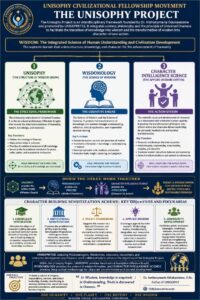
Universal-Oneness Philosophy provides the philosophical foundation of Odukaesieme’s integrated theoretical system. It rests upon the Law of Universal Oneness, which holds that reality functions as one interconnected and interdependent system in which individuals, institutions, nations, and civilisations participate within a common moral and existential order.
Accordingly, Unisophy promotes global consciousness, shared responsibility, peaceful coexistence, sustainable development, and the common good by encouraging humanity to transcend division, conflict, prejudice, and narrow self-interest through the recognition of humanity’s essential interconnectedness.
3. THE SCIENCE OF WISDOM (WISDOMOLOGY)
Wisdomology constitutes the intellectual and scientific foundation of Odukaesieme’s theoretical system. It is the Science of Wisdom and the Wisdom of all Sciences—the Science of Sciences. Wisdomology systematically assimilates, evaluates, integrates, applies, and disseminates knowledge for the advancement of human understanding, civilisation, and the common good while harmonising all academic disciplines within the universal philosophy of Unisophy.
Wisdomology argues that modern civilisation has expanded scientific and technological knowledge far more rapidly than wisdom and moral maturity. Consequently, knowledge alone cannot guarantee responsible judgement or beneficial outcomes.
As Odukaesieme states:
“Without wisdom, knowledge becomes destructive, power becomes dangerous, and civilisation becomes unstable.”
Wisdom therefore directs knowledge towards justice, responsibility, peace, sustainable development, and the flourishing of humanity.
4. APPLICATION TO ARTIFICIAL INTELLIGENCE (AI)
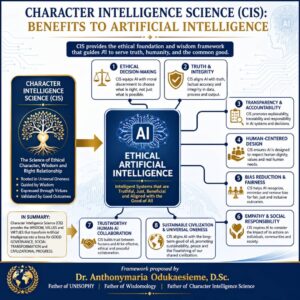
Odukaesieme extends this integrated theoretical framework to Artificial Intelligence by arguing that computational intelligence alone cannot guarantee safe, trustworthy, or beneficial AI systems.
Character Intelligence Science provides a scientific framework for embedding integrity, justice, humility, responsibility, compassion, accountability, transparency, and human-centred values into the design, development, governance, evaluation, and deployment of Artificial Intelligence.
Accordingly, the future of AI depends less upon computational sophistication than upon the wisdom, character, and moral responsibility of those who design, govern, regulate, and deploy intelligent systems. AI must therefore remain an instrument that advances human dignity, freedom, justice, peace, sustainable development, and the enduring progress of civilisation.
CONCLUSION
Character Intelligence Science, Universal-Oneness Philosophy, and Wisdomology collectively establish an integrated philosophical and scientific framework that unifies ethics, science, philosophy, education, governance, economics, technology, and Artificial Intelligence within a coherent theory of human development and civilisational progress. Wisdomology provides the scientific and intellectual foundation, Universal-Oneness Philosophy establishes the governing philosophical principle of Universal Oneness, and Character Intelligence Science translates both into practical and measurable applications for human conduct, institutional excellence, national transformation, global cooperation, and trustworthy Artificial Intelligence.
Odukaesieme’s central thesis maintains that civilisation cannot secure its future through scientific knowledge, technological innovation, or computational intelligence alone. Rather, humanity must intentionally cultivate wisdom and character as measurable, teachable, and indispensable forms of intelligence that guide every application of knowledge towards the common good. His integrated theoretical system consequently redefines intelligence by positioning wisdom and character alongside cognitive capability as indispensable foundations for sustainable human advancement.
The future relationship between humanity and Artificial Intelligence will therefore depend not primarily upon the sophistication of intelligent machines but upon the wisdom, character, and moral responsibility of those who conceive, govern, and deploy them. Character Intelligence Science consequently offers a coherent interdisciplinary theory for aligning Artificial Intelligence with ethical responsibility, human dignity, sustainable development, and the enduring advancement of civilisation while contributing a distinctive philosophical and scientific perspective to contemporary scholarship on intelligence, ethics, governance, and the future of humanity.
Dr Anthonymaria Odukaesieme, D.Sc.
Founder of the Academic Disciplines of Unisophy, Wisdomology, and Character Intelligence Science.