

Written By Dr. Anthonymaria Odukaesieme, D.Sc.
Father of UNISOPHY, Wisdomology, and Character Intelligence Science
INTRODUCTION
Artificial Intelligence (AI) is transforming the world through its remarkable ability to process information, recognize patterns, learn from data, and automate complex tasks. From healthcare and education to finance, governance, security, agriculture, and scientific research, AI has become one of the defining technologies of the twenty-first century.
Despite these extraordinary capabilities, Artificial Intelligence has one fundamental limitation: it possesses intelligence but not character. AI can calculate, predict, and optimize, but it cannot naturally distinguish between moral good and moral evil. It lacks conscience, integrity, humility, compassion, and wisdom unless these values are intentionally incorporated into its design.
This ethical gap has generated increasing global concern over AI bias, misinformation, privacy violations, discrimination, autonomous weapons, manipulation, and irresponsible decision-making. These challenges reveal an important truth: intelligence alone is not enough. Intelligence must be guided by character.
Character Intelligence Science (CIS) addresses this challenge by providing a scientific framework that integrates ethical character with intelligent systems. Rather than competing with Artificial Intelligence, Character Intelligence Science strengthens AI by providing the moral foundation necessary for trustworthy, responsible, transparent, and human-centered innovation.
UNDERSTANDING CHARACTER INTELLIGENCE SCIENCE
Character Intelligence Science is the scientific study of how ethical character shapes intelligent judgment, responsible leadership, sound decision-making, innovation, governance, and sustainable human development.
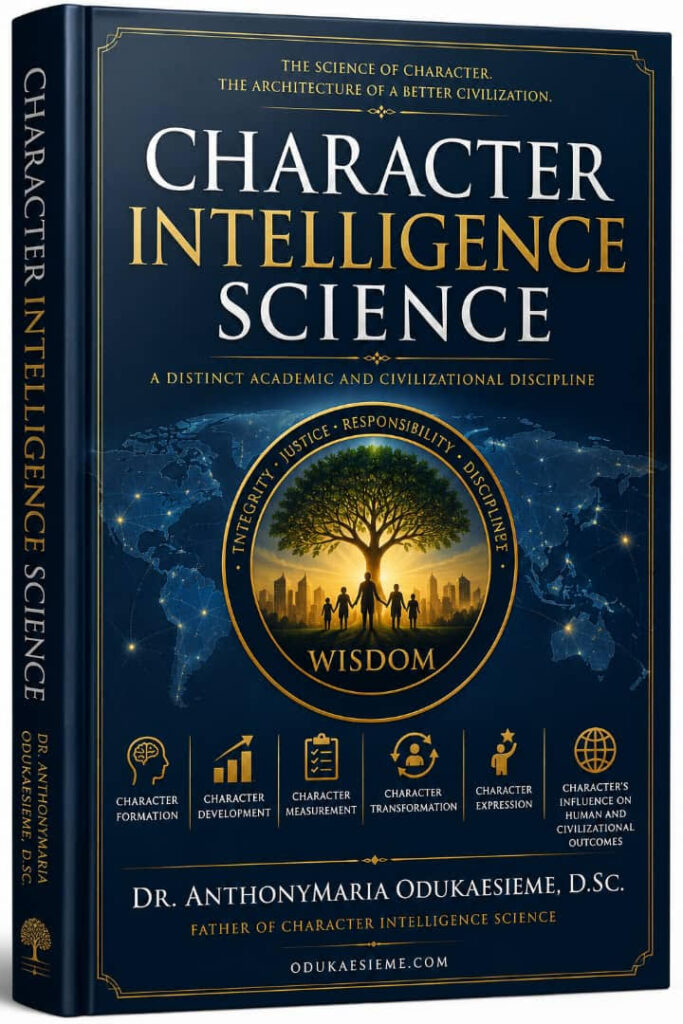
Its central principle is simple yet profound:
“Character directs intelligence toward wisdom, while wisdom directs intelligence toward the common good.”
This principle recognizes that intelligence without character can become destructive, whereas intelligence guided by ethical character becomes a force for peace, justice, progress, and civilization.
THE NEED FOR CHARACTER IN ARTIFICIAL INTELLIGENCE
As AI becomes increasingly autonomous, society must ensure that its decisions reflect ethical values rather than mere computational efficiency.
Character Intelligence Science therefore proposes that AI should be developed within an ethical framework that promotes responsibility, accountability, fairness, transparency, respect for human dignity, and service to humanity.
Instead of asking only, “Can AI perform this task?”, Character Intelligence Science also asks, “Should AI perform this task, and under what ethical conditions?”
This shift represents the transition from purely intelligent machines to responsibly intelligent systems.
BENEFITS OF CHARACTER INTELLIGENCE SCIENCE TO ARTIFICIAL INTELLIGENCE
Character Intelligence Science contributes significantly to Artificial Intelligence by promoting:
• Ethical decision-making.
• Trustworthy and accountable AI systems.
• Fairness and reduction of algorithmic bias.
• Transparency and responsible governance.
• Human-centered innovation.
• Respectful and context-aware human interaction.
• Protection of human dignity and fundamental rights.
• Safe, sustainable, and socially beneficial AI development.
These principles help ensure that Artificial Intelligence serves humanity responsibly rather than merely increasing technological capability.
CONCLUSION
Artificial Intelligence represents one of humanity’s greatest technological achievements. However, its long-term success will depend not only on computational intelligence but also on ethical character.
Character Intelligence Science provides the moral architecture necessary for building AI systems that are trustworthy, responsible, transparent, safe, and dedicated to the advancement of humanity.
The future belongs not merely to intelligent machines, but to intelligent systems guided by character.