

10.1 INTRODUCTION
Wisdom is not fully expressed in what a person knows, but in what that knowledge produces in thought, conduct, relationships, decisions, and character.
Throughout this treatise, Wisdom has been examined as a reality of Oneness, Wholeness, Interconnectedness, Interdependence, and Universal Order. The preceding chapters examined Christ Jesus as the Embodiment of Wisdom, His divine and human nature, His relationship to Creation, the meaning of Acts 17:28, and the biblical imagery of the Vine and the branches.
The teaching of Christ in John 15 provides a natural transition into the subject of human character.
Christ declares that those who abide in Him are to bear fruit. The language of fruitfulness therefore connects relationship with conduct. The invisible relationship between the branch and the vine is expected to produce visible fruit.
This principle is fundamental to the study of Wisdom.
Wisdom must eventually become visible.
It becomes visible in the way a person speaks.
It becomes visible in the way a person treats others.
It becomes visible in the way power is exercised.
It becomes visible in the way knowledge is used.
It becomes visible in the way truth is defended.
It becomes visible in the way responsibility is accepted.
It becomes visible in the way weakness is treated.
It becomes visible in the way success is handled.
It becomes visible in the way failure is confronted.
It becomes visible in character.
Character may therefore be understood as one of the principal practical expressions of Wisdom.
A person may possess knowledge without Wisdom.
A person may possess intelligence without character.
A person may possess education without ethical maturity.
A person may possess authority without integrity.
A person may possess wealth without compassion.
A person may possess religious knowledge without spiritual transformation.
Wisdom brings these dimensions into proper relationship.
The purpose of this chapter is therefore to examine the relationship between Wisdom, fruitfulness, and human character, with particular attention to the Christian understanding of character as demonstrated in the life and teachings of Christ Jesus.
10.2 THE MEANING OF FRUITFULNESS
Fruitfulness is a recurring biblical concept.
In its ordinary agricultural sense, fruitfulness refers to the production of fruit by a living plant.
In biblical teaching, however, fruit frequently becomes a metaphor for the observable consequences of a person’s inner life.
Jesus teaches:
“Ye shall know them by their fruits.”
This principle connects character with conduct.
Fruit is observable.
The root may be hidden.
The internal condition of a tree may not immediately be visible.
But fruit eventually reveals something about the tree.
Similarly, human character may not always be immediately apparent. People can present themselves in different ways. Words can conceal motives. Public reputation can differ from private conduct.
Over time, however, patterns of conduct reveal character.
Fruitfulness therefore introduces an important principle of ethical evaluation.
What does a person’s life produce?
Does it produce truth or deception?
Peace or conflict?
Justice or exploitation?
Love or hatred?
Service or domination?
Responsibility or negligence?
Humility or arrogance?
Integrity or corruption?
The question of fruit therefore becomes a question of character.
10.3 WISDOM AS MORE THAN KNOWLEDGE
Knowledge concerns what a person knows.
Understanding concerns the meaning and relationships among what is known.
Wisdom concerns the proper application and ordering of knowledge in life.
This distinction is important.
A person may know that honesty is good and still practise dishonesty.
A person may know that corruption harms society and still participate in corruption.
A person may understand the dangers of pride and still behave arrogantly.
A person may know the importance of compassion and still treat vulnerable people cruelly.
Therefore, knowledge alone does not guarantee character.
Wisdom requires transformation from intellectual recognition into responsible action.
This is one reason the biblical Wisdom tradition repeatedly connects wisdom with conduct.
Wisdom is practical.
It affects decisions.
It affects relationships.
It affects speech.
It affects justice.
It affects leadership.
It affects the treatment of neighbours.
It affects the use of wealth.
It affects the treatment of the poor.
It affects the exercise of power.
Wisdom therefore cannot be reduced to intellectual brilliance.
10.4 THE INNER AND OUTER DIMENSIONS OF CHARACTER
Character has both an inner and an outer dimension.
The inner dimension includes motives, intentions, desires, values, convictions, and dispositions.
The outer dimension includes speech, actions, decisions, habits, and relationships.
The two dimensions are related but not always perfectly aligned.
A person may perform a good action for an improper motive.
Another person may have a good intention but lack the discipline to translate it into effective action.
Wisdom therefore requires the integration of inner disposition and outward conduct.
Christian teaching places considerable emphasis on the heart because actions ultimately emerge from the interior life.
Jesus teaches that “out of the abundance of the heart the mouth speaketh.”
This does not mean that every isolated statement perfectly reveals the entirety of a person’s character.
Rather, it identifies a relationship between inner life and outward expression.
Character formation therefore requires more than behavioural appearance.
It requires transformation at the level of motive, desire, conviction, and habit.
10.5 CHRIST AS THE MODEL OF EXEMPLARY CHARACTER
The Christian understanding of exemplary character is fundamentally Christological.
Jesus does not merely teach moral principles.
He demonstrates them.
His life becomes a model through which Christian discipleship understands humility, love, truth, service, obedience, courage, compassion, forgiveness, and sacrifice.
Christ’s character is therefore inseparable from His teaching.
He teaches love and demonstrates love.
He teaches humility and demonstrates humility.
He teaches service and demonstrates service.
He teaches truth and demonstrates truth.
He teaches forgiveness and demonstrates forgiveness.
He teaches obedience to the Father and demonstrates obedience.
This unity between teaching and conduct is one of the highest forms of moral integrity.
A person who teaches one thing while consistently practising its opposite demonstrates fragmentation.
A person whose conduct corresponds substantially with his professed principles demonstrates integrity.
Christ therefore becomes, within Christian theology, the supreme model of integrated Wisdom and character.
10.6 HUMILITY AS A FOUNDATION OF WISDOM
Humility occupies a central position in the biblical understanding of Wisdom.
James writes:
“God resisteth the proud, but giveth grace unto the humble.”
The Book of Proverbs similarly connects humility with wisdom.
Humility does not mean weakness.
It does not mean the denial of one’s abilities.
It does not require pretending to be unintelligent.
True humility involves accurate self-understanding.
A humble person recognises both strengths and limitations.
A humble scientist recognises the limits of scientific knowledge.
A humble philosopher recognises the possibility of error.
A humble theologian recognises the distinction between divine revelation and human interpretation.
A humble leader recognises that authority is a responsibility rather than absolute ownership.
A humble scholar recognises that learning continues throughout life.
Humility therefore protects Wisdom from arrogance.
It creates intellectual openness.
It permits correction.
It makes learning possible.
It allows truth to be pursued beyond personal preference.
In this sense, humility is not the enemy of excellence.
It is one of the conditions of genuine excellence.
10.7 HONESTY AND TRUTH
Truth is central to the concept of Wisdom developed in this treatise.
Wisdom cannot flourish through deliberate deception.
Honesty therefore becomes an important expression of character.
Honesty involves commitment to what is true.
It includes truthful speech, truthful representation, truthful scholarship, truthful reporting, and truthful conduct.
Academic honesty is particularly important.
A scholar must distinguish between original ideas and borrowed ideas.
Sources must be acknowledged.
Evidence must not be fabricated.
Conclusions must not be exaggerated.
Uncertainty must not be presented as certainty.
These principles are not merely academic technicalities.
They are expressions of character.
Truthfulness therefore belongs to both intellectual and moral life.
The pursuit of Wisdom requires intellectual honesty.
10.8 HARD WORK AND THE DISCIPLINE OF EXCELLENCE
Wisdom does not eliminate effort.
The pursuit of excellence requires discipline.
Knowledge requires study.
Character requires practice.
Leadership requires responsibility.
Scientific work requires patience.
Scholarship requires sustained attention.
Moral development requires repeated choices.
Hard work therefore becomes an important practical expression of Wisdom.
However, hard work should not be confused with mere activity.
A person can work extremely hard while pursuing a destructive objective.
Wisdom therefore asks not merely:
“How hard are you working?”
It also asks:
“What are you working toward?”
“What values govern your work?”
“Who benefits from your work?”
“What consequences does your work produce?”
Work becomes wise when effort is properly ordered toward worthy ends.
10.9 LOVE AS THE EXPRESSION OF RELATIONAL WISDOM
Love is another fundamental dimension of character.
Christian theology places love at the centre of moral life.
Jesus identifies love of God and love of neighbour as central commandments.
The apostle John declares:
“God is love.”
Love recognises the value of another person.
It opposes the reduction of human beings to objects.
It challenges exploitation.
It encourages compassion.
It creates responsibility.
It motivates service.
However, biblical love should not be confused with mere emotional affection.
Love can require correction.
Love can require sacrifice.
Love can require truth.
Love can require patience.
Love can require justice.
Love can require difficult decisions.
Therefore, love and Truth should not be treated as enemies.
Wisdom brings them into proper relationship.
Truth without love can become harshness.
Love without Truth can become sentimentality.
Wisdom seeks truthful love and loving Truth.
10.10 INTEGRITY AND THE UNITY OF CHARACTER
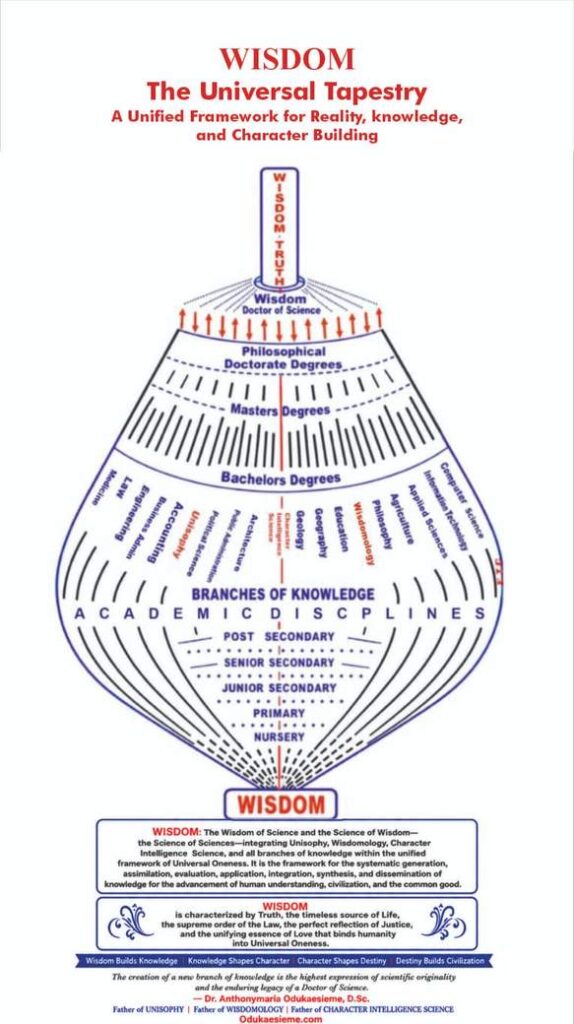
Integrity refers to wholeness and consistency.
A person of integrity seeks correspondence between values, words, and actions.
This principle is closely related to the concept of Wholeness in the definition of Wisdom.
Wisdom involves integration.
Integrity involves integration.
A fragmented character may say one thing and do another.
A person may publicly condemn corruption while privately engaging in it.
A leader may preach humility while demanding excessive personal honour.
A teacher may promote honesty while manipulating facts.
A religious person may speak about love while practising hatred.
These contradictions reveal fragmentation between professed values and actual conduct.
Integrity therefore becomes a practical expression of wholeness.
It does not mean moral perfection.
Human beings can fail.
The presence of integrity does not imply the absence of mistakes.
Rather, integrity includes the willingness to recognise error, accept responsibility, seek correction, and return to what is right.
10.11 REPENTANCE AND CHARACTER DEVELOPMENT
Character development should not be understood as a claim that human beings become morally flawless.
Christian theology recognises human weakness and the possibility of failure.
The important question is what follows failure.
Does the person deny it?
Does the person blame others?
Does the person conceal it?
Does the person justify it?
Or does the person acknowledge it, repent, seek forgiveness, make restitution where appropriate, and change direction?
Repentance is therefore an important dimension of character development.
A wise person is not necessarily one who has never made mistakes.
A wise person is one who can learn from mistakes.
This principle is important for intellectual as well as moral life.
A scholar may discover that a previous argument was incomplete.
Wisdom requires the courage to revise it.
A leader may recognise that a decision caused harm.
Wisdom requires accountability.
A person may discover that a deeply held assumption was mistaken.
Wisdom requires openness to correction.
Thus, Wisdom and humility operate together.
10.12 CHARACTER AND THE USE OF POWER
Character becomes especially visible when power is available.
A person without authority may appear humble simply because circumstances provide no opportunity for domination.
A person with authority faces a different test.
How is power used?
Is it used for service?
Is it used for justice?
Is it used for personal enrichment?
Is it used to intimidate?
Is it used to protect the vulnerable?
Is it used responsibly?
Christ provides a distinctive model of leadership.
He teaches that greatness is associated with service.
This reverses the ordinary temptation to define greatness through domination.
Power therefore becomes a test of character.
The greater the power, the greater the responsibility for its ethical use.
This principle applies to political leadership, business, religion, education, science, medicine, technology, and family life.
10.13 CHARACTER AND WEALTH
Wealth is another test of character.
Wealth itself is not automatically equivalent to wisdom or foolishness.
Its moral significance depends partly upon how it is acquired, used, and understood.
A person may use resources to promote human flourishing.
Another may use wealth for exploitation.
Another may accumulate wealth through corruption.
Another may possess little wealth but display extraordinary generosity.
Therefore, material possession cannot be used as the sole measure of human excellence.
Wisdom asks deeper questions.
How was wealth acquired?
How is it used?
Does it promote justice?
Does it support families and communities?
Does it contribute to human flourishing?
Does it become an object of domination?
Does it control the person who possesses it?
The character of a person is therefore not determined by wealth but can be revealed through the use of wealth.
10.14 CHARACTER AND KNOWLEDGE
Knowledge increases human capability.
That increase in capability creates responsibility.
Scientific knowledge can heal.
It can also harm.
Technology can connect people.
It can also be used for manipulation.
Economic knowledge can create prosperity.
It can also be used for exploitation.
Political knowledge can support justice.
It can also be used for oppression.
Medical knowledge can preserve life.
It can also be misused.
Therefore, knowledge without ethical intelligence can become dangerous.
This is one of the central reasons for integrating Wisdom and Character Intelligence.
The question is not simply:
“What can humanity do?”
Wisdom also asks:
“What ought humanity to do?”
“What is right?”
“What serves human dignity?”
“What preserves life?”
“What promotes justice?”
“What is consistent with Truth?”
The distinction between capability and responsibility is fundamental to ethical civilisation.
10.15 CHARACTER AND SCIENTIFIC KNOWLEDGE
Science provides powerful methods for investigating aspects of the natural world.
Scientific knowledge has transformed medicine, agriculture, communication, transportation, energy, and countless other areas of human life.
But science alone does not determine every moral question.
Scientific knowledge can tell us what is possible.
Ethics asks what is permissible.
Wisdom asks how knowledge should be properly ordered toward human and ecological flourishing.
This does not diminish science.
It clarifies its relationship with other forms of knowledge.
Scientific excellence requires intellectual honesty, careful methodology, openness to evidence, and willingness to correct error.
These are themselves character virtues.
Therefore, scientific excellence and ethical character are not unrelated.
The scientist is also a moral agent.
The laboratory is not outside ethics.
The use of scientific knowledge has consequences.
Wisdom therefore calls for both intellectual excellence and ethical responsibility.
10.16 CHARACTER AND ECOLOGICAL RESPONSIBILITY
Human character also affects the natural environment.
Human beings use land, water, forests, minerals, energy, and biological resources.
These uses can contribute to flourishing or destruction.
Environmental responsibility therefore has a moral dimension.
Carelessness can damage ecosystems.
Greed can encourage exploitation.
Negligence can cause pollution.
Short-term thinking can undermine long-term ecological stability.
Wisdom therefore requires consideration of consequences beyond immediate benefit.
The principle of stewardship is particularly important within Christian theology.
Creation is not presented as a meaningless object for unlimited exploitation.
Human beings are called to exercise responsible dominion and care.
This means that ecological responsibility can be understood as an expression of character.
A wise society considers future generations.
10.17 CHARACTER AND SOCIAL JUSTICE
Character cannot be restricted to private morality.
Human beings participate in social structures.
Justice therefore becomes a dimension of collective character.
A society can institutionalise values.
It can institutionalise honesty or corruption.
It can institutionalise justice or discrimination.
It can encourage responsibility or irresponsibility.
It can reward integrity or manipulation.
Therefore, the examination of character should include institutions.
The question becomes:
What kind of character does a society reward?
What kind of behaviour does it punish?
What kind of leadership does it promote?
What kind of education does it provide?
What kind of economic conduct does it encourage?
These questions move the study of Wisdom from the individual toward civilisation.
A wise civilisation does not merely educate intelligent individuals.
It develops institutions capable of supporting truth, justice, responsibility, and human dignity.
10.18 CHARACTER AND LEADERSHIP
Leadership magnifies character.
A leader’s decisions affect other people.
Therefore, leadership requires more than competence.
It requires ethical intelligence.
A competent but corrupt leader can cause enormous damage.
A highly intelligent but dishonest leader can manipulate institutions.
A charismatic but irresponsible leader can mislead large populations.
A wise leader therefore requires character.
The qualities of humility, honesty, courage, justice, compassion, discipline, and responsibility become particularly important.
Leadership should not be understood as possession of followers.
It should be understood as responsibility for people and purposes.
Christ’s model of servant leadership provides a powerful Christian foundation for this understanding.
10.19 CHARACTER AND HUMAN EXCELLENCE
Human excellence should be understood comprehensively.
It includes intellectual excellence.
It includes moral excellence.
It includes relational excellence.
It includes professional excellence.
It includes spiritual maturity.
It includes responsible citizenship.
A person should not be regarded as excellent merely because of exceptional ability in one domain.
Excellence requires integration.
This is consistent with the central concept of Wisdom.
Wisdom integrates.
It does not fragment.
A brilliant mind with destructive character represents incomplete human development.
A morally sincere person without adequate knowledge may also struggle to translate good intentions into effective action.
The ideal is therefore integration.
Knowledge.
Understanding.
Wisdom.
Character.
Responsibility.
Excellence.
These dimensions should work together.
10.20 WISDOM AND CHARACTER INTELLIGENCE
The concept of Character Intelligence developed in this broader intellectual framework seeks to emphasise the capacity to recognise, understand, develop, and practise ethical character.
It is presented here as a proposed conceptual framework rather than as an already universally recognised scientific discipline.
Its central concern is the relationship between intelligence and ethical conduct.
Traditional measures of intelligence may focus on cognitive abilities such as reasoning, memory, problem-solving, or verbal and mathematical skills.
Character Intelligence addresses a different question:
How is human intelligence expressed ethically?
A highly intelligent person may know how to achieve an objective.
Character Intelligence asks whether the objective itself is worthy and whether the means used to achieve it are ethical.
This distinction is crucial.
Intelligence can increase power.
Character determines, in part, how that power is directed.
Wisdom therefore provides an integrating framework within which intelligence and character can be brought together.
10.21 THE THREE Hs: HUMILITY, HONESTY, AND HARD WORK
Within the ethical framework developed by Odukaesieme, three qualities occupy a particularly important practical position:
Humility.
Honesty.
Hard work.
These three qualities may be understood as complementary.
Humility opens the mind to learning and correction.
Honesty anchors conduct in Truth.
Hard work transforms intention into disciplined action.
Without humility, intelligence can become arrogance.
Without honesty, intelligence can become manipulation.
Without hard work, good intentions can remain unrealised.
Together, these qualities form a practical foundation for human excellence.
They do not constitute the entirety of character.
Other virtues remain essential, including love, justice, courage, compassion, patience, temperance, responsibility, and faithfulness.
Nevertheless, humility, honesty, and hard work provide a useful practical triad within the ethical framework of this treatise.
10.22 WISDOM AND THE PROPER PLACE OF CHARACTER
Wisdom concerns order.
Character also concerns order.
A person of character seeks to place desires, abilities, responsibilities, and actions within an appropriate moral order.
This explains why character cannot be separated from Wisdom.
Wisdom asks:
What is true?
What is good?
What is right?
What is my responsibility?
What is the proper place of this action?
What are its consequences?
How should knowledge be used?
How should power be exercised?
How should relationships be maintained?
Character translates these answers into conduct.
Thus, Wisdom provides orientation while character provides embodied expression.
The two are not identical.
Wisdom is broader than character.
Character is one of the principal ways Wisdom becomes visible in human life.
10.23 WISDOM, CHARACTER, AND CIVILISATION
Civilisation is ultimately expressed through human beings and the institutions they create.
Therefore, the quality of civilisation is inseparable from the quality of character within its institutions.
Advanced technology cannot compensate indefinitely for widespread corruption.
Economic systems cannot flourish sustainably without trust.
Political systems cannot function properly without integrity.
Educational systems cannot fulfil their purpose without truth.
Healthcare systems require ethical responsibility.
Religious communities require integrity.
Scientific institutions require honesty.
The development of civilisation therefore requires character development.
This is why the study of Wisdom must extend beyond abstract philosophy.
Wisdom must enter the practical structures of human life.
A civilisation becomes more mature when its knowledge, institutions, technologies, and power are increasingly ordered toward truth, justice, responsibility, human dignity, and the common good.
10.24 THE FRUIT OF WISDOM
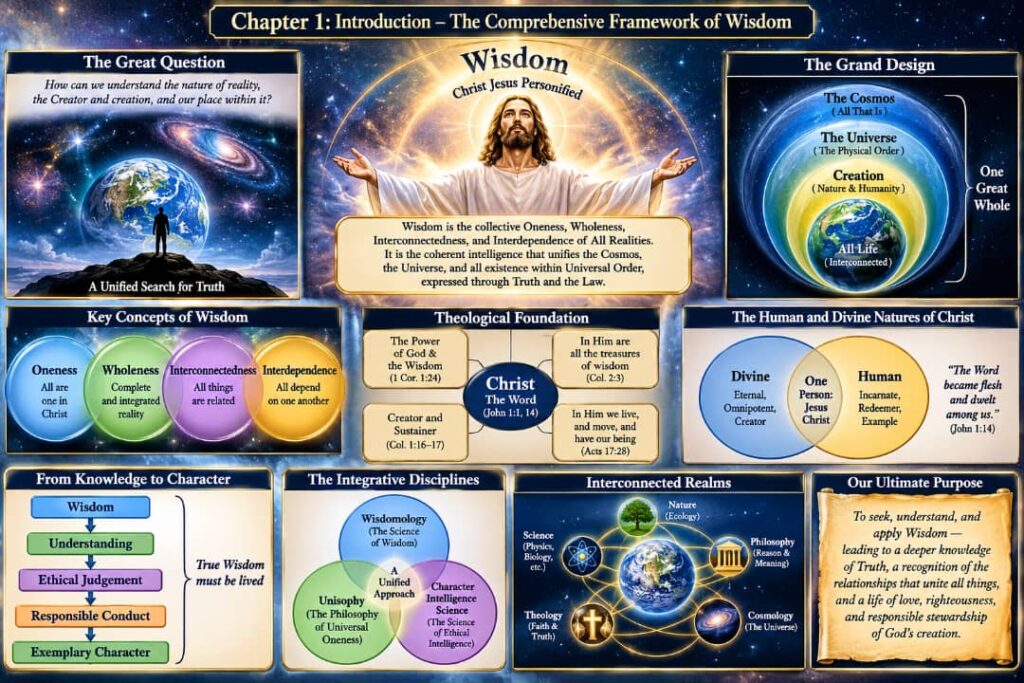
The ultimate question of this chapter is therefore simple:
What does Wisdom produce?
Wisdom should produce Truth.
Wisdom should produce responsible knowledge.
Wisdom should produce humility.
Wisdom should produce honesty.
Wisdom should produce love.
Wisdom should produce justice.
Wisdom should produce responsible action.
Wisdom should produce character.
Wisdom should produce human excellence.
Wisdom should contribute to the flourishing of individuals and communities.
These fruits should not be understood as automatic consequences of merely possessing information.
They emerge through formation.
A person must learn.
A person must reflect.
A person must practise.
A person must accept correction.
A person must develop discipline.
A person must cultivate character.
A person must seek Truth.
Within Christian theology, the ultimate source of spiritual fruitfulness is abiding in Christ.
Thus the teaching of John 15 provides the theological foundation for this chapter.
The branch bears fruit because it remains connected to the vine.
10.25 CONCLUSION
Wisdom and character are inseparable dimensions of mature human existence.
Wisdom provides orientation toward Truth, order, meaning, responsibility, and the proper relationship among realities.
Character gives practical expression to that orientation.
The life of Christ Jesus provides the central Christian model of this integration.
Christ teaches Truth and embodies Truth.
He teaches love and embodies love.
He teaches humility and demonstrates humility.
He teaches service and demonstrates service.
He teaches obedience and demonstrates obedience.
The Vine and branches metaphor further reveals that fruitfulness is connected with relationship.
The branch must abide in the vine.
Likewise, within Christian theology, the disciple is called to abide in Christ and bear fruit.
This fruitfulness has ethical consequences.
It affects character.
It affects relationships.
It affects leadership.
It affects the use of knowledge.
It affects the treatment of creation.
It affects society.
It affects civilisation.
The study of Wisdom therefore cannot remain confined to abstract definitions.
Wisdom must become lived reality.
It must move from the mind to the heart, from the heart to conduct, and from individual conduct toward the transformation of communities and institutions.
This is the practical significance of the relationship between Wisdom and Character.
Knowledge asks what we know.
Understanding asks what that knowledge means.
Wisdom asks how it should be ordered and lived.
Character demonstrates whether that Wisdom has become embodied in human conduct.
The fruit ultimately reveals the quality of the tree.
And the quality of human fruitfulness remains one of the most important measures of human excellence.
REFERENCES
The Holy Bible, King James Version.
Aristotle. (1999). Nicomachean Ethics (2nd ed., T. Irwin, Trans.). Hackett Publishing Company.
Aquinas, T. (1981). Summa Theologiae: A Concise Translation. Christian Classics.
Augustine. (2008). The Trinity (E. Hill, Trans.). New City Press.
Carson, D. A. (1991). The Gospel According to John. Eerdmans.
Frankl, V. E. (2006). Man’s Search for Meaning. Beacon Press.
MacIntyre, A. (1984). After Virtue (2nd ed.). University of Notre Dame Press.
Morris, L. (1995). The Gospel According to John. Eerdmans.
Peterson, E. H. (2005). Christ Plays in Ten Thousand Places: A Conversation in Spiritual Theology. Eerdmans.
Ridderbos, H. (1997). The Gospel of John: A Theological Commentary. Eerdmans.
DEFINITION OF WISDOM
Wisdom is the collective Oneness, Wholeness, Interconnectedness, and Interdependence of All Realities. It is the coherent intelligence that unifies Creation, the Cosmos, the Universe, and all existence within Universal Order, expressed through Truth and the Law established by the Creator.
— Odukaesieme
www.odukaesieme.com